
Overcoming drought and taking proactive measures in agricultural production.
(Baonghean) - Regulating and actively serving irrigation water resources, along with adjusting the cropping schedule for agricultural production in the current drought situation; in the long term, it is necessary to invest in the synchronous development of irrigation works, especially important projects to prevent saltwater intrusion and preserve freshwater in the Lam River. This is the directive of the Chairman of the Provincial People's Committee after conducting on-site inspections in various localities...
According to the North Central Meteorological and Hydrological Station, the intense heatwave will continue for the next 9-10 days. Therefore, drought relief efforts in our province will become even more difficult and challenging. To date, farmers have planted 31,000 hectares of summer-autumn crops, but 15,000 hectares remain unproductive due to water shortages. In particular, a significant portion of the planted area will suffer from seedling death if water scarcity persists.
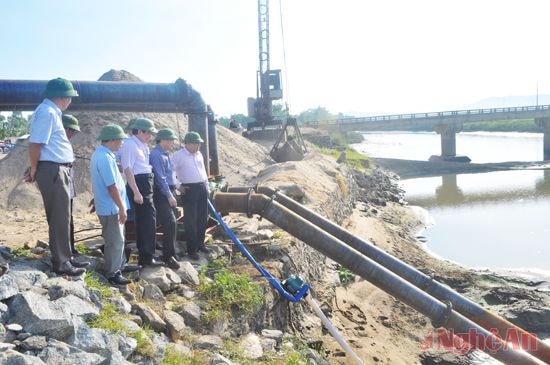 |
| Comrade Nguyen Xuan Duong inspects the Hung Chau pumping station (Hung Nguyen). |
The summer-autumn crop season is currently in its peak period requiring irrigation water for sowing seedlings and preparing the land. However, with temperatures ranging from 39 to 41°C, continuous strong southwest winds, and the lack of rain during the early summer months, many fields in various localities are dry, cracked, and unsuitable for cultivation. Mr. Nguyen Phu Han, Chairman of the People's Committee of Hung Nguyen district, said: "Although the spring rice crop was harvested 10 days ago, only about 25% of the summer-autumn rice area has water for planting (the total summer-autumn area of the district is 5,500 hectares). Because 80% of the area depends on water from the Nam Dan River, 18% of the rice area gets water directly from the Lam River, and 2% from reservoirs and dams, all these water sources are very low and depleted. Pumping stations and pumps can only operate for 4-15 hours a day. Many communes not only lack irrigation water, but also experience the situation where sown rice seedlings are starting to wither and die. Some communes have to buy water from fish ponds or transport water in barrels to irrigate the seedlings."
Faced with the urgent need for irrigation water, Hung Nguyen district has guided and directed communes to implement a rotational pumping schedule, encouraged people to conserve water, and instructed the Irrigation Enterprise to dredge canals. Simultaneously, it requested the Nam Irrigation Company Limited to install transfer pumping stations and mobile pumps... to increase water supply. Mr. Thai Ba Long, a pump operator at Hung Chau Pump Station, said: “Nam Irrigation Company Limited has installed three additional pumps to pump water from the Rum River into the Hung Chau Pump Station's discharge tank with a capacity of 2,000 m3/h to irrigate 500 hectares of rice in the area. However, currently, due to low river levels, the water is sometimes salty and sometimes fresh (due to saltwater intrusion), and the pumps only operate when there is a freshwater source. Because of these difficulties, we can only irrigate about 100 hectares of summer-autumn rice. The company always assigns staff and workers to be on duty 24/7, waiting for a freshwater source to pump water for the people's production.”
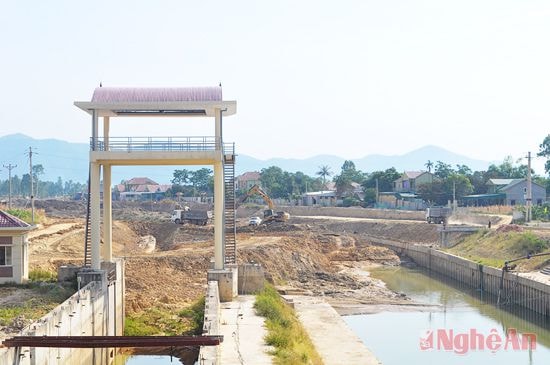 |
| Construction is underway on the downstream section of the canal at the new Nam Dan sluice gate. |
Nghi Loc District is located at the "end of freshwater, beginning of saltwater" (at the end of the Nam-Hung-Nghi irrigation system, but at the beginning of saltwater intrusion via the Nghi Quang River). Currently, the local authorities and people of Nghi Loc are struggling to cope with the drought. Therefore, the district has only planned to cultivate 2,600 hectares of rice in the summer-autumn crop (less than the 2,000 hectares in 2014), but currently only 1,800 hectares have been prepared and planted, and it is predicted that the remaining planted area will likely not be protected.
Mr. Nguyen Thanh Hai, Vice Chairman of the Nghi Loc District People's Committee, said: "If the weather from now until June 20th brings rain and sufficient water for production, we will continue to direct farmers to cultivate rice on uncultivated rice fields using short-day varieties such as VT NA2, PC6, Khang Dan 18... We will also convert approximately 500-700 hectares of rice land to other crops like corn, vegetables, and other cash crops. To ensure a stable water supply for production in Nghi Loc district, the province needs to invest in a system of irrigation works connecting to the Northern Irrigation System (between Son Thanh - Yen Thanh and Nghi Van - Nghi Loc), and dredge the entire Cam River, Ke Gai Canal, Nha Le Canal, and Cai Stream..."
The Southern Irrigation System is responsible for supplying freshwater for agricultural production in Hung Nguyen, Nam Dan, Nghi Loc districts, and Vinh City... but despite great efforts, they have to accept the reality that 11 out of 36 pumping stations in the system only operate for 5-7 hours/day, and the water source in the Lam River is depleted, with no replenishment, leading to salinity intrusion. In the Southern Irrigation System, due to the lack of surface water, only sediment remains at the bottom, compromising water quality. Meanwhile, in Nam Dan, out of 10 state-managed pumping stations, only 2 have water to pump (only 5-6 hours/day), and the water source canals are dry, rendering local pumping stations inoperable. In Hung Nguyen, out of 18 state-managed pumping stations, only 5 have water (only 5-7 hours/day). In Nghi Loc, 4 pumping stations operate for 10-12 hours/day. In the Vinh City area, all three pumping stations are without water, leaving 2,200 hectares without water for production.
Given the situation, Nam Irrigation Company Limited regularly monitors and checks the water quality in the system and notifies local authorities to check water quality before pumping, absolutely prohibiting pumping water when salinity levels exceed 1%. The company has installed 3 electric and diesel pumping units and several pumps at critical points. Preparing machinery and equipment to pump stagnant water from the reservoir to the downstream areas of the canal, while also organizing the dredging of vulnerable canal sections that have been silted up... Mr. Bach Hung Tuyen - Director of Nam Irrigation Company Limited, said: “Following the direction of the Department of Agriculture and Rural Development, on May 3rd, the company completed the construction of a dam to block the Cam River to raise the water level and limit saltwater intrusion. This method has preserved a portion of freshwater for people's production. However, to have a stable water supply for production, localities need to seriously implement the rotational pumping plan, prioritizing remote areas with water scarcity, and hydropower plants should continue to release water at a higher flow rate, while investing in a comprehensive irrigation system.”
In the coming period, the forecast indicates that the drought situation will remain complex, significantly impacting production and people's lives. Therefore, after inspecting the drought situation in Hung Nguyen, Nam Dan, Nghi Loc, and Vinh City, the Chairman of the Provincial People's Committee, Nguyen Xuan Duong, assigned the Department of Agriculture and Rural Development the responsibility to closely monitor the weather and climate developments and the water shortage and drought situation; to closely coordinate with the North Central Meteorological and Hydrological Station to obtain forecast information on water levels and drought; to direct and guide localities to effectively implement drought prevention and control measures, protect production, and direct drought-affected localities to stop production and wait for water to switch to planting short-term varieties such as PC6, VF1, etc. He also instructed the Department to coordinate with the People's Committees of districts, cities, and towns to direct the Departments of Agriculture and Rural Development and the Irrigation Companies to strictly manage water resources, prevent leakage and loss from reservoirs, and distribute water rationally and efficiently. There is a specific irrigation schedule and a rotational irrigation system is implemented to conserve water. Coordination between irrigation management units and electricity companies is directed to ensure timely electricity supply for water pumping.
The Chairman of the Provincial People's Committee also requested the Department of Industry and Trade to inspect and direct hydropower plants to release water in accordance with procedures and meet the water needs of the downstream areas of the Ca River. The Ban Ve Hydropower Company and the Khe Bo Hydropower Company should prioritize water release to serve agricultural production in 2015, ensuring the downstream water level of the Ca River is sufficient for the pumping stations to operate. Nghe An Power Company needs to prioritize electricity supply to pumping stations to proactively combat drought. Irrigation companies should closely coordinate with local authorities, directing rotational irrigation and water concentration to ensure water supply for areas at the end of the canals.
For reservoir areas, specific calculations of water volume and irrigation frequency are necessary to manage irrigation effectively, ensuring crop growth and development while minimizing water usage, and paying particular attention to water availability during the rice heading and flowering stages. Agricultural and forestry companies and enterprises, as well as agricultural and forestry farms, should implement water-saving irrigation measures. Provincial departments and agencies, according to their functions and responsibilities, should proactively coordinate with localities to effectively implement drought prevention and control measures. One essential task is for the Department of Agriculture and Rural Development to take the lead in coordinating with other departments and agencies to liaise with central ministries and agencies to develop and implement two projects as soon as possible: the saltwater intrusion prevention and freshwater retention project on the Cam River and the construction of a forced pumping station to supply water to low-lying canals; and the implementation of the saltwater intrusion prevention and freshwater retention project on the Lam River to serve the southern Nghe An and northern Ha Tinh regions.
The timely attention and guidance of provincial leaders, along with the efforts of all levels and sectors, especially the farmers, all focused on overcoming the difficulties caused by drought, have created a proactive approach to achieve high efficiency in agricultural production.
Hoang Vinh
| RELATED NEWS |
|---|


