
Overcoming formalism in Party branch activities.
(Baonghean) - Recently, the Standing Committee of the Que Phong District Party Committee assessed the results of 10 years of implementing the Project "Improving the quality of Party branch activities in the period 2007 - 2010 and subsequent years". Bao Nghe An newspaper had an interview with Comrade Tran Dang Khoa - Member of the Standing Committee, Head of the District Party Committee's Organization Department - on this matter.
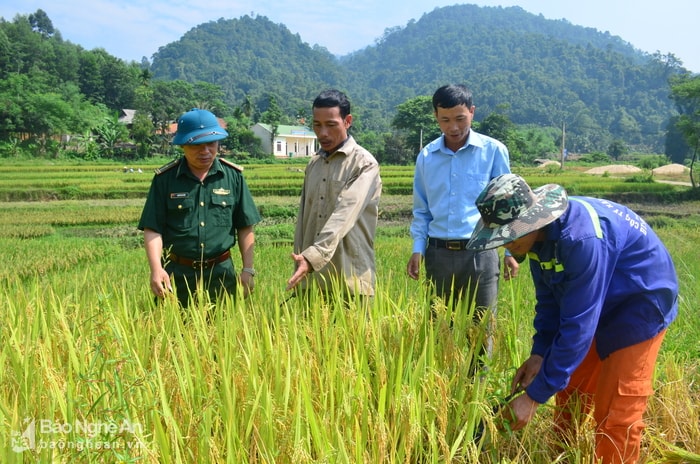 |
| Comrade Le Van Phuong (second from the left) - Secretary of the Pom Om Party Branch, Hanh Dich commune (Que Phong district) discusses the results of the rice harvest with commune officials and people. |
PV:After 10 years of implementing the above project, how does the Standing Committee of the District Party Committee assess the results, Comrade?
Comrade Tran Dang Khoa:I recall that before the Project was implemented, the concern of the District Party Committee's Standing Committee was that although Party committees at all levels had seriously led and directed the implementation of the monthly regular branch meetings as stipulated in the Party Charter.
However, the content of Party branch meetings in many places is still scattered and general; some Party branches in administrative agencies, healthcare facilities, and schools still focus heavily on professional work and do not pay enough attention to Party building; they have not identified key issues that need to be focused on for discussion; the spirit of self-criticism and criticism among some Party members is still limited; the number of Party members attending meetings is not full or consistent; and in some places, the minutes of Party branch meetings are still rudimentary.
Following the issuance of the Plan, the understanding of the significance and importance of improving the quality of Party branch activities has been renewed in both content and form.
Many grassroots Party organizations have established Steering Committees and developed plans, assigning tasks within the Party committees to organize implementation, such as the Party Committees of the Public Security and Military forces; some Party committees at the commune and town levels have printed copies of the entire content of the Project and the procedures for organizing regular Party branch meetings to the Party branches and selected pilot Party branches to guide implementation, such as the Party Committee of Tri Le commune and the Party Committee of Kim Son town.
Every year, Party committees at all levels have included this content in their inspection and supervision programs. The District Party Committee's Organization Department has also conducted surveys on the organization of Party branch meetings in most of the subordinate Party organizations, and has assigned cadres to directly attend meetings with Party branches in the areas under its responsibility as assigned by the District Party Committee Standing Committee.
PV:So what are the outstanding results after 10 years of implementing the Project?
Comrade Tran Dang Khoa:First and foremost, the regular meetings of the Party committee and branch have been maintained in a more orderly manner than before, adhering to the prescribed schedule.
In particular, following the review in accordance with Resolution No. 4 of the 11th and 12th Central Committees, Party committees and branches have focused on improving the quality of Party branch meetings, organizing regular meetings more frequently, and paying attention to organizing thematic Party branch meetings.
| The Que Phong District Party Committee has 48 grassroots party organizations, including 20 party committees and 28 grassroots branches directly under it; there are 304 branches directly under the grassroots party committees, including 194 branches in hamlets, villages, and 110 branches directly under the party committees of government agencies. |
The percentage of party members attending monthly meetings is 80-90% or higher; most absent members have requested leave and provided valid reasons.
Furthermore, the content of Party branch meetings has undergone many innovations, gradually overcoming formality and monotony. In regular meetings, many Party branches have paid attention to current affairs information and the dissemination of new policies and guidelines.
Many Party branches have organized for cadres and Party members to study and learn about the ideology and moral example of Ho Chi Minh, and to register to study and follow his example; they have further strengthened political and ideological education among cadres and Party members; and they have focused on discussing and resolving specific issues of the locality and unit, as well as issues related to the rights and responsibilities of Party members.
The preparation of content for Party branch meetings by the Party branch committee and the Party branch secretary was given serious attention and implemented rigorously. The results of evaluating and classifying grassroots Party organizations and Party members after the implementation of the Project show that the percentage of grassroots Party organizations achieving the "clean and strong" status has increased over the years. The number of Party branches failing to complete their tasks and Party members violating Party membership standards has significantly decreased.
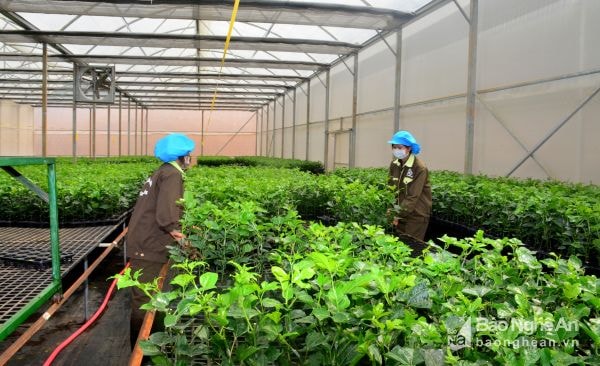 |
| Passion fruit seedling production in Tri Le commune (Que Phong district). (Photo: Archival image) |
PV:The most important issue is for the Standing Committee of the District Party Committee to assess the existing shortcomings and limitations in order to promptly address and rectify them in Party branch activities, especially in the current context. Could you elaborate on this?
Comrade Tran Dang Khoa:The Standing Committee of the District Party Committee also noted that the study and implementation of the Project in some grassroots Party organizations was slow, and some places were confused in directing its implementation. The understanding of some cadres and Party members was not thorough; their awareness of the position, role, and function of the Party branch was still limited.
In particular, the role of the Party branch secretaries is noteworthy; some, despite receiving annual training and professional development, still face difficulties in the implementation process. Some grassroots Party organizations have only disseminated and studied the policies and resolutions of higher levels to the Party committee members, failing to widely disseminate them to cadres and Party members.
On the other hand, implementation in some Party branches, especially in those in agencies, units, and enterprises, still has limitations. Most Party branches focus only on leading and directing production and business activities. Some aspects, such as ideology and the development of mass organizations, are still seasonal in nature.
Many school Party branches do not regularly maintain their scheduled meetings, especially during the summer break, and many branches do not hold meetings as required.
In particular, the inspection revealed that thematic meetings were infrequent, and some party branches did not hold any thematic meetings for more than a year.
The recording and monitoring of meetings in some Party branches in remote areas are still rudimentary and incomplete. Some branches have inaccurately recorded required information for future inspection and supervision, such as: the opinions expressed by Party members; the number of opinions agreed upon, votes cast, signatures of the meeting chair and secretary, etc.; the record-keeping system also has many shortcomings.
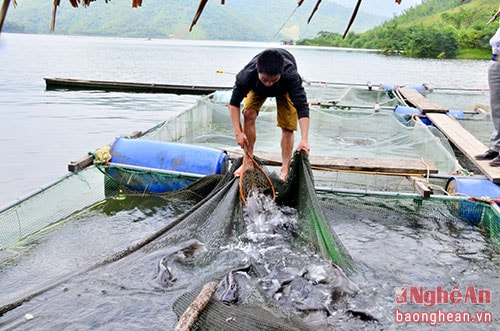 |
| Fish farming in cages in the Hủa Na hydroelectric reservoir, Quế Phong. (Photo: Archival image) |
PV:So what are the solutions for Que Phong to build upon its achievements and overcome its limitations so that each Party branch becomes stronger, contributing to building a truly strong Party organization? Because, as President Ho Chi Minh advised, "A strong Party is due to good Party branches. Good Party branches are due to good Party members."
Comrade Tran Dang Khoa:In the coming period, the Standing Committee of the District Party Committee will focus on leading and directing the continued dissemination of the Project to all Party branches and Party members throughout the district's Party organization, in conjunction with the implementation of Directive 05 on promoting the study and emulation of Ho Chi Minh's thought, morality, and style, and Resolutions 4 of the 11th and 12th Central Committees. Specifically, we require increased thematic discussions, linked to the implementation of contents such as: building new rural areas, and projects and plans for implementing the resolutions of the Party congresses.
On the other hand, defining the role of the leader is extremely important, so the District Party Committee is studying and developing a plan to provide professional training for grassroots Party branch secretaries and organizing a competition for outstanding Party branch secretaries to create opportunities for Party committees at the grassroots level, especially those in villages and hamlets, to exchange and learn from each other, thereby promoting the pioneering and exemplary role of Party branch secretaries and grassroots Party committee members. Of course, this must be accompanied by increased inspection and supervision by higher-level Party committees to ensure timely evaluation.
PV:Thank you, comrade!
Thanh Duy


