
Addressing the problem of "too many teachers, too few skilled workers"
(Baonghean) - The situation of university and college graduates who have not yet found jobs is always a "hot" issue in the forums where National Assembly and Provincial People's Council representatives interact with voters. So, what are the causes?
Vocational schools are having difficulty recruiting students.
While society in general and businesses, factories, and enterprises in particular are "thirsty" for skilled labor, especially high-level skilled workers, many vocational schools in the province are facing difficulties in student recruitment. The Do Luong Economic-Technical Vocational College, for the past three years (2012-2014), has either failed to meet or barely met its enrollment targets. Specifically, in 2012, the school had a target of 150 students for intermediate vocational training but only recruited 137; in 2013, it recruited 120/150 students for intermediate vocational training, and in 2014, it recruited 110/120 students for intermediate vocational training. The target for elementary vocational training was just met with 690/690 (2013) and 505/505 (2014). Not to mention, many students drop out midway through their studies. For example, in 2011, the school enrolled 150 students in its vocational training program, but after 2 years of training, only 60 graduated; in 2012, it enrolled 137 students, and after 2 years, only 104 graduated.
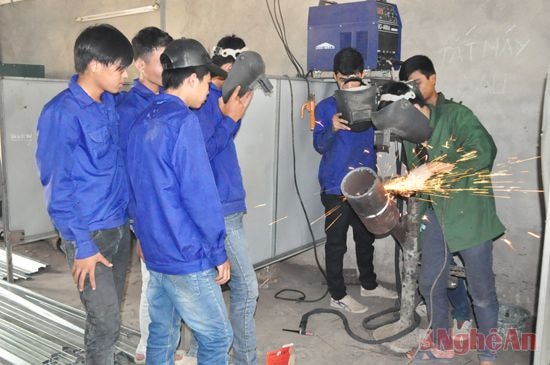 |
| Practical training session for students at Yen Thanh Vocational College of Agriculture and Industry. |
Meanwhile, the Western Economic and Technical Vocational College (Thai Hoa Town) – the center of the Northwest region of Nghe An province – has a fairly wide recruitment area. However, to meet the province's annual enrollment targets, the school faces considerable challenges and implements a series of solutions: going directly to local areas to raise awareness and encourage young people to pursue vocational training; coordinating with high schools and junior high schools in districts and towns to organize meetings with parents and students to introduce and guide them towards vocational training; and conducting surveys to understand the aspirations and needs of vocational training in society, thereby developing training programs and training scales that closely match reality. In addition, the school strengthens its cooperative relationships with businesses, factories, and farms inside and outside the province to create opportunities for students to practice and improve their skills, while also creating job opportunities for students when these businesses and establishments accept them.
In fact, the school's post-training employment rate is over 80%, with many vocational training programs at the intermediate level guaranteeing 100% employment, such as welding, automotive, industrial electricity, and veterinary medicine. Mr. Pham Nam Hai, the school's principal, stated: "Although we meet and exceed the training targets set by the province every year, attracting an average of 900 students annually, including approximately 230-260 intermediate vocational students and the rest at the basic level, compared to the potential of the vast recruitment area with over 1.1 million people in Western Nghe An, where the number of untrained workers is high, especially among young people from ethnic minority groups, these results are very limited. Not only is recruitment difficult, but maintaining class sizes is also very challenging…"
Recently, the Culture and Social Affairs Committee of the Provincial People's Council conducted an inspection of vocational training and employment, pointing out that vocational training institutions are currently facing difficulties in recruiting students. The percentage of workers with vocational training in the province is less than 50%, and the number of skilled workers is particularly modest compared to the needs of businesses.
Causes and solutions
The main reasons are the parents' and students' obsession with academic degrees; while career guidance and vocational training, as well as the issue of student placement after lower secondary school, have achieved some noteworthy results, they still have many limitations.
Another reason is that vocational schools are required to teach 70% vocational skills and only 30% theory, yet the facilities and teaching equipment in most vocational schools are both insufficient and inadequate. Mr. Tran Van Tuan, Principal of Yen Thanh Vocational College of Agriculture and Industry, admitted that the facilities used for vocational training for students are mainly salvaged from decommissioned factories and workshops; some of the cars are from as far back as 1982, while the car market is constantly changing in terms of types and modern designs.
Sharing the same view, Mr. Pham Nam Hai, Principal of the Western Region Economic and Technical Vocational College, said: "Welding is currently applying G6 welding technology, but the school does not yet have the equipment to train students to meet the demands of society." According to the Department of Labor, War Invalids and Social Affairs, the province has 64 vocational training institutions, but only 3 schools have facilities that meet the standards: the Vietnam-Korea Technical Vocational College, the No. 4 Vocational College of the Ministry of National Defense, and the Nghe An Commercial and Tourism Vocational College. Furthermore, many vocational schools, especially those located in the districts, lack dormitories, while most vocational students are children of farmers and poor households with difficult transportation conditions.
Along with inadequate facilities, the quality of staff and teachers in vocational schools also has limitations. Although the province has set requirements for vocational schools to improve training quality, the allocated staffing quotas for these schools are still low, and there is no policy to attract skilled engineers and teachers. This hinders the main goal of attracting and improving the quality of training high-quality human resources to meet the requirements of industrialization and modernization that the province is setting. Some argue that there are currently too many vocational schools in the province, while management is inadequate, leading to competition in student recruitment, while the demand for learners is not high, resulting in waste and low training effectiveness. The incentive from wage policies for skilled workers is also a barrier hindering the increase in vocational training rates and the training of skilled workers...
Given the aforementioned shortcomings, the question arises: what can be done to ensure sufficient enrollment at vocational schools and improve the quality of training to meet the ever-increasing demands of society? Accordingly, the immediate solution is to revise the wage policy for workers and laborers directly involved in production in companies, factories, enterprises, and construction sites, especially skilled and highly qualified technicians and workers, so that they can earn a living from their skills and expertise. This will change mindsets and encourage more workers to pursue vocational training and stay committed to their chosen profession. Simultaneously, it is necessary to strengthen career guidance and student streaming from the lower secondary level, so that those who cannot afford higher education can transition to vocational training, striving to have at least 30% of students participating in vocational training by 2020.
Along with that, vocational schools also need investment in facilities, a quality teaching staff, and innovative teaching methods. In conjunction with this, these institutions need to train students according to the specific needs of businesses and must create their own unique appeal to attract learners.
Vocational training plays a crucial role in developing human resources to serve the socio-economic development of the locality; implementing the streaming of students at the lower and upper secondary levels; and equipping young people with a profession to establish themselves and their careers. Therefore, solutions, mechanisms, and policies are needed to encourage vocational training institutions and trainees in line with development orientations, contributing to mitigating the current situation of "too many teachers, too few skilled workers."
Text and photos:MAI HOA


