
Address the issue of resolutions being issued merely for the sake of formality!
(Baonghean) - Quynh Vinh is a densely populated commune with a large area, accounting for 1/4 of Hoang Mai town. In previous years, the leadership and management of the Party committee and government were stagnant, and some key officials even committed violations and were disciplined, affecting the overall progress.
To date, thanks to the implementation of appropriate resolutions,Quynh Vinh commune (Hoang Mai town) has seen many positive changes, and the people's trust in the Party committee and government is increasingly strengthened.Nghe An Newspaper had a dialogue with Comrade Ho Sy Tung - Secretary of the Party Committee of Quynh Vinh commune - about a number of related issues.
PV:It is known that a few years ago, the situation in Quynh Vinh commune had many "bottlenecks," even stagnation, and many of the local political tasks were not completed. Could you please tell us the reasons for that situation?
Comrade Ho Sy Tung:Based on a frank assessment of the situation, the Party Committee of the commune clarified the causes of the local weaknesses and stagnation in its political report presented to the XXIV Party Congress of the commune, term 2015-2020. First and foremost, the working methods of the commune-level apparatus were not truly scientific and systematic.
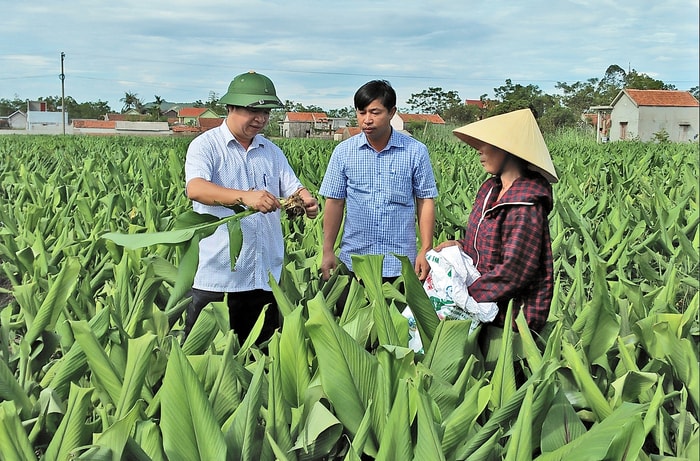 |
| Local leaders inspect a turmeric cultivation model in the fields of Quynh Vinh commune (Hoang Mai town). Photo: Mai Hoa |
Many projects are issued but not followed up on, nor are difficulties and obstacles assessed and addressed; instead, they are merely implemented for the sake of appearances. Officials have not shown genuine interest or developed effective methods in disseminating information and mobilizing the public to participate in local movements such as land consolidation, land exchange, and rural development; nor have they addressed outstanding and pressing issues in the area.
Financial management lacks transparency, and investments are inefficient; some pressing needs of the people, as well as outstanding issues repeatedly raised by the people, remain unresolved. Some officials lack exemplary conduct and have been disciplined for violations. Consequently, the people's trust in the local Party committee and government has diminished. The role of Party branches is still limited in many aspects, and the quality of their meetings is not clearly defined.
PV:So, what solutions has the Party committee implemented to address this, Comrade?
Comrade Ho Sy Tung:Following the Party Congress of the commune, the administrative apparatus was reorganized and streamlined based on capabilities and strengths to ensure appropriate placement.
The priority issue for the Party Committee is to focus on changing working methods and practices based on the systematic development and promulgation of a comprehensive work program and plan for the entire term, and the working regulations of the Party Committee; detailing the program for each year, quarter, and month to closely match reality.
The commune also organized the assignment of specific responsibilities to each Party committee member, assigning them to oversee specific areas and fields in the organization and implementation process, and holding them accountable to the Party committee for the results of their respective areas and fields.
Regular progress assessments should be conducted, focusing on resolving difficulties and obstacles arising from practical experience, ensuring that tasks are implemented according to the set schedule, and overcoming the problems of neglecting tasks, being passive, or overlapping tasks. The propaganda and mass mobilization work of Party committees and authorities should be reformed to be more specific, in-depth, and closely aligned with the target groups.
Along with that, we focus on improving the effectiveness and efficiency of government administration in all areas, with an emphasis on planning, planning management, strengthening land management; administrative discipline and order, enhancing the sense of responsibility and public service ethics of officials and civil servants; and at the same time, adopting a clear and decisive attitude in handling violations quickly and thoroughly, creating equality and raising public awareness of law compliance, especially regarding land.
In conjunction with that, the commune focuses on resolving people's requests, complaints, and denunciations by strengthening dialogue to address them.
A series of pressing issues facing the people were prioritized and addressed on the basis of transparency and openness regarding resources, promoting broad democracy among the people. When local funds collected from land auctions, savings from expenditures, and contributions from the people were used to construct many projects visible to the public, the Party committee and government truly regained the people's trust.
In just over two years since the congress, the commune has renovated and upgraded nearly 50 km of concrete roads. The inter-village road system, which was previously unpaved, has now been completely paved with concrete, and only 30% of the internal village roads remain unpaved to meet the standards of the new rural development program.
The commune has also built 28 new classrooms and functional rooms for all levels of education. The commune has also worked with the Quynh Luu Electricity Branch to renovate and upgrade the power grid system, and added three more power substations, ensuring better electricity supply for residents.
The commune focuses on directing land consolidation and exchange; encouraging farmers to transform the economic structure through projects developing farm and household-based economies, and projects converting inefficient, upland rice land and other arable land to commercial turmeric cultivation.
As a result, from just under twenty farms and family-run agricultural enterprises, the commune now has 65 farms and family-run agricultural enterprises. The area planted with turmeric has also reached 165 hectares, with an average income of 200 million VND/hectare. Many households have also developed additional services such as supplying and processing turmeric starch.
At the same time, the commune proactively took the initiative to open vocational training classes in sewing and mechanics to supply workers for projects that have been and are being implemented in the region. Currently, there are more than 500 workers employed in two garment factories and the Hoa Sen Steel Sheet Factory in Hoang Mai and the Nghi Son Economic Zone.
The average per capita income at the end of 2016 was 28.7 million VND; the poverty rate decreased to 5.2% and is expected to be 4% by the end of 2017.
PV:Based on local experience, what lessons should be learned by Party committees and local authorities in general, and specifically for Quynh Vinh commune?
Comrade Ho Sy Tung:It is crucial to harness the combined strength, unity, and consensus of the entire political system, from the commune level to the grassroots, and of all the people.
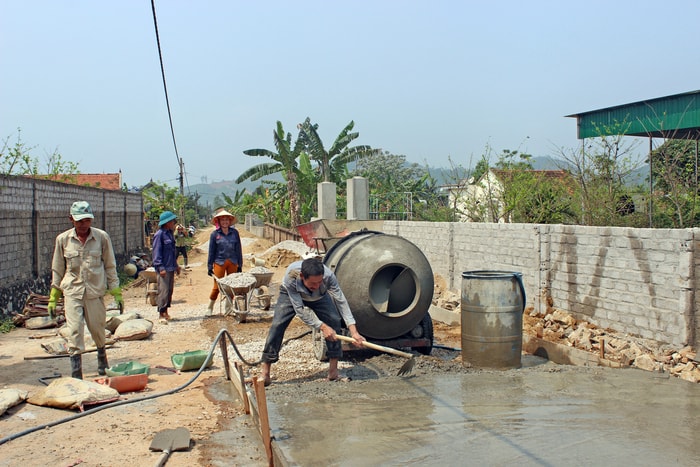 |
| Residents of Quynh Vinh commune (Hoang Mai town) are building a road. Photo: Thanh Thuy |
Officials and civil servants must be truly responsible, pioneering, and exemplary in performing their duties, especially the role of the leaders of Party committees, government agencies, and organizations and units.
The leadership and guidance methods of Party committees must be reformed, and the way the government operates must be based on adhering closely to resolutions, policies, plans, tasks, grassroots levels, and the people. Emphasis should be placed on inspection and supervision, especially regular and unscheduled inspections and supervision.
In reality, wherever there is a lack of inspection and supervision, work becomes stagnant, inefficient, and fails to meet the expectations of the people.
On the other hand, inspection and monitoring are necessary to identify difficulties and shortcomings, and then propose solutions to overcome them in order to meet the set deadlines and work objectives.
In my opinion, higher authorities need to focus on building and improving the quality of the staff and civil servants at the grassroots level, especially in communes with difficult conditions.
In addition, attention should be paid to promptly resolving administrative procedures requested or proposed by the grassroots units when the content is deemed lawful and reasonable, so that the units can proactively carry out their tasks.
This content doesn't require significant financial investment, but delays not only fail to meet planned deadlines but also erode trust and sometimes even create inertia within the organization.
PV:Thank you, comrade!
Mai Hoa(Perform)
| RELATED NEWS |
|---|


