
Leveraging advantages and creating breakthroughs in socio-economic development.
On January 4th, under the chairmanship of Prime Minister Nguyen Tan Dung, the Government held its regular December 2011 meeting to discuss the draft report reviewing the direction and management of the Government's working regulations in 2011 and the Government's work program for 2012; the report on administrative reform in 2011; the work of inspection, handling of complaints and denunciations, and the fight against corruption in 2011; and the situation regarding the implementation of Vietnam's international commitments in 2011.
On January 4th, under the chairmanship of Prime Minister Nguyen Tan Dung, the Government held its regular December 2011 meeting to discuss the draft report reviewing the direction and management of the Government's working regulations in 2011 and the Government's work program for 2012; the report on administrative reform in 2011; the work of inspection, handling of complaints and denunciations, and the fight against corruption in 2011; and the situation regarding the implementation of Vietnam's international commitments in 2011.
In addition, the Government also heard reports and discussed the Project to improve the efficiency of the state-owned enterprise sector; the issue of extending the deadline for paying corporate income tax in 2012 for small and medium-sized enterprises and enterprises employing a large workforce; and the Government's submission on the draft Decree on the management of gold trading activities.
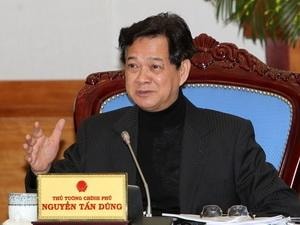
Prime Minister Nguyen Tan Dung delivers the concluding remarks at the meeting. (Photo: Duc Tam/VNA)
The draft report reviewing the direction, management, and implementation of the Government's working regulations in 2011 and the 2012 work program, presented by Minister and Head of the Government Office Vu Duc Dam, shows that in 2011, the world situation underwent rapid, complex, and unpredictable changes that impacted Vietnam's socio-economic situation. Domestically, inflation and interest rates rose sharply, severe natural disasters and floods occurred in many places; production and business faced many difficulties, and the risk of macroeconomic instability became a major challenge…
In that context, the Government has focused on proactive, flexible, and decisive direction and management to achieve the set tasks and objectives. To date, although many difficulties and challenges remain, overall, the socio-economic situation in 2011 has achieved important results.
At the beginning of the year, the Government issued Resolution 02 on key solutions to guide and manage the implementation of the socio-economic development plan and the state budget estimate for 2011. Given the volatile domestic and international socio-economic situation, which adversely affected our economy, the Government promptly issued Resolution 11, and simultaneously reported to the Politburo to issue Conclusion 02, and reported to the National Assembly to issue Resolution 59, outlining key tasks aimed at achieving the primary goal of curbing inflation, stabilizing the macroeconomy, and ensuring social security.
In focusing on the task of curbing inflation and stabilizing the macroeconomy, the Government has implemented a tight and cautious monetary and credit policy; flexibly managed monetary policy tools to control and stabilize the money market, curb inflation, and gradually reduce lending interest rates in line with the declining inflation rate; ensured the liquidity of the banking system; focused on measures to reduce budget deficits; resolutely cut investment in inefficient, unnecessary, slow-progressing, and protracted projects, concentrating capital on important, urgent projects nearing completion and social welfare programs.
Thanks to the strong and coordinated implementation of various solutions, the goals of curbing inflation and stabilizing the macroeconomy have yielded positive results. From the second quarter onwards, the rate of price increase gradually decreased, with an annual increase of 18.13%; credit interest rates tended to decrease; exports increased by 33.3% compared to 2010, exceeding the set target; the trade deficit was 9.9% of total export turnover, much lower than the target of 18% set by the National Assembly; foreign exchange reserves increased from 3.5 weeks of imports to 7.5 weeks of imports; and the budget deficit decreased to 4.9% of GDP (the plan was 5.3%).
The government has also focused on directing efforts to overcome difficulties, maintain and develop production and business, and ensure reasonable growth; paying attention to ensuring social security and addressing pressing social issues; strengthening national defense and security, maintaining social order and safety; actively and proactively implementing effective foreign affairs activities; and focusing on implementing the Government's working regulations, coupled with reforming working methods and improving the effectiveness and efficiency of leadership and management.
Regarding the Government's work program for 2012, the Government identified the overall objective in its direction and management as prioritizing inflation control, macroeconomic stability, maintaining reasonable growth while reforming the growth model and restructuring the economy, improving quality, efficiency and competitiveness; ensuring social welfare, social security and improving people's living standards.
The key tasks to achieve the above objectives are identified as focusing on macroeconomic stability, controlling inflation, and ensuring major economic balances; removing obstacles and promoting production, business development, and market expansion; restructuring the economy and innovating the growth model towards improving efficiency and competitiveness; continuing to effectively implement social security policies and develop social welfare; and continuing to innovate and improve the effectiveness of leadership and management, and effectively implementing the working regulations and work program.
During discussions on reviewing the direction, management, and implementation of the Government's Working Regulations for 2011 and the 2012 Work Program, Prime Minister Nguyen Tan Dung and members of the Government acknowledged that, looking back at the achievements and shortcomings in socio-economic development in 2011, the Government's leadership and management activities in 2011 had significant strengths, such as: the Government seriously implemented the Party's guidelines and resolutions; linked leadership and management with practical realities, analyzed, evaluated, and forecasted the situation, thereby promptly identifying, adjusting, and proposing appropriate policies and solutions for the country's socio-economic development.
Over the past year, the Government has frankly acknowledged the difficulties and challenges; clearly recognized the advantages in the development process; effectively implemented the viewpoint on stability and development; and pursued the principle of growth and development going hand in hand with social progress and equity, affirming the view that in increasingly difficult circumstances, even better attention must be paid to social welfare. In management and direction, the Government has provided comprehensive and coordinated guidance, while always focusing on key priorities, directing the resolution of pressing immediate issues while ensuring long-term sustainability.
Government members all uphold a high sense of responsibility to the Party, the country, the people, and the tasks of their respective sectors; they do a good job of disseminating information and creating social consensus in implementing socio-economic development goals; they are open, honest, frank, and transparent about what has been achieved and what has not; and accountability and accountability work has been implemented more effectively and comprehensively, from the Prime Minister and Deputy Prime Ministers to Ministers and heads of sectors.
Emphasizing that, in the context of the general difficulties of 2011, the Government managed the economy more systematically and proactively; the policies implemented ensured consistency... Minister of Planning and Investment Bui Quang Vinh, Minister of Justice Ha Hung Cuong, Governor of the State Bank Nguyen Van Binh... proposed that, in 2012, ministries and sectors should dedicate more time to the work of drafting laws and ordinances; overcome the backlog of detailed regulations for the implementation of laws and ordinances; promote administrative reform; effectively implement the work of preventing and combating corruption and waste, and practicing thrift; overcome the situation where the work program is both burdensome and does not fully cover all activities of the Government; and effectively implement the information and reporting system as well as statistical and forecasting work to serve the Government's direction and management activities. At the same time, ministries and sectors need to coordinate more closely in directing and implementing the country's overall socio-economic development tasks.
Regarding strategic breakthroughs, Minister of Justice Ha Hung Cuong stated that training human resources, especially high-quality human resources, is a matter that needs special attention in 2012 and subsequent years to meet the increasingly high demands of the reform process. In addition, promoting international integration, expanding export markets, especially for goods considered to be Vietnam's strengths; removing difficulties for production and business; inspection and supervision; ensuring social security and welfare; vocational training and job creation for rural workers… are also major tasks that many government members believe need to be prioritized in the government's leadership and management in 2012.
Besides the aforementioned advantages, Prime Minister Nguyen Tan Dung also pointed out some shortcomings and weaknesses in leadership and management that need to be addressed in state management in lawmaking, planning, and resource management. In this spirit, Prime Minister Nguyen Tan Dung emphasized that one of the Government's key tasks this year is to create all favorable conditions and a transparent environment for socio-economic development, focusing on three bottlenecks: infrastructure, institutions, and human resources.
Therefore, ministries, sectors, and localities must focus on removing obstacles in state management to attract all resources into investment and development (Public-Private Partnership - PPP, Build-Operate-Transfer - BOT, Build-Transfer - BT in infrastructure investment), strategic planning for industries and sectors (steel, cement, automobile manufacturing, etc.), inspection and supervision work, ensuring discipline and order, especially for state-owned enterprises. In addition, the Government should focus on effectively addressing pressing social issues such as food safety and hygiene, crime prevention, and environmental protection. The Ministry of Health should focus on reviewing the hospital system plan, including developing specific criteria for regional hospitals, and simultaneously developing plans to effectively address hospital overcrowding and implement universal health insurance – Prime Minister Nguyen Tan Dung requested.
Regarding mineral resources, Prime Minister Nguyen Tan Dung affirmed that the Government resolutely requires ministries, sectors, localities, and businesses to strengthen the strict management of mineral resource exploitation in a way that is efficient, sustainable, promotes deep processing, and protects the environment. The Prime Minister also emphasized the need to strengthen the fight against corruption, while ensuring that corruption cases are handled publicly and transparently, following the correct legal procedures, thereby building public trust.
Regarding the "Enhancing the Efficiency of State-Owned Enterprises" project, Prime Minister Nguyen Tan Dung stated that restructuring aims to enable enterprises to better fulfill the roles assigned by the State and improve production and business efficiency, especially to effectively play a leading role in promoting socio-economic development, stabilizing the macroeconomy, ensuring major economic balances, and addressing issues related to social welfare, national security, and defense.
Prime Minister Nguyen Tan Dung requested relevant ministries and agencies to continue reviewing the legal framework governing the operation of state-owned economic groups, especially the implementation mechanisms, the state ownership model, and clarifying responsibilities within the board of directors and the relevant ministries regarding planning, operation, capital management, inspection, personnel management, and corporate governance mechanisms. Initially, focus should be placed on developing a specific roadmap that concentrates capital in core business sectors, internal management regulations, primarily by reviewing and amending the operating charter, financial and personnel regulations, and clearly defining the functions of the Board of Directors and the General Director.
(According to VNA/Vietnam+)


