
Discover historical sites associated with traditional festivals.
(Baonghean)In addition to beach tourism, visitors to Cua Lo can explore cultural and spiritual tourist attractions by riding bicycles or electric vehicles. In the refreshing sea breeze, visitors can find peace and tranquility at fascinating landmarks such as Mai Bang Temple, Van Loc Temple, Lang Hieu Temple, and Yen Luong Temple…
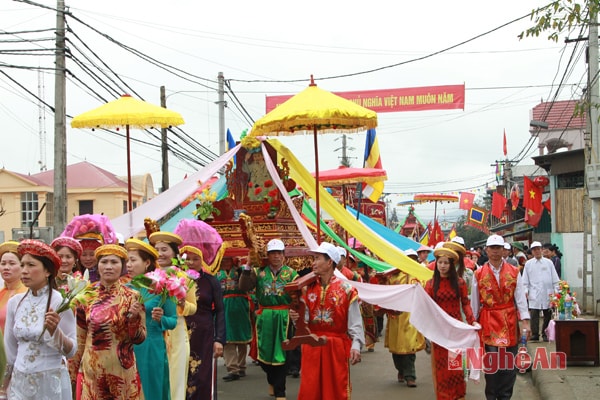 |
| Procession at the Van Loc Temple Festival. Photo: Xuan Nhuong |
Nghi Thuy (Cua Lo Town) still preserves unique customs, traditions, beliefs, and festivals. Currently, there are two temples in the ward that are hundreds of years old: Mai Bang Temple and Yen Luong Temple - where the annual fishing festival takes place. According to Mr. Truong Van Ngo (83 years old) - Head of the Management Board of Yen Luong Temple - an ancient temple approximately 400 years old, the temple was built during the late Le Dynasty (1630), a religious architectural work dedicated to deities who contributed to the nation. Legend has it that in the third year of Chinh Hoa (1682), the lives of the people of Yen Luong were unstable; fishermen encountered strong waves and winds at sea; crops failed, famine and disease were rampant. The village sent people to Cờn Temple (Quỳnh Phương, Quỳnh Lưu) to bring back incense sticks to worship the Four Holy Mothers, four deities who often help the people have smooth sailing, bless fishermen with safe voyages and prosperous business... Every year, Yên Lương Temple has two major festivals: the Kỳ Yên Festival on the 15th day of the second lunar month and the Lục Ngoạt Festival in the middle of the sixth lunar month. During these festivals, the people organize many activities to express the beliefs and cultural identity of the fishermen in the coastal region, such as: processions to welcome the deities, offerings to the deities, and festival activities: cockfighting, swinging... In particular, the Lục Ngoạt Festival has become a traditional festival of the fishermen of Yên Lương village. The festival takes place over 3 days (14, 15, 16) of the sixth lunar month with the ceremony of paying homage to heaven and earth, the procession of the palanquin, the grand sacrifice, and the prayer for a good fishing season.
For each fisherman here, the fishing festival is one of the most important festivals, a grand celebration for the entire village. During the festival days, all fishermen take a break from going to sea. Previously, the festival was held once a year, but now, due to various factors, the village of Yen Luong holds a grand ceremony every three years. The festival takes place on the 15th day of the 2nd lunar month. On the day of the festival, the villagers carry the sacred images of the Great King Sat Hai (the God who governs the sea), the female and male deities (sea gods), etc., from the Yen Luong temple to the boats at the mouth of the estuary for the welcoming ceremony. The altars are decorated brightly and solemnly. Every house sets up an altar with offerings. Each boat is decorated with lanterns and flowers. The village selects a ceremonial committee consisting of elderly, virtuous, and respected elders. The chief worshipper offers sacrificial gifts (excluding seafood) and recites a prayer expressing the villagers' gratitude to the sea and their hope for a bountiful fishing season and safe journeys for their boats. The festival includes traditional coastal games: sports competitions, boat races, and rowing. Because of this profound significance, in recent years the Nghi Thuy Party Committee and government have organized the event on a large scale, both to create a competitive spirit in labor and production and to preserve and promote the traditional culture of the coastal region. This also reflects the fishermen's aspiration to firmly establish themselves at sea.
The culture of Nghi Thuy village is rich and diverse, clearly reflecting the characteristics of a coastal region and preserving many valuable customs. Every year on the 15th day of the second lunar month, fishermen gather at the village temple to offer incense and pray for a successful fishing season. Especially for fishermen, before and after each trip to sea, they never forget to light incense before the altar of the Whale God to receive His blessings. Currently, Nghi Thuy fishermen still preserve two whale skeletons at the Yen Luong temple. Mr. Truong Ngoc Hai – Vice Chairman of the Nghi Thuy Farmers' Association – said: The custom of worshipping the Whale God has existed for a long time among the people here; it has become a belief within the spiritual life of the fishermen. After each fishing trip with a full catch, they bring the whales to offer to "Him." The temple dedicated to the Whale God, after many historical changes, no longer exists. After the Yen Luong temple was restored and renovated, the people brought "Him" to be worshipped there.
Leaving Nghi Thuy, we headed to Nghi Tan – home to the Van Loc Temple. The temple is dedicated to Grand Marshal Nguyen Su Hoi, a figure credited with founding and establishing the village. Mr. Phung Ba Diem, Chairman of the Nghi Tan Ward Senior Citizens Association and a member of the Van Loc Temple management board, explained: According to ancient traditions dating back hundreds of years, every three years, in the years of the Rat, Rabbit, Horse, and Rooster, the local people enthusiastically organize a procession carrying the palanquin, dragon throne, and ancestral tablets of Nguyen Su Hoi. This is a major festival, attracting a large number of local people and residents from the surrounding area, creating a lively, joyful, and solemn atmosphere, no less vibrant than the Lunar New Year. Typically, the festival begins on the afternoon of the 11th and ends on the evening of the 16th of the first lunar month, comprising three parts: the purification ceremony, the announcement ceremony, and the procession. The procession is the most solemn, dignified, and magnificent activity of the festival, attracting thousands of local people and villagers. A special feature is that along the route the procession passes, the clans (especially the founding clans) are tasked by the village with erecting archways in front of their ancestral temples and setting up altars with ancestral tablets, royal decrees, incense, wine, fruits, and candles to welcome and pay homage to the palanquin and ancestral tablet of Nguyen Su Hoi.
The festival features many vibrant cultural and sporting activities, such as traditional opera, reformed opera, human chess competitions, cockfighting, tug-of-war, etc. On the Cấm River in front of the Vạn Lộc Temple, a boisterous boat race takes place, attracting thousands of people from the villages of Vạn Lộc, Trung Kiên, Tri Thủy, Yên Lương, Mai Bảng, and others living along the riverbanks. The boat race organized by Vạn Lộc village aims to recreate the heroic achievements on the waterways of the naval forces of Nguyễn Sư Hồi and to commemorate his contribution in teaching the villagers how to build boats for river and sea travel. On these days, the Cấm River is vast, with waves lapping against the shore, interspersed with the cheers and shouts of fishermen crowded on their fishing boats, which are densely moored along both banks of the river, adorned with flags. Along with preserving the traditional festival, Nghi Tan ward has been receiving attention and investment from the leaders of Cua Lo town and provincial departments to gradually upgrade the landscape and architecture of the Nguyen Su Hoi temple and the festival activities, so that it becomes one of the highlights attracting tourists.
According to statistics, Cua Lo town currently has 29 historical sites (including 10 classified sites). To further promote the historical and cultural value, and to meet the spiritual needs of the people and tourists from near and far, in 2013, Cua Lo approved the project "Preservation, Restoration and Promotion of the Values of Historical Sites" in the area. Along with mobilizing social resources for the restoration and preservation of historical sites, Cua Lo has developed local cultural and spiritual tourism tours to serve tourists, linking them with historical sites such as Van Loc Temple, Mai Bang Temple, Yen Luong Temple, Lang Hieu Temple, Lo Son Pagoda, and Dao Ngu Pagoda… Notably, in the 2014 tourist season, the Cua Lo – Dao Ngu Pagoda tour will be launched to serve tourists using speedboats operated by Song Ngu Son Company. This is one of the important components of the Song Ngu Son project, worth hundreds of billions of VND.
Thus, along with beach tourism and resort tourism, cultural and spiritual tourism, with nearly 30 historical sites as destinations, is also a strength that Cua Lo has been developing and exploiting in the summer of 2014 with the hope that tourists will be more satisfied when visiting Cua Lo.
Thanh Thuy


