
Exploring the Ban Ve Hydroelectric Reservoir - Part 8: The "Green Shoots"
(Baonghean) - One image that haunted our team of reporters throughout the trip was that of the children in the villages in the middle of the lake. The complex terrain and the difficult struggle for survival of the adults have led to countless difficulties in the lives and education of the children...
In the past, we have visited the villages in the middle of the Ban Ve hydroelectric reservoir many times and witnessed the difficult lives of the people there. Most villages lack roads, and transportation relies mainly on motorboats and... walking. The most difficult situation is faced by those families who have returned to their old villages from resettlement areas, living freely in their former communities.
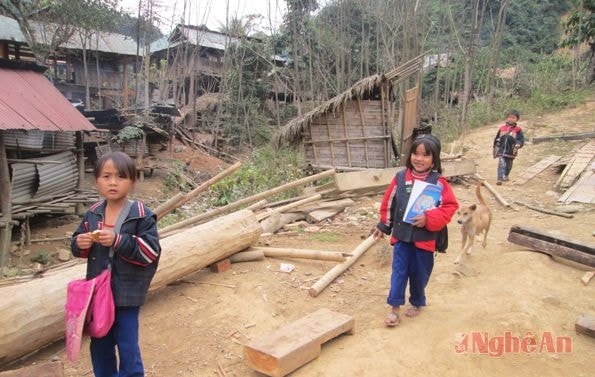 |
| Children from Xop Chao village go to school. |
We have already mentioned this in previous articles in this series and other publications. However, there is one more thing that, if not mentioned, would be a significant oversight amidst this vast lake: the lives and education of the children here. Although no official survey has been conducted, it is estimated that the number of children of school age living around this hydroelectric reservoir easily reaches thousands.
Nearly a year ago, we visited Xop Lam village, a "tribe" in the heart of Ban Ve Lake. Called a village, it's actually the home and farmland of the former Xop Lam villagers, formerly part of Huu Duong commune. They returned from resettlement sites in Thanh Chuong and Que Phong districts. They all live in makeshift huts. Their lives are precarious, so no one is sure how long they can stay here. In one of the huts at the end of the village, four-year-old Luong Thi Thien Chi was cradling a puppy in her arms. In this desolate place, the little girl, who should be in kindergarten right now, only had the small dog for companionship, and she seemed very attached to it.
Thien Chi's father, Mr. Luong Van Dung, said that he knew his daughter was old enough to go to kindergarten, but because there was a shortage of arable land in their new place of residence (Yen Khe - Con Cuong), he had to bring her back to their old village to work on the farm. The children's education had to be put on hold. He also considered sending his daughter to relatives in the resettlement area so she could attend school, but seeing how young she was, he decided to bring her along instead. He'll wait until she's a little older...
In the village, there are nearly a dozen children of preschool and elementary school age. Some of the younger children are very eager to learn. Every morning, Lo Van Phong asks for a ride on a boat belonging to a ferryman on the lake to get to school. Because he doesn't have a household registration, Phong has to "attend" at Huu Khuong Elementary School (Tuong Duong). Despite the hardship, Phong is very diligent in his studies. Phong's day begins at 5 a.m., when the boat owner starts the engine to pick up passengers, and he quickly grabs his schoolbag and runs down to the dock. Phong never forgets to bring his lunchbox containing breakfast and lunch. He only gets to go home in the afternoon, when the boat owner finishes dropping off passengers and conveniently stops by to pick him up.
To ensure their children receive an education, many parents have chosen to send them to schools near their village. All the students in the village have to travel to class by boat provided by Mr. Luong Van Phong. Sharing the same precarious life on the lake, he easily empathizes with the children and doesn't charge anyone any money. However, this boat ride is only temporary. The lives of the villagers are similar. Perhaps soon they will move to another forest to cultivate fields, and the children will once again face the risk of dropping out of school.
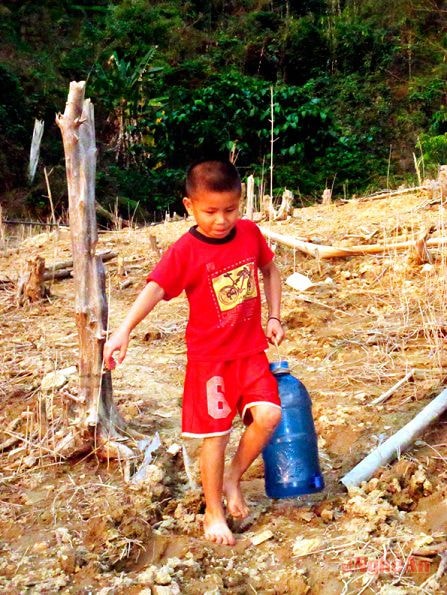 |
| A child in Xop Lam village is returning from fetching water. |
On this trip, we decided to return to this "tribe" in the middle of the lake. The village of Xop Lam still has more than a dozen households clinging to it, farming and raising livestock. The young boy, Lo Van Phong, said he's still attending school. His older sister, Lo Thi May, has finished 5th grade and is currently staying home. It's not that the teachers refuse to accept her, but rather that her parents want her to help with household chores, so they've kept her out of school. Meeting us again in the weak sunlight of a late afternoon at the end of the lunar year, Mr. Lo Van Than, May's father, said that in the middle of this lake, making a living is difficult, and raising children to go to school is equally challenging.
Without household registration, these children do not benefit from any government policies for students in mountainous areas. Books, clothes, and food are all provided by their parents. Every new school year, parents leave their work in the fields to build makeshift shelters for their children to stay in while they study. According to Mr. Than, this is also a reason why many people feel discouraged. In this area, getting an education is sometimes more difficult than finding food. At least when they return to their old hometowns, they still have rice in the fields and fish in the lakes, so they don't have to worry about going hungry. In the midst of this difficult struggle for survival, people easily underestimate the importance of education, something they consider unrelated to their current lives, even though it is crucial for their children's future.
The lake is large, but the water source near the village has become polluted, mainly used for bathing and washing. Anyone unfamiliar with it will get itchy all over if they jump in to bathe. On normal days, the children have to go to streams on the hillsides to fetch water. That afternoon, someone in the village was building a new house, and the children went to carry water back for cooking. The most energetic was still Lo Thi May. This year, at 11 years old, May could gather firewood, wash clothes, cook, and even carry water and pound rice. These are also normal tasks for children in the village. Mr. Than said that he often feels sorry for his daughter but doesn't know where to move because the family's resettlement site is in Que Phong, and the land already has owners. The financial assistance has run out, and they can't buy it back anymore.
Returning down the Nam Non River, we came back to Xop Chao village (Luong Minh - Tuong Duong). Although we had visited this small village a couple of times before, each visit brought a different feeling, even though the scenery and people here remained the same. It was still a village with stilt houses hidden behind the green curtain of forest and water. Our traveling companion, a village official, told us: Xop Chao used to belong to Kim Da commune. Since the Ban Ve reservoir was built, the commune was dissolved, and the villagers chose to move to the mountainous area where the reservoir doesn't flood. Currently, the village has nearly 90 households, almost 500 people. The people are more settled now than before, as they have gradually become accustomed to the hardships of the mountainous region. Only the education of the young children remains a major challenge. Although the school's infrastructure has been invested in and built quite fundamentally by the State, with sufficient classrooms for students and housing for teachers, the most pressing concern remains the children's access to education. Although it's a single village, the population is divided into three distinct groups. The hamlets are isolated and only accessible by motorboat, so parents have to take their children to and from school every day. Those who can't afford it have to send their children to school with families who own motorboats used for transporting goods in and out of the village. Each day, they have to contribute money to buy fuel along with the boat owner. In total, each student spends several hundred thousand dong per month on transportation alone.
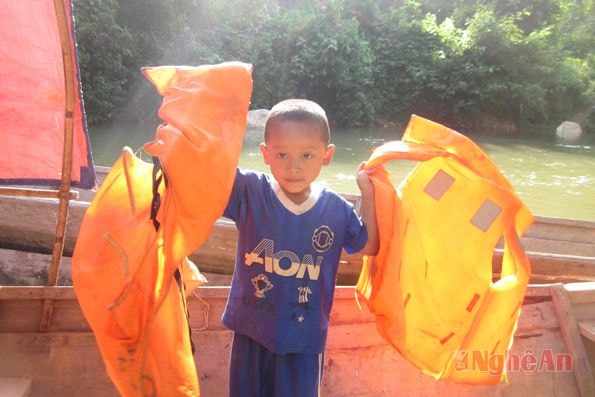 |
| Get your life jackets ready before boarding the boat. |
This morning, the two brothers, Lo Thai Binh and Lo Thai Nguyen, were taken to school by their father in a boat. Because their family owns a motorboat, these two students attend class quite regularly, and their academic performance is much better than many of their classmates.
Lô Thái Nguyên shared: "I'm still scared sometimes when my dad drives the motorboat, especially when another boat comes from the opposite direction; our boat rocks precariously as if it's about to capsize. But I don't want to quit school because here the teachers teach me so many things that I wouldn't know at home."
In the kindergarten classroom, teacher Nga is teaching her little ones to sing. The song is about a kindergarten where the teacher is as kind as a mother. Her hands are not only skilled at dancing but also very dedicated to caring for her students. Thanks to her hands, these hardworking little girls become neat and clean. The singing and reading make the small, quiet village much warmer.
Creating that atmosphere required a great effort from the teachers, parents, and the young students. At this school, there are three male elementary school teachers and one female kindergarten teacher. Mr. Lo Van Tuan, who has worked at this school for two consecutive years, shared: "One of the teachers at the school bought a motorboat to make transportation easier and to serve the needs of the staff. After a long period of use, the boat became old and damaged. Recently, a charity organization invested in a new boat for the school. This is timely encouragement to help the teachers feel more secure and committed to one of the most disadvantaged schools in the commune."
At midday, the boat landing in Xop Chao village bustled with the sounds of children. After school, the students from Xop Chao, Xop Pang, and Xop Vi returned home. The children, like nimble little birds, jumped onto the boats. Each one was as quick and agile as a true river dweller. The boy Lo Thai Binh loudly recited the poem he had learned that morning: “Today on the O Lau dock / I sit and remember Uncle Ho’s beard…” His voice echoed throughout the dock.
Children are like that; no matter where they are or what difficult circumstances they face, they always live innocently. These young sprouts by the Ban Ve lake are no exception. This very innocence reminds us that they still need much care, especially in an area where young children are also sacrificing themselves for the energy needed for the economic development of their homeland and country!
Reporters' Team
| RELATED NEWS |
|---|


