
Urgent measures needed to control rice planthoppers in the late rice season.
(Baonghean)According to the Provincial Plant Protection Department, brown planthoppers and white-backed planthoppers have emerged and are causing damage at a fairly high density on summer-autumn rice crops, requiring timely measures to prevent rice from being "burned" by planthoppers at the end of the season.
Yen Thanh district has the most severely affected area by rice planthoppers in the province. According to Mr. Nguyen Sy Hung, Vice Chairman of the District People's Committee, approximately 3,000 hectares of early-planted summer-autumn rice in the district have already flowered, while the late-planted summer-autumn rice is in the late tillering to heading stage. Of particular concern is the appearance of brown planthoppers and white-backed planthoppers, not simultaneously but causing localized damage in some highland areas with densities ranging from 200-300 insects/m2, reaching 700-1,500 insects/m2 in some areas, and even up to 3,000-5,000 insects/m2 in localized areas.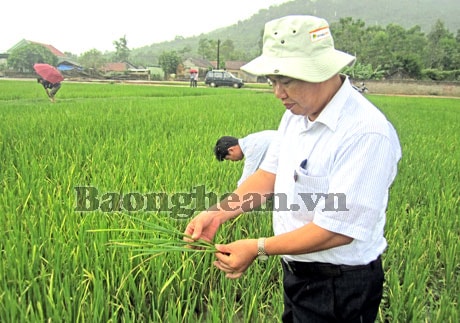
Inspecting the pest and disease situation on summer-autumn rice crops in Yen Thanh.
As of August 7th, the entire district had 1,093.8 hectares of rice infected with planthoppers, including 52 hectares severely infected, concentrated in the communes of Tang Thanh, Xuan Thanh, and the town center. On the area of late-planted summer-autumn rice (sown after June 15th), planthoppers have also appeared with a common density of 50-100 insects/m2, in some areas 200-500 insects/m2, and locally 1,000-2,000 insects/m2. According to the forecast of the district's Plant Protection Station, brown planthoppers and white-backed planthoppers will continue to increase in density and cause localized damage to some rice fields in the heading and flowering stages. The district has directed communes to guide farmers to monitor and spray to control planthoppers on rice according to the recommendations of the relevant authorities...
This year's summer-autumn rice crop saw over 90,000 hectares planted throughout the province. Currently, the summer-autumn rice crop is in the heading, flowering, and milk-filling stages, while the main rice crop is tillering vigorously and heading. According to the summary results of the Provincial Plant Protection Sub-Department, rice planthoppers have emerged and caused damage to the summer-autumn rice crop with a common density of 200-300 insects/m2, reaching 1,000-2,000 insects/m2 in some areas, and locally reaching 2,500-3,500 insects/m2 in Yen Thanh and Dien Chau districts. The total area infested with planthoppers as of August 9th is over 1,407 hectares, including 237 hectares with moderate infestation and over 58 hectares with severe infestation, notably with localized outbreaks of planthopper damage. On the main rice crop, rice planthoppers are causing damage with a common density of 30-50 insects/m2, reaching 1,000-1,500 insects/m2 in some areas, and even 3,000-4,000 insects/m2 in localized areas. Of particular concern is the rapidly increasing infestation in various localities; in just the first 7 days of August, 157 hectares of main rice crops in the province were infested, with 6.5 hectares severely affected, concentrated in Anh Son and Con Cuong districts.
According to Mr. Nguyen Tien Duc, Head of the Provincial Plant Protection Department: From the beginning of the season until now, rice planthoppers have been causing damage at normal densities. However, the development of planthopper populations has started to increase sharply from the heading and flowering stages of rice, especially in Yen Thanh, Do Luong, Con Cuong, and Anh Son districts. Forecasts indicate that the scope and density of planthopper damage will continue to increase in the coming period. Meanwhile, from now on, rice plants have poor transport capacity. After flowering and ripening, areas with high planthopper densities, if not properly controlled, will continue to suffer from severe damage, severely impacting yields due to plant drying and grain shriveling. Therefore, localities and farmers need to regularly inspect fields to spray promptly, because if spraying is delayed, even if the planthoppers are controlled, the rice plants will still dry out and yield will be lost.
It is important to recognize that rice planthoppers are one of the main, significant, and dangerous pests affecting rice cultivation. The Plant Protection Department recommends that, to protect the yield of the summer-autumn rice crop, it is essential to focus on and urgently control planthoppers at the end of the season. For brown planthoppers and white-backed planthoppers, farmers should be advised and directed to control them in areas with planthopper densities of 1,500 individuals/m² for rice from the heading stage onwards and 2,000 individuals/m² or more for rice in the heading stage, using systemic insecticides such as Elsin 10EC, Oshin 20WP, Dantotsu 16 WSG, Chess 50 WG, Sutin 50 SC, etc.
For areas where rice plants have a high density of rice planthoppers (3,000 or more per square meter) after heading to the ripening stage, contact and fumigant insecticides such as Bassa 50 EC, Victory 585 EC, Penalty Gold 40 EC, etc., should be used for spraying. When spraying, ensure the recommended amount of water is used and that the entire plant and leaves are thoroughly wet to increase the effectiveness of the insecticide.
Phu Huong


