
"Thirst" in Nam Can
(Baonghean)Despite the impact of typhoon number 2, there was some rain in Ky Son district, but the amount was still insufficient to alleviate the drought in Nam Can commune, a border area of Ky Son. The prolonged heatwave has caused all streams and springs to dry up.
Along the road to the Nam Can border gate, we saw many corn fields belonging to the Mong people that had withered and dried up. In Truong Son village, many women and children carried plastic containers down to the streams and creeks to fetch water.
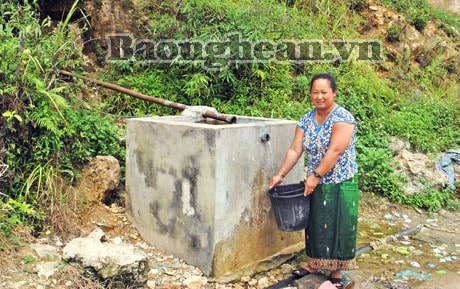
Ms. Mai Y Ly in Truong Son - Nam Can village collects naturally flowing water from a reservoir built by the commune along the mountainside.
Ms. Mai Y Ly (32 years old) from Truong Son village, using a plastic bucket to collect water dripping from a makeshift tap in the mountainside, confided: "After the impact of typhoon number 2, we were so happy to have heavy rain, but instead, the weather was gloomy for several days, with little rain followed by intense sunshine. Now we have to go fetching water for daily use, which is very difficult." According to Ms. Ly, the commune invested in a pipeline for Truong Son village to draw water from the mountainside and channel it into a small water tank. However, the water flows slowly, and it takes a long time to get enough; each family takes turns getting about 3 cans of water, mainly for cooking. For bathing, they have to go down to the stream or creek.
We went up to Tien Tieu village and met Ms. Ho Y Hua who was fetching water. She lamented, "All the water tanks in Tien Tieu have dried up. Currently, the people of Tien Tieu village have to 'create water' themselves by going into the forest to find it, digging a small hole in a damp spot to collect the seeping water. My husband has been searching for a water source for the past few days but hasn't found one yet, and we're having to share a water hole with another family."
Ly Ba Xua, Deputy Head of Tien Tieu village, said: "The village has over 150 households but only 3 water tanks, all of which have been dry for a long time. Water in the streams and springs has dried up. For the past few days, the village has been mobilizing people to go into the forest to explore and dig holes to get water from inside the mountain. Finding water this way is very difficult; sometimes it takes several days in the forest to find and dig a water hole. And to carry the water back, they have to walk several kilometers up steep slopes and through deep ravines."
Along the road to Khanh Thanh village (a village without a self-flowing water system), we saw a truck carrying water to sell to villages in Nam Can. Unlike the water tankers in the coastal communes of Dien Chau and Quynh Luu, this truck had its back full of water containers; they sell the water by the container.
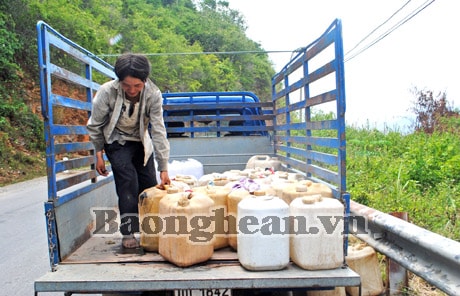
The car sells water to the people of Nam Can commune.
The driver didn't reveal the price of water per can, only saying: "We find a source of clean water, then fill it into cans and transport it by car to Nam Can. We sell it to whoever needs it. Sometimes, 2-3 families pool their money to buy a whole 'cart of water,' about 50 cans of 20 liters each, to use in their fields for growing corn and rice."
Mr. Lau Cho Cua said: "The people in Nam Can are still poor, so they rarely buy water for daily use; they mostly find water themselves. The water transported by trucks is mainly sold to households in mountainous, rocky areas where it's impossible to find water sources."
Mr. Ho Chong Nhia, Chairman of the People's Committee of Nam Can commune, said: Nam Can has 737 households (4,010 people), the commune has 6 villages, of which 3 are Mong villages: Tien Tieu, Truong Son and Huoi Poc, and the remaining 2 are Khmu and Thai villages. The State has invested in building a gravity-fed water system for 5 villages in Nam Can (only Khanh Thanh village does not have one). The reason for the severe water shortage in Nam Can is that the water source at the headwaters has dried up, making it impossible to supply the village water tanks. In addition, the water pipeline system has been damaged by landslides and some sections have been vandalized by some irresponsible residents.
The water source in Noọng Dẻ village is heavily polluted due to the concentration of buffalo and cattle farming by the villagers right at the source. To cope with the severe water shortage, the Nậm Cắn Commune People's Committee has allocated funds to build three water storage tanks, each costing 1 million VND. These tanks, though called tanks, can only hold less than 1 cubic meter of water and were built to collect water trickling from damp mountain crevices. Two villages share one tank. Previously, the commune had invested in building two small wells for the villages to store water, but these wells are unusable due to the water having dried up.
According to some village elders in Nam Can, another important reason is that the headwater forests bordering the Vietnam-Laos border have been completely deforested for a long time. Without forests, the water source cannot be preserved. Further investigation revealed that the gravity-fed water system in Nam Can has been invested in with state funds, but it is still fragmented and ineffective. For example, the two villages of Truong Son and Tien Tieu, with over 320 households, only have 6 water tanks, 3 in each village.
According to Mr. Ho Chong Nhia, Tien Tieu village needs six water tanks because whenever water is available, there is always a scramble for it for bathing and washing. Nam Can urgently needs government investment to repair and upgrade its water supply system so that the people can improve their living conditions and alleviate poverty.
Van Truong


