
Thirst in the highlands
(Baonghean) - During the scorching hot days, we traveled to several highland districts to witness the hardships and difficulties faced by ethnic minority communities in the villages of western Nghe An due to water scarcity. Having enough water for daily use is a burning dream for the people here…
(Baonghean) - During the scorching hot days, we traveled to several highland districts to witness the hardships and difficulties faced by ethnic minority communities in the villages of western Nghe An due to water scarcity. Having enough water for daily use is a burning dream for the people here…
Lack of water for daily use.
Following National Highway 48 to Yen Luom village, Chau Quang commune, Quy Hop district, during the peak of the hot season, we met Mrs. Truong Thi Chinh, drenched in sweat, struggling to carry water back to her village. Setting her basket down under a tree by the roadside to rest, she said: "Before, the Yen Luom stream had crystal-clear water, you could see every pebble. Now, because people cut down trees to clear land for farming, mine for tin, and exploit white stone, the stream has become muddy, killing all the fish and shrimp, let alone providing water for the villagers... Many households have dug very deep wells but still can't find water, so they have to walk more than 2 kilometers down to Bai hamlet to beg for water."
Mr. Nguyen Van Thanh, Head of Yen Luom village, Chau Quang commune, Quy Hop district, said: In 2011, the village received investment for a clean water project under Program 134/CP, with a budget of 1.2 billion VND, and the local government and people contributed an additional 360 million VND. The project was completed and put into use, and the people of Yen Luom village were very happy. But the joy was short-lived. In August 2013, due to the impact of typhoons No. 8 and No. 10, Yen Luom village, along with many other villages in Chau Quang, suffered serious flooding and landslides, burying and washing away 330 meters of the main water pipeline from the Quy Hop water plant to Yen Luom, leaving more than 117 households with nearly 500 people in Yen Luom village without clean water. According to Nguyen Ngoc Luyen, Chairman of the Chau Quang Commune People's Committee: Following complaints from residents of Yen Luom, the Chau Quang Commune People's Committee is making every effort to address the water pollution and is developing a plan to resolve the current clean water shortage as soon as possible.
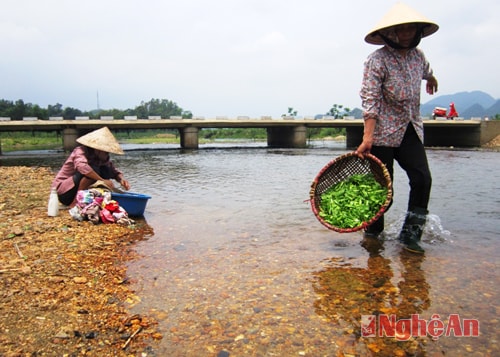 |
| The people of Yen Luom village use water from a polluted river for daily life. |
Leaving the parched village of Yen Luom, we made our way to Van Loi commune, a place more than 15 km from Quy Hop town. Situated next to a limestone mountain range, it is one of the communes in the district facing severe water shortages. Along the way, we encountered parents bringing their children to Van Loi Kindergarten with a 20-liter water container. Ms. Lo Thi May, mother of Vi Thi Oanh, pointed to the container and said, "Water is very scarce here, so each parent has to bring two 20-liter containers a week, along with a bundle of firewood to give to the school." Sharing about the difficulties and shortages faced by the teachers here, Ms. Phung Thi Hieu, Deputy Principal of Van Loi Kindergarten, said: "Recently, the school requested permission from the commune government to dig a well more than 40 meters deep, but the water pumped up is murky. We have to filter it, but we only dare to use it for washing, not for drinking, because it's not hygienic for the children. So we had to make a rule that each week, parents must bring 40 liters of water and a bundle of firewood for each child to use for drinking and cooking while staying at the school for the daycare."
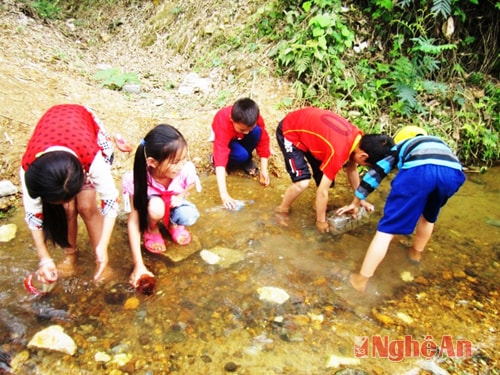 |
| The children of Yen Luom village, Chau Quang commune, use jars and bottles to scoop up stream water for their use. |
According to locals, most water sources are contaminated with limestone, and even those who manage to dig wells find them very deep, about 30 to 40 meters, with very little water available. To obtain clean water, the only option for residents here is to collect and store rainwater.
Traveling along National Highway 7, we reach Muong Long, the "gateway to heaven," in Ky Son district. Muong Long is known as the "Sa Pa of Nghe An," but these days, the heat and drought here are no less intense than in the areas along National Highway 48. Mr. Ly Pa Cho, from Muong Long 1 village, lamented: "The weather this year is so strange! In Muong Long commune, in the past, we needed thin blankets to lie down at noon, but now it's unbearably hot at midday. The rock crevices always yielded plenty of water, but this year people have to carefully collect it, and the trees are all withered..."
Descending to the communes of Pha Danh, Huoi Tu... we met the Khmu and Mong people in the villages of Keo Luc, Huoi Dun... trudging under the scorching sun for hours just to collect a basketful of water, which they laboriously carried back home for use. Patches of forest and dry, white reeds emitted thick, hot steam. The Chairman of the Ky Son District People's Committee, Bui Tram, who has been closely associated with the high-altitude Ky Son district for many years, said: "Up here, we have never seen the Mong people in Muong Long, Na Ngoi, Nam Can, or the Khmu people in Keng Du... complaining about water shortages like this year."
When will the thirst end?
In mountainous districts like Con Cuong, Tuong Duong, and Ky Son, despite having many rivers and streams, water shortages for daily use are still a frequent problem during the summer. The Party and State's Programs 135 and 134 have transformed the face of the highlands; however, for various reasons, many projects, especially clean water supply projects in highland communes, are in a state of disrepair or abandoned, while people are forced to use polluted water.
For example, Quy Chau district has 12 communes and towns, and almost every locality has one or two gravity-fed water supply systems. The gravity-fed clean water system in Chau Binh commune was completed and handed over at the end of 2012. This system has supplied water to 500 households and 3 schools in the area, but the people have not been able to benefit from it for long before the system is damaged and deteriorating.
Currently, nearly 90% of the villages in Ky Son district have clean water facilities, but due to the high mountainous terrain and scarce water resources, the flow is not strong enough. Furthermore, after many years of use, the pipelines, reservoirs, and water taps have been damaged and deteriorated, with many water tanks left unused. Mr. Vy Hung, Vice Chairman of the Ky Son District People's Committee, said: “We are currently compiling statistics and planning repairs for the damaged and deteriorated clean water facilities. The people also need to be aware of protecting and preserving the clean water facilities built in their villages to prevent further damage...”
According to statistics from the Center for Clean Water and Rural Sanitation in the entire province, only 27% of rural residents currently have access to water that meets the standards of the Ministry of Health. This is due to the slow investment and upgrading of many water supply stations, their severe deterioration, or their unfinished construction, rendering them unusable. Furthermore, attracting businesses to invest in rural clean water projects and mobilizing public contributions remain limited.
Explaining this issue, Mr. Dang Van Quyen, Head of the Construction Project Management Department - Department of Agriculture and Rural Development of the province, said: The main reason is climate change. While the water source was surveyed and designed to be sufficient, after a period of operation, the source dries up, failing to supply the project. Furthermore, mountainous areas frequently experience natural disasters and landslides, damaging and degrading the invested water supply facilities. In addition, some people have poor awareness due to deforestation and mineral exploitation, which also causes the water source from streams and springs to be depleted. Moreover, the facilities are not maintained or repaired in a timely manner, and when they break down, no one reports it for timely repair. Most of the clean water projects are gravity-fed, and because the design and consulting roles of the local authorities have not been given sufficient importance, the completed projects are often unsuitable...
The weather remains hot and sunny. Strong southwest winds are blowing, and water levels in rivers and streams continue to drop rapidly, spreading the drought over a wider area. If there is no rain in the coming days, many villages will be completely out of water… When will the people in the highlands stop thirsting? This urgently requires the attention and intervention of relevant authorities and sectors.
Text and photos:Pham Ngan


