
Piêng Lâng's Aspiration
(Baonghean) - Now, Piêng Lâng (Nậm Giải, Quế Phong) is no longer the desolate land devastated by the flood nearly a decade ago, but has become a famous destination attracting travelers from near and far. The beauty of the traditional Thai village nestled among clouds on the mountaintops, the vibrant green of the vast passion fruit hills, and the endless tranquility of this remote and secluded place... have created Piêng Lâng's unique "specialty"...
So, I used my work as an excuse to treat myself to a leisurely journey to the remote Piêng Lâng. That is, I went with a mindset of both leisurely sightseeing and maintaining a clear mind to understand and record the features of this borderland, which I hadn't had the chance to return to in almost a decade. Mr. Ngân Văn Minh, the head of Piêng Lâng village, came down to the Nậm Giải commune People's Committee to handle some paperwork and procedures regarding passion fruit seedlings for the new season, and enthusiastically became a guide for visitors to the village. “The road to Piêng Lâng is still the same single-lane road, but it has changed a lot. Before, the road was steep and rocky, slippery with red earth in the rainy season, and bumpy with gravel and pebbles in the summer… After several expansions and improvements, the road has been ‘paved’ with several new layers, making transportation much more convenient,” Mr. Minh happily shared.
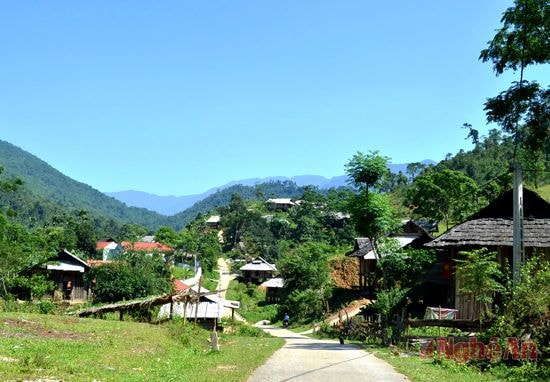 |
| The road to Pieng Lang |
Village head Ngan Van Minh is only in his early 30s but has already been "managing" Pieng Lang village for six years. Open, sincere, and hospitable like other members of the Thai ethnic group, Head Minh is highly regarded by many visiting groups, both for his deep understanding of the village's history and traditions. "The 65 households in Pieng Lang today originally came from Puc and Meo villages, whose houses and fields were swept away by the 2007 flash flood. The flood came in the night, and no one had time to react. In the morning, standing precariously on their rooftops, they looked out at the vast expanse of water, seeing their buffaloes, cows, pigs, and chickens... floating before them, feeling helpless. Many families lost their mothers, their husbands..."
"The people of Piêng Lâng today haven't forgotten the past," said village head Minh, recounting both recent and distant stories. The road from the center of Nậm Giải commune to Piêng Lâng is less than 7 km, yet it feels vast and distant amidst the memories of the past. When they lived in their old homes, the villagers struggled due to a lack of arable land, the steep mountainous terrain, and the harsh climate, making agricultural production extremely difficult. After the floods, the village became even more desolate. "We received rice and relief supplies from the government and various organizations, but the villagers told each other, 'We can't rely on aid forever; we have to find a way to make a living.' In 2009, the district and commune authorities held a meeting to encourage the villagers to relocate to a new place, further away but with more spacious and favorable terrain for living and production. The Piêng Lâng resettlement village was established at that time. Piêng Lâng, in the Thai language, means a flat area with a flowing stream." "Piêng Lâng is the aspiration of our people," Village Chief Minh shared sincerely, hastily pressing the accelerator to reach the top of the final slope.
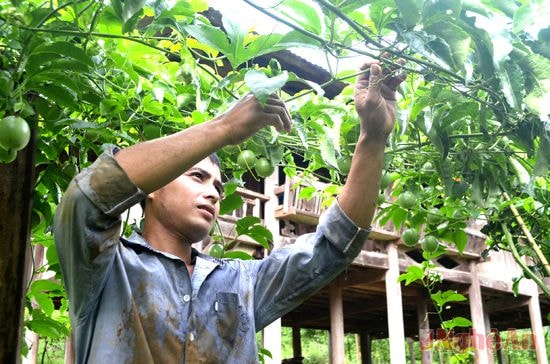 |
| Mr. Le Van Dieu takes care of his passion fruit garden. |
As a resettlement village, Piêng Lâng differs from the other seven villages of Nậm Giải commune in its well-planned internal road network, resembling a chessboard. The entire internal road system is paved with concrete, stretching all the way to the rice paddies. Along the roadsides, glimpses of green terraced rice paddies in the planting season can be seen, the clear Huồi Cò Mạ stream meanders around the hard rice paddies, and the sounds of plows and buffaloes tilling the soil for the new harvest can be heard...
Village chief Ngan Van Minh led me up to a high hilltop. From the top, the 65 stilt houses in Pieng Lang spread out like a fan, leaning against the perpetually cloud-shrouded peak of Pu Huong, resembling a magnificent ink painting of nature. Chief Minh gestured with his hand and confided, “The aspiration of the Thai people throughout the Nam Giai region was to have a flat piece of land to live and work. And here, that aspiration has come true. In Pieng Lang, each household was allocated 2,000 square meters of land to build a house, with a vegetable garden, a separate livestock area, and many households even dug ponds for fish farming. Not to mention, on average, each person in the household has 5 acres of rice paddies to cultivate. The people of Pieng Lang are very happy!”
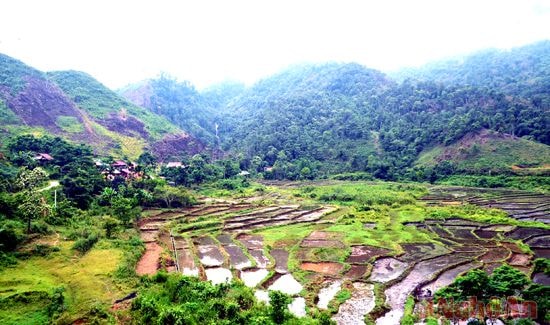 |
| Scenery of Piêng Lâng. |
That joy is present in every story told today, not only in the hearts of the elderly but also in the young families who came to settle in Pieng Lang with the aspiration to get rich in this difficult land. Le Van Dieu (born in 1984) is one such typical young man. Tall, with fair skin and a scholarly face, few would guess that this appearance hides a resolute and determined personality. Dieu's story is a mix of joy and sorrow, intertwined with the ups and downs and many hardships of his life. Dieu is originally from Meo village. His family is small; his father died early, leaving only him and his mother, so from a young age, Dieu has been the pillar of the family. "When I was in Meo village, I worked hard alone on a few acres of rice paddies, and in my free time I went into the forest to gather forest products and did odd jobs as a porter..." - Dieu confided. In 2007, a flash flood swept through Meo village. The rickety stilt house where Dieu and her mother lived couldn't withstand the fury of nature. "I regret it so much, I couldn't save my mother... It wasn't until several days later that the villagers informed me, telling me to go down and retrieve my mother's remains in Nghia Dan. Now, my mother's grave is still there..." Dieu recounted, her voice choked with emotion.
We all fell silent, gazing out at the vast expanse of green before us. The passion fruit garden of young owner Le Van Dieu, spanning over 2 hectares, gleamed in the dazzling morning sun, laden with its first fruits of the season. Passion fruit gardens like Dieu's are a highlight of Pieng Lang today, imbued with the miraculous feat of "carrying" passion fruit over the mountains, "planting" deep roots and firmly establishing themselves in the soil of this border region, and in the hearts of the local people.
“Now the villagers are grateful to the officials and the government for bringing good crops to our remote village. A few years ago, when the officials encouraged us to plant passion fruit, my family wasn't very enthusiastic because we were skeptical about this new, unfamiliar crop. The officials kept promoting and encouraging us, providing seeds, fertilizers, and technical guidance very attentively, before we finally dared to plant it!” – said Mr. Le Van Dieu. Dieu's family was one of the four initial households in Pieng Lang that experimented with planting passion fruit. After two successful seasons, many villagers trusted in following suit. Passion fruit thrives in Pieng Lang's climate and soil, yielding 25 tons per hectare in the first harvest. “Thanks to passion fruit, my family escaped poverty. But now that we've escaped poverty, we must strive to become well-off and wealthy. We'll reinvest the income from passion fruit in raising breeding buffalo and cattle,” the young owner of a now-stable property excitedly shared about his plans.
Sitting beside her, Village Head Ngan Van Minh added, "It's not just Dieu's family; in Pieng Lang, many young families who have recently moved out to live independently share the same aspiration to overcome poverty. They enthusiastically cleared land and leveled it to plant passion fruit, acacia trees, cassava, etc., to generate short-term income and support long-term growth. Now, the total area of passion fruit cultivation in the village has reached over 7 hectares, and this year, the Nam Giai commune government is planning to expand the area by another 4 hectares. Pieng Lang is flourishing with aspirations!"
Notes:
KY PHUONG


