
Hung Son's Green Aspiration
It was only when I stood on a hilltop deep in the Mac Dien tea plantation, with its green tea swaying in the breeze, its layers of leaves spreading across the valley slopes, a boundless green reflecting the sunlight that captivated my gaze, that I understood the somewhat restrained sentiments of the chairman of Hung Son commune (Anh Son district). It turned out that he was simply expressing his heartfelt aspirations for a better life for the land and its people...
(Baonghean)It was only when I stood on a hilltop deep in the Mac Dien tea plantation, with its green tea swaying in the breeze, its layers of leaves spreading across the valley slopes, a boundless green reflecting the sunlight that captivated my gaze, that I understood the somewhat restrained sentiments of the chairman of Hung Son commune (Anh Son district). It turned out that he was simply expressing his heartfelt aspirations for a better life for the land and its people...
The motorbike taxi ride was a quick four or five kilometers, and the driver, Tường Sơn, was very talkative, asking, "Are you a journalist writing about the tea plants in Hùng Sơn? Or are you a close friend of that Party Secretary or Chairman who just played chess with me over here?" The driver's enthusiastic demeanor reassured me, calming my anxiety about finding something to gossip about and write about my destination—a spontaneous but determined trip that couldn't be avoided.
Amidst the rice paddies and cornfields along the riverbanks, and the scattered patches of "past mulberry trees," a red line marks the dirt road connecting the suspension bridge to Hung Son village, easily deceiving newcomers into believing it's a land of persistent poverty. The old, dilapidated commune headquarters, half-hidden behind the acacia and eucalyptus trees, resembled a state-run farm from a bygone era of state-controlled economy. But I immediately realized my initial mistake when I saw a tall, modern building under construction nearby... Standing in the spacious, simply furnished office of the commune chairman, before I could even make a phone call to request an audience, I heard greetings preceded by footsteps. The warm handshake and friendly gaze from that first moment dispelled my intention to perform the formalities of presenting my press card and giving reasons for visiting the commune, meeting this comrade, and discussing this or that matter!
Amidst the eagerness to visit the verdant Mực Điền that I had heard so excitedly about from my colleagues, the Chairman of the commune, Mr. Võ Văn Hiền, decisively did something that I interpreted as him trying to introduce the story through the exquisite flavor of the plants and leaves that are increasingly enriching the lives of the people of Hùng Sơn: He offered me a cup of green tea from Hùng Sơn tea, a product with confidently established packaging and branding in both domestic and international markets. Although not a connoisseur of tea leaves, I felt a sense of exhilaration as I held the cup tightly in my hands, inhaling the delicate aroma and leisurely savoring the lingering sweet and slightly bitter taste… Perhaps that was when I began to feel a kind of “love between the plant and the land” that would truly “draw” me in later years…
“So, no written reports, targets, or indicators for this year or this period… journalists, okay?” I knew the commune chairman wanted to avoid his usual routine of receiving dozens of reporters from various newspapers and media outlets each year to write about and investigate the socio-economic situation of this locality, where tea cultivation has brought about a miraculous transformation in the lives of the people in just 10 years. So, let's go! Before the tea ceremony was over, the chairman himself was urging us on. We set off on his motorbike, the clattering rubber tires bouncing on the bumpy village roads that stretched into the seemingly endless green tea plantations. A new face of Hung Son countryside had emerged, a place that, just a few years ago, seemed distant and unattainable due to the river crossings to reach National Highway 7, or the arduous journey of forty kilometers through the mountains to transport corn, acacia trees, and tea leaves for processing. The suspension bridge spanning the Lam River, connecting Tuong Son commune to Hung Son riverbank where the legendary Dragon Ferry and Royal Wharf once stood, was inaugurated in 2012. Along with the expansion of the raw material supply route on this side down to Tan Ky, this has awakened the fertile land, which had been dormant for millennia, awaiting the dedication and hard work of its people.
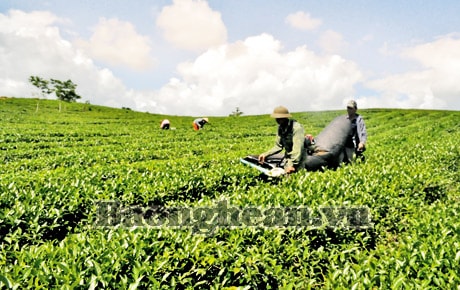
Farmers in Hung Son harvest tea. Photo: D.S.
While not the largest tea-growing area in Anh Son district, Hung Son can be considered the most concentrated and beautiful tea-growing region in Nghe An, comparable to the famous picturesque tea-growing areas of the Northwest. And it's even more admirable to know that Hung Son tea products are playing a leading role in the Nghe An tea brand in both domestic and international markets! This feeling, this observation, came when the commune chairman led me to an unnamed hilltop, and I was truly overwhelmed by the vibrant beauty of the land, with layers of green tea swaying at the foot of the hills, stretching endlessly across the valley slopes, their lush green hues captivating the eye. Red gravel roads wind around the tea hills, bustling with tractors, carts, and oxen carrying harvested tea to the Hung Son Tea Processing and Service Enterprise. In the bright sunshine, the bustling sound of tea-picking machines echoes across the mountain slopes and valleys... The people of Hung Son have become wealthy not only because they know how to cultivate tea, but also because they apply many cultivation methods and, especially, increase harvesting productivity to ensure the season is met by purchasing tea-picking machines.
“It took 10 years to create a 420-hectare tea plantation with purebred new varieties like today, all thanks to the aspirations of the leaders and people of Hung Son over the past few decades to awaken the potential of the land!” – Chairman Vo Van Hien told me about the green aspirations of Hung Son, a land of ups and downs, hoping for prosperity from the winds of renewal of the entire homeland and country. This means that to have a vast mountainous area of Mac Dien (originally named Muc Dien, associated with the Len But place on the river and mentioned in historical accounts of Le Loi's Lam Son uprising and the Can Vuong movement initiated by King Ham Nghi) covered in tea plants as it is today, it took the sweat and effort of generations of leaders and people of Hung Son to experiment with countless plant and animal species… that were once thought to be abandoned, left to become wild forests, and replaced with mulberry trees in the fields.
Following the path through the Mac Dien mountain valley, we traversed the endless tea plantations back to the commune center, stopping by the Hung Son Tea Processing and Service Enterprise (under the Nghe An Tea Investment and Development Company). A bustling atmosphere of purchasing and processing filled the air. Enterprise Director Tran Van Long stated that the enterprise's processing capacity of 45 tons of tea per day is ensuring sufficient raw material supply for the Hung Son tea growing region.
He also confirmed to me that tea products from Hung Son raw material area are the main product of the Nghe An tea brand, accounting for about 30% of the province's high-quality product output. This is because Hung Son is the only locality with a large concentrated tea growing area of pure LDP variety (1,2), and this new variety has also been determined by the Central Tea Seed Institute to be able to "stand" only in Nghe An after failed trial planting in Phu Tho tea region. In 2012, Hung Son's tea bud production reached 3,250 tons, with an income value of 10.07 billion VND...
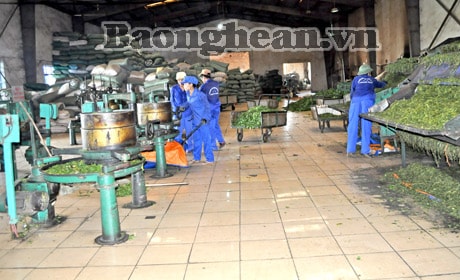
Tea processing at Hung Son Tea Processing and Service Enterprise. Photo: D.S.
Around midday, when the Party Secretary of Hung Son commune, Tran Duc Chau, arranged to meet me along with Chairman Hien and Director Long, I realized I was facing three "royal guards" who had wholeheartedly brought tea plants to Hung Son, restoring greenery to the vast historical Mac Dien region.
...It all started in 2000, when the Anh Son Tea Processing Enterprise faced a severe shortage of raw materials, leading to a deadlock in its business. In the midst of this shared concern, the Head of Planning, Tran Van Long, took on the task of finding land for tea cultivation. During that Tet holiday, when Tran Van Long and Mr. Tran Duc Chau (then the commune chairman), and Mr. Vo Van Hien (now the commune chairman), the head of the agricultural cooperative and Farmers' Association, met in the office of the Anh Son District Party Secretary, Nguyen Thanh Phung, the idea of introducing tea cultivation to Hung Son was formed – a seemingly adventurous undertaking. Even Mr. Phung himself asserted that Hung Son's only way to survive was to plant mulberry trees in the fields. And while mulberry trees thrived for several seasons, silkworms refused to grow in Hung Son, let alone produce silk, and for some reason, they kept dying off in successive generations...
Mr. Chau recalled: “For years before that, we traveled everywhere, bringing back all kinds of seedlings to plant with the sole hope that Hung Son would have a crop that could sustain itself and alleviate hunger for the people. Lychee and longan trees didn't bear fruit; pepper plants withered, cassava also failed… When trees didn't work, we turned to livestock, but after raising goats for a long time, we finally built up a herd, only to find that the price of goats had plummeted to a third! People gradually lost faith… Looking back now, I realize that successfully introducing tea plants to Hung Son was a miraculous stroke of luck!” Director Long added: “The land in Hung Son is ideal for tea plants, due to its thick soil layer and suitable slopes. The entire Mac Dien area can be said to have its own unique microclimate with a very high temperature difference between day and night…”
This results in tea leaves that are curled, small, tightly packed, and have a very special flavor that is favored by the market. Besides supporting tea growers according to our initial commitment, our enterprise has also successfully transferred the technology for producing bio-fertilizers for tea cultivation to tea growers, contributing to ensuring national food safety and hygiene standards and clean production according to VietGAP standards.”
There's an interesting story: when the leader of the Japanese expert team came to transfer the new tea processing technology to Hung Son Tea Processing and Service Enterprise, he gave Director Long a tael (approximately 37.5 grams) of Japanese tea as a gift. When he left, Long reciprocated with a tael of Hung Son tea, and shortly afterwards, he quickly returned to sign a purchase agreement.
Yes, there was confidence and pride in today's achievements, but the "difficult beginnings" were filled not only with sweat but also tears. The three "musketeers" Tran Duc Chau, Vo Van Hien, and Tran Van Long, representing two "sides"—the state and the business/scientist—collaborated to secretly cultivate 3 hectares of tea. They did it secretly because the people didn't trust them, the district leaders (except for Vice Chairman Dang Ba Dong) didn't support it, the commune collective disagreed; even their wives and children had to hide it, because it meant sacrificing previously cultivated land... When the first harvests yielded income, they were overjoyed to the point of tears.
Now, the people of Hung Son are truly committed to tea cultivation, actively expanding the planted area; with the renewed enthusiasm of the commune leaders, the encouragement of the district, and the good cooperation of the tea processing and service enterprise in the area, it can be said that it is not easy to find such a close connection between the "four stakeholders" as in the Hung Son tea growing region. Furthermore, the Hung Son tea processing and service enterprise is also the first place to successfully apply the bio-fertilizer production project of the Center for Application of Science and Technology - Department of Science and Technology of Nghe An province.
Now, in Hung Son, tea cultivation involves households with at least five to seven acres, and some even with hectares. As long as tea is cultivated, no one is poor anymore. For example, the couple Thai Doan Khanh, born in 1978, cultivates 1.3 hectares of tea, harvesting 23 tons in 2012 and earning a net profit of 60 million dong. Thanks to tea cultivation, this young couple has also built a house worth half a billion dong. Khanh said, "If we hired laborers, we could still earn around forty million dong a year." "So why not hire them and become the boss?" Khanh laughed. "Tea cultivation has its own passion; I can't stand a day without working in the tea plantation!" Chairman Hien stated that thanks to the development of tea cultivation, jobs have been created for even the poorest households in the commune. Currently, Hung Son only has 9% of households classified as poor, compared to 17% in the entire district.
Farewell, Hung Son. I felt a lingering reluctance to leave, as I hadn't had enough time to fully understand the Mac Dien - Hung Son region, which is vigorously transforming into a vibrant and sustainable land; to empathize with the heartfelt aspirations of the commune chairman, who harbors a deep desire for a better life for the land and its people. A desire for the Mac Dien - Hung Son green tea region to become a raw material area combined with eco-tourism, linked to the historical relics of the Lam Son uprising and the legendary Dragon Boat at Ben Ngu; and, with just one condition: the government's support in paving the roads in the raw material area. Then, the sustainable development of this land will no longer be a matter of debate!
Dinh Sam


