
Khe Tín lacks clean water for daily use.
(Baonghean)The village is nestled in a limestone valley on the road to the Khe Kem Waterfall tourist area, not far from the lush green forests of Pu Mat National Park. However, every year, this village of 85 households, nearly 300 people, suffers from a water shortage for several months…
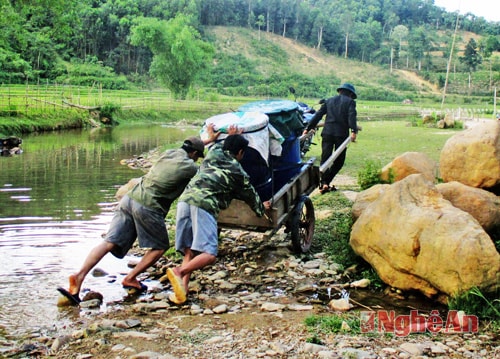 |
| The villagers of Khe Tín carry spring water home for their use. |
As summer arrives, even before dawn, the villagers of Khe Tin hamlet (Yen Khe commune, Con Cuong district) are already up fetching water for drinking. Up to 90% of households in the hamlet lack access to clean water. The sounds of motorbike engines, barrels, cans, and buckets clashing echo throughout the hamlet. At this time, no one can sleep anymore. From young children to the elderly, everyone is awake. A day in the "thirsty" village of Khe Tin begins like this.
In the past, when the forests were abundant, the streams and wells dug by the villagers were always full of water. However, for more than a decade now, the streams dry up in the summer, and the wells run dry, leaving Khe Tin in dire straits due to water shortages. The villagers have to travel far to fetch water from the Khe Luong stream, 5 kilometers away from the village. This stream used to be the largest in the region, but over the years, the forests have been cut down, and there are no longer trees to retain water, causing the stream to gradually dry up. Now, the Big Stream (the Thai name for the stream) is just a small stream. But it is the source of life for thousands of people in the surrounding villages.
Unable to fetch water in the morning due to tending his tea garden, at 2 PM, in the sweltering heat of the summer, Mr. Nguyen Dinh Dung and two neighbors loaded three barrels onto a handcart to fetch water from the stream. It took considerable effort for this group of strong young men to push the barrel out of the stream. Afterward, the barrel was attached to the back of a motorbike to create a makeshift handcart. Mr. Dung explained that for decades, every summer, the villagers have faced a shortage of water. Droughts have caused all the wells in the village to dry up, forcing people to fetch water from the Khe Luong stream. However, recently, the stream has also become increasingly polluted due to people living nearby bathing and washing clothes directly in the stream, and cattle roaming freely in the water, contaminating the water source.
In Khe Tin village, the shortage of clean water lasts for about 3-4 months each year, from May to July or August. Initially, villagers would go to wells in the village that still had water to ask for it, even having to pay for it. But then the wells in the village gradually dried up. Since they couldn't buy water anymore, they had to fetch this dirty water from the stream, filter it, and use it. During the hot season, each family needs two laborers to fetch water, leaving no time for other tasks.
Mr. Nguyen Dinh Hien, head of Khe Tin village, said: During the hot season, if there is no rain for about a week, all the wells dug by the villagers run dry. For both daily use, bathing, washing clothes, and drinking water for livestock, each household has to transport water 2-3 times a day to have enough. Many families, lacking sufficient water for their livestock, have had to sell off their buffaloes, cows, and pigs when the hot season arrives. In the village, more than half of the 30 hectares of tea plantations are in dire straits due to a lack of irrigation water. Besides drinking water, each week households with children attending the kindergarten have to contribute two 20-liter containers of water for the children's daily needs.
Besides Khe Tin village, Trung Yen, Trung Thanh, and Trung Huong villages, with a total of over 1,000 inhabitants, also face the same water shortage. Trung Chinh village, being closer to the spring source, is less affected.
More than 10 years ago, a gravity-fed water system was built to serve the people of Yen Khe commune. However, after a while, the system deteriorated and was abandoned. Even now, the empty tanks and rusty pipes remain exposed to the rain and sun. This situation is partly due to the poor awareness of the people in using and protecting public facilities in the upstream villages. Many households have independently drilled their own water pipes, causing water loss. The people in these "thirsty" villages in the heart of the mountains still long for a clean water system. Mr. Nguyen Dinh Dung shared: "Perhaps now the people here truly understand the importance of gravity-fed water systems, which many people previously tried to destroy. Hopefully, if a new water pipeline is built and installed in the future, people will be more conscious of preserving public property. Having to fetch water like this in the summer is extremely difficult."
Huu Vi


