
When the acacia tree "takes root"
(Baonghean) - Although acacia trees have been present in Con Cuong for 15 years, it is only in recent years that they have truly taken root in this land. Seeing the benefits from this species, the local people have decided to commit to it and consider it one of their main crops…
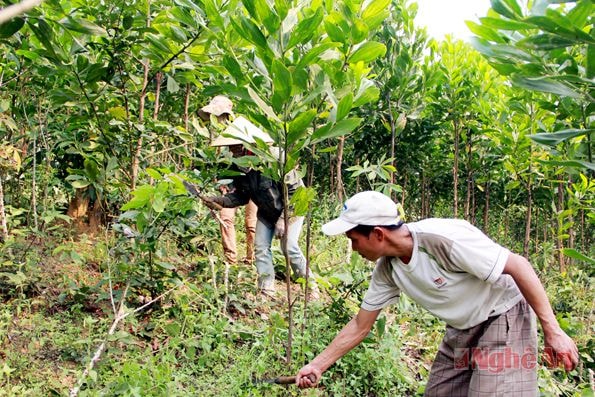 |
| Farmers in Mau Duc commune (Con Cuong district) are pruning their acacia plantations. |
Anyone traveling along the Mau Duc - Binh Chuan inter-communal road (Con Cuong district) will witness vast acacia forests, bringing vibrant green to hills previously barren. We visited the acacia forest of Mr. Vi Van Anh in Na Duoi village (Mau Duc district). He and his wife were thinning their acacia trees, about one year old. Seeing us approach and asking questions, the husband stopped and happily replied: “This is the second batch of acacia trees my family has planted; the first was harvested over a year ago. Now, even without government support for money and seedlings, my wife and I decided to invest our own money in planting. The previous batch, despite not receiving much investment in time, effort, and costs, yielded 120 million VND, a considerable sum for farmers in remote areas. This batch will certainly have a higher yield, and our income will increase because we've invested more.” The acacia forest owned by Mr. and Mrs. Anh covers an area of about 4 hectares and is currently thriving thanks to proper technical care, promising to generate a considerable income within the next 4-5 years.
Not far from the acacia forest of Vi Van Anh and his wife is the more than 4-hectare acacia forest of Loc Vinh Tai. This is also the second crop of acacia trees that Mr. Tai has carefully and meticulously cared for, as it is the main crop of his family. After more than 5 years, his family harvested over 100 million VND from the previous crop, which helped renovate their house, buy some amenities for daily life, and support their children's education. The remaining money was reinvested by Mr. and Mrs. Loc Vinh Tai to further develop their acacia plantation. Currently, the second crop of acacia trees is taller than a person and thriving.
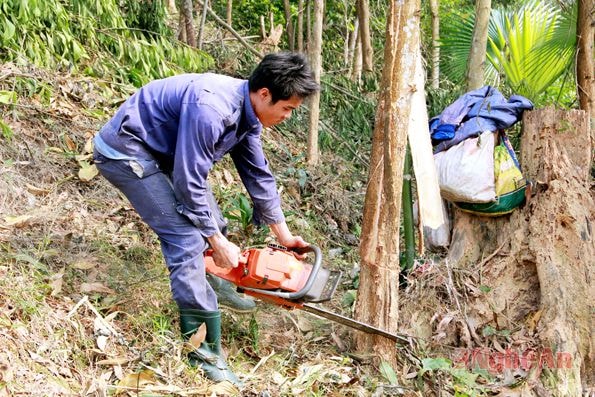 |
| Acacia harvesting in Mau Duc commune (Con Cuong district) |
In a conversation with Mr. Ngan Van Duong, Vice Chairman of the People's Committee of Mau Duc commune, we learned that many households in Mau Duc have large areas of acacia trees, like Mr. Anh and Mr. Tai. Some households have even larger areas, such as Mr. Lang Van Hai and Mr. Lang Thanh Doai (Ke Sung village), with some households expanding their acacia plantations to 8-10 hectares. Currently, Mau Duc is one of the communes with the largest acacia plantation area in the entire district. Acacia trees have contributed to changing the lives of farmers, helping many households escape poverty and become wealthy. More importantly, it has helped farmers change their perception of crop structure and fostered a sense of self-reliance, preventing them from relying solely on government support policies.
Many people still vividly remember the arrival of acacia trees in Mau Duc around 2003. At that time, the people weren't particularly enthusiastic about this type of raw material tree, planting them only as a trend because the government provided support in terms of seedlings, fertilizers, and labor. In subsequent years, Mau Duc continued to receive several projects to expand acacia cultivation, and farmers continued to receive support when participating in acacia planting. In 2008, the first acacia crop was harvested, and despite minimal investment in care, some households still earned a considerable income. From then on, the Thai ethnic people in Mau Duc began to have a different perspective on acacia as a raw material. The area planted with acacia trees has continuously increased rapidly; in 2012, the entire commune had only 260 hectares, but by 2015, this number had reached 2,700 hectares, and the goal is to have acacia trees cover the entire area of land used for raw material cultivation by 2020.
From Mau Duc, we continued north to Chau Khe, also one of the communes with the largest area of acacia trees in the district. We stopped in Chau Son village, where the majority of the Dan Lai ethnic group lives, and heard many stories from the locals about escaping poverty and prospering thanks to acacia trees. First, there was the story of Mr. La Van Lieu's family, who more than 10 years ago were among the poorest in the village. His wife and children spent their days in the forest cutting bamboo, gathering firewood, or collecting honey to sell to earn money to buy rice. On rainy days, the whole family had to go to the market to buy rice on credit or borrow money to have something to eat. Then, the government implemented a policy to support reforestation and the development of acacia tree plantations, and Mr. Lieu's family decided to receive forest land to plant the raw material trees.
To date, he has harvested his first crop of acacia trees several years ago, earning approximately 100 million VND. With additional loans, he built a new, fairly spacious and well-equipped house. Currently, the second crop of acacia trees is developing well and will be ready for harvest in a few years, promising even higher yields. If he sells them at a good price, Mr. Lieu's family will earn hundreds of millions of VND more. The people of Dan Lai in Chau Son village also talk about the families of Mr. La Van Thuyet, Mr. La Van Thanh, and Mr. Tran Van Thang... They share a commonality: their families were very poor before, but thanks to developing and expanding their acacia plantations, they now have enough to eat and save, have built spacious houses, and bought motorbikes and refrigerators.
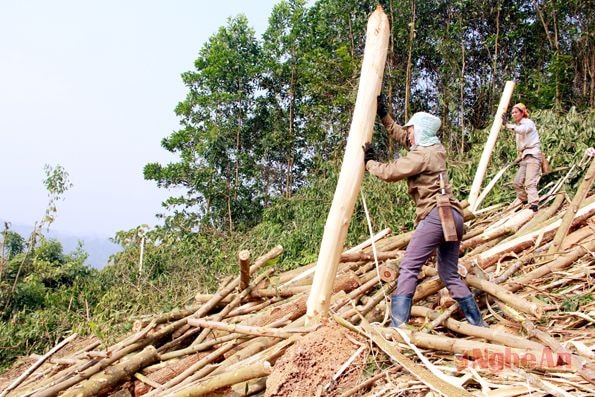 |
| Transporting raw acacia wood after harvesting. |
Mr. Nguyen Ngoc Luyen, Vice Chairman of the Chau Khe Commune People's Committee, said: "Along with the bamboo tree, acacia is considered a main crop for farmers. Although prices sometimes drop, the current price is still not high, and we believe that acacia trees still bring economic benefits because they are suitable for the local soil conditions and hilly terrain." Currently, Chau Khe commune has over 600 hectares of acacia, of which about 400 hectares belong to the project to replace slash-and-burn farming in the two border villages of Khe Bu and Khe Na. Thus, the Thai and Dan Lai ethnic minorities in these two villages have basically switched from growing rice and corn to growing acacia for raw materials, which is both economically valuable and environmentally friendly. Not to mention, Chau Khe currently has about 400 hectares of forest land that are about to be replanted, with acacia for raw materials playing a key role. It can be affirmed that acacia has an important position in the forests of Chau Khe, and is chosen by farmers as the main crop.
Not only in Mau Duc and Chau Khe communes, but also in other communes such as Chi Khe, Thach Ngan, and Luc Da, acacia trees still dominate the development of forest plantations. In an interview with us, Mr. Nguyen Khac Sy, Head of the Agriculture and Rural Development Department of Con Cuong district, affirmed: “Previously, acacia trees were not given much attention by farmers, but now they have established their position. Currently, no other crop has brought the same economic benefits as acacia trees. In the last 5-7 years, many households have escaped poverty thanks to this type of tree. We haven't yet compiled complete and accurate statistics on the area planted with acacia trees, but we can confirm that this type of tree accounts for a large portion of the total planted area, changing the perception of most farmers.” Besides its economic value, expanding the area planted with acacia trees also increases forest cover, balances the ecosystem, and ensures a living environment for humans and other species.
Acacia trees are taking root in Con Cuong. The important thing is to have a rational plan that ensures a stable market for the timber so that local people can feel secure in developing forest plantations.
Tuong Anh - Ho Phuong


