
when businesses partner with farmers
(Baonghean) - In the linkage between the four stakeholders (farmers, scientists, businesses, and the State), farmers and businesses play a decisive role, as this linkage aims to strengthen close coordination between production and consumption. Especially in the current context, agricultural production is increasingly developing towards improving quality and large-scale production to create goods, and since it is a commodity production, a linkage between producers and businesses is essential.
Recently, the link between farmers and businesses has improved somewhat through contracts for building large-scale model fields or establishing specialized areas for cultivating raw materials to serve the processing industries of factories producing sugar, tea, pineapple, cassava starch, etc. However, not all businesses and production facilities maintain a loyal and consistent partnership. Situations of bumper harvests leading to price drops, where businesses pressure farmers to buy products at low prices, have occurred, such as at the Nghe An Tate&Lyle Sugar Factory (Quy Hop) and the Concentrated Pineapple Juice Factory (Quynh Chau)... Conversely, when harvests are poor but prices are high, many production facilities pressure businesses to buy at excessively high prices and even sell their products on the free market to other traders, unilaterally canceling the contracts agreed upon by both parties. This is a situation that has occurred recently, resulting in no benefit for either side.
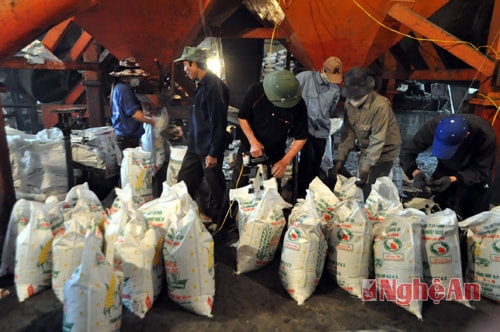 |
| Fertilizer production at Nghe An Agricultural Materials Joint Stock Company. Photo: Mai Hoa |
Learning from that experience, in recent years, especially in 2013, the linkage between businesses and production facilities has been improved through more specific and stringent contracts, ensuring the long-term interests of each party, thus leading to better contract implementation.
In the rice production sector, the link between farmers and businesses is even more crucial. Although Nghe An is not yet a rice-exporting province like some provinces in the Mekong Delta or Red River Delta, Nghe An already has a surplus of rice, with some being sold on the free market in many provinces, including exporting to China through informal channels. Therefore, rice production in Nghe An urgently needs a linkage between four stakeholders, especially two: farmers and businesses, to invest in production and product distribution through the establishment of value chains.
Recently, several businesses have actually partnered with farmers through investment contracts in production and product procurement. The Nghe An Agricultural Materials Corporation is a pioneer in signing contracts with many agricultural service cooperatives in Nghe An and Ha Tinh provinces over two years (2012 and 2013). The corporation invests in and advances farmers seeds and fertilizers according to guided production processes, and provides intensive farming training to participating households. At the end of each production season, the corporation buys back the produce from the high-yield rice fields at a price 10% higher than the free market price at the time of purchase. As a result of the last rice crop, over 1,000 tons were purchased, and a larger quantity is expected in the upcoming summer-autumn crop.
Along with the Nghe An Agricultural Materials Joint Stock Corporation, there is also Vinh Hoa One-Member Limited Company (referred to as Vinh Hoa Company) in Yen Thanh. This company specializes in trading high-quality rice seeds and purchasing the harvested product from farmers. Vinh Hoa Company's high-quality AC5 rice seed product has been certified as "Nghe An rice" by the Vietnam Intellectual Property Office. Using this rice variety and the "Nghe An rice" brand, Vinh Hoa Company has signed contracts with dozens of agricultural service cooperatives in Nghe An and Ha Tinh provinces to cultivate thousands of hectares of AC5 rice. In recent years, the exclusive distribution of the AC5 rice variety nationwide has continuously enhanced the competitiveness of "Nghe An rice" in the market.
In 2011, Vinh Hoa Company officially launched the "Nghe An rice" brand in the northern provinces, mainly Hanoi, with the amount of paddy rice purchased at that time being only 600 tons, equivalent to 390 tons of milled rice. In 2012, the company decided to expand its network of partnerships with agricultural service cooperatives to produce and purchase AC5 rice varieties on thousands of hectares. However, by the end of 2012, the company had only managed to purchase 1,700 tons of paddy, equivalent to 1,100 tons of milled rice, mainly supplying cities such as Hanoi, Nam Dinh, Hai Phong, Thanh Hoa, Vinh, and Hue… By 2013, the demand for "Nghe An rice" suddenly increased through orders from cities and provinces in the North, including Ho Chi Minh City, with hundreds of tons of rice ordered by Hat Ngoc Company. This was to meet the consumption needs of the city and also to be exported to the US for marketing and product introduction.
This year, Vinh Hoa Company purchased rice from farmers at prices ranging from 7,200 VND/kg at the beginning of the harvest season to 7,600 VND/kg at the end of the harvest season. According to Mr. Phan Van Hoa, the company's director, this price is 30% higher than the general market price, allowing farmers to profit 50% of their total production costs. Meanwhile, the company mills the purchased rice and sells it to partners at 14,000 VND/kg. The net profit after deducting all costs from purchasing, transportation, milling, bank loan interest, and worker wages is almost negligible, or even just breaking even. So why, despite the lack of profit, does the company still buy rice from farmers at such high prices?
In the spring of 2013 alone, Vinh Hoa Company purchased 11,200 tons of rice, and according to Mr. Phan Van Hoa, the company's director, almost all of it has been sold after milling. The reason the company bought AC5 rice at such a high price was to increase farmers' income, encouraging them to continue planting more AC5 rice in the following season. Meanwhile, in the spring and summer-autumn seasons of 2013, Vinh Hoa Company sold 450 tons of AC5 seeds for planting on over 15,000 hectares of rice, earning an estimated profit of 8-9 billion VND. Thus, the value chain of producing high-quality AC5 rice, branded as "Nghe An rice," will be shared through farmers selling their rice at a high price and the company expanding its production area to profit from seed sales. Therefore, mutual benefit is essential for the sustainable existence and development of production and business. This approach by Vinh Hoa Company is truly commendable and should be encouraged by many other businesses currently operating in the agricultural production sector.
Doan Tri Tue


