
When farmers receive support
Each year, Quynh Luu allocates approximately 1 billion VND to invest in activities transferring science and technology to farmers, supporting the development of small-scale industries, trade, services, and agriculture using scientific and technological advancements. Quynh Luu's approach involves seeking out successful economic models and groundbreaking initiatives that lead to legitimate wealth creation among farmers, then investing a portion of the funds in them, encouraging them to move forward and create a strong ripple effect…
(Baonghean)Each year, Quynh Luu allocates approximately 1 billion VND to invest in activities transferring science and technology to farmers, supporting the development of small-scale industries, trade, services, and agriculture using scientific and technological advancements. Quynh Luu's approach involves seeking out successful economic models and groundbreaking initiatives that lead to legitimate wealth creation among farmers, then investing a portion of the funds in them, encouraging them to move forward and create a strong ripple effect…
In the midst of the vast rice fields of Hamlet 4, Quynh Doi Commune, Quynh Luu District, stands out the farm of Mr. Ho Tat Qui, raising lean foreign breed pigs, cattle, fish, and birds. The farm, though only about 3,500 square meters, is scientifically and hygienically arranged, with interconnected fish ponds, livestock pens, and fruit orchards. Mr. Qui and his workers are busy feeding the pigs and cattle. 200 pigs (150 fattening pigs, 20 sows, 30 piglets) and 19 beef cattle consume approximately 350 kg of feed per day, costing nearly 5 million VND. In addition, there are tasks like bathing and cleaning the pens, making the work very strenuous.
He said that the total investment in the farm to date is over 2 billion VND, including over 600 million VND borrowed from banks, loans from relatives, and especially 100 million VND in support from the Science and Technology Fund, of which Quynh Luu district contributed 60 million VND. Starting the farm in 2011, Mr. Qui studied the experience in Yen Bai, following the model of a joint-stock company (Thailand), investing on an industrial scale according to guidelines, ensuring procedures for disease prevention and environmental protection. In addition to financial support, Quynh Luu district also sent agricultural extension officers and science and technology officers to encourage and provide additional technical support.
To date, after more than two years, the farm has generated income with an annual pork production of 40 tons. In the first six months of 2013, he sold 15 tons of pork, in addition to selling breeding pigs, fish, bananas, gourds, pumpkins, etc., gradually earning enough income to pay off investment debts and labor costs on the farm. Each year, after deducting expenses, the farm earns a profit of nearly 200 million VND. This is currently a large-scale lean pork farming model in Quynh Luu, applying the correct technical process for raising lean pigs with biosafety according to VietGAP standards. Besides developing the economy, it also provides a good source of breeding stock to meet the needs of the district and creates jobs for 3-4 workers.
Meanwhile, the family of Mr. Nguyen Van Dam, in Hamlet 8, Quynh Hau, decided to invest in a medicinal herb garden on their rice paddy land. After researching market demand and realizing that medicinal herbs were highly valued, they invested money, effort, and research into the technical process to cultivate a garden of medicinal herbs including Angelica sinensis, Gymnema sylvestre (for treating diabetes), and Lonicera japonica (for treating liver and gallbladder diseases). The garden, covering 5,000 square meters, was planted in January 2013. Currently, the medicinal plants are thriving; the Angelica sinensis has produced many tubers and is expected to be harvested at the end of 2013, while the Lonicera japonica is already ready for harvest.
Mr. Tuan, son of Mr. Nguyen Van Dam, said: Honeysuckle flowers are currently being purchased by the Institute of Medicinal Materials at 1 million VND/kg, while Angelica sinensis, which regulates qi and nourishes blood, is known as "female" ginseng and is used in cosmetics or as a blood tonic for women, currently having significant economic value. Mr. Dam's family invested nearly 200 million VND in their medicinal herb garden, of which 60 million VND was provided by Quynh Luu district through the industrial park development program. They expect to earn at least 400 million VND after harvest.
Quynh Bang, Quynh Lien, and Quynh Luong are famous vegetable-growing areas in Quynh Luu district (now Quynh Lien and Quynh Luong are part of Hoang Mai town). For decades, vegetables have brought prosperity and happiness to the people here. Although the government has invested in underground wells and electricity to the fields, the harsh weather and high water requirements of the vegetables have led the farmers in Quynh Luu to develop an innovative automatic irrigation system that mimics natural rain. Starting in Quynh Lien, this movement has since spread to Quynh Luong and Quynh Bang.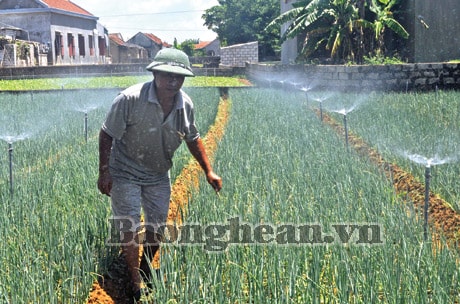
Automatic irrigation system for vegetables in Quynh Bang commune, Quynh Luu district.
Mr. Ho Ba Thuan from Tan Hai hamlet, Quynh Bang commune, said: “My family has installed a semi-automatic sprinkler system for 5 acres of vegetables, mainly spring onions and sweet cabbage. These are two types of vegetables that need a lot of water. Before, my wife and I spent all day in the sun watering them. Now, we just sit inside and plug in the switch, and the water sprays like rain, soaking evenly from the leaves to the ground. I can smoke my pipe and drink tea comfortably.”
The system operates on the principle that water is drawn from the well through main pipes, then channeled from the main pipes to irrigation points where sprinkler nozzles are installed. When water sprays forcefully from the nozzles, a steel bar blocks the spray head above, causing the water to splash in all directions. Mr. Thuan also stated that the investment in the irrigation system cost 10 million dong, but vegetable yields increased by 30%, and significantly improved working conditions for the whole family. Thanks to the vegetable farming, Mr. Thuan's family was able to build a spacious three-room house, and his children received a good education and found stable jobs.
Mr. Ho Dang Nang, whose house is next door, also installed a semi-automatic irrigation system for his 3 sao (approximately 0.3 hectares) of vegetables at a cost of 5 million VND. Mr. Nang said: "My family's income mainly comes from vegetables because we don't have rice fields. After many years of hard work, now that we have an irrigation system, my wife and I have time to rest. We're also happy that traders come directly to the garden to buy vegetables, so we don't have to go to the market at night like before. We earn about 60 million VND per year from vegetables." Thus, from the model of investment and support for science and technology in Quynh Lien, the semi-automatic vegetable irrigation system has now spread to many communes with hundreds of households investing in it, bringing great benefits.
In 2012, the Quỳnh Lưu district government paid strong attention to identifying and supporting exemplary models of wealth creation in the communes, as well as developing new science and technology models. The district allocated 1.1 billion VND to support science and technology for models with breakthrough potential.
Notable examples of projects supported by the district include: building the brand of Nui Do bottled water for Lien Thanh Joint Stock Company in Quynh Lap commune (50 million VND); supporting the brand building of Hanh Huong Phu Loi 2 - Quynh Di seafood products (30 million VND); supporting the website and brand building of Hong Phu Quynh Hong ornamental flower and plant village (40 million VND); supporting a 100m2 cold storage model for preserving seafood products for Mr. Nguyen Chi Chinh, Hong Phong village, Quynh Phuong (100 million VND); supporting a bio-secure pig farming model following VietGAP standards for 200 pigs for Mr. Ho Tat Quy, hamlet 4, Quynh Doi (60 million VND); supporting the development of bio-secure intensive whiteleg shrimp farming following VietGAP standards on 0.5 hectares in Quynh Bang (60 million VND); breeding and raising pheasants for breeding and commercial purposes with 20 parent pairs in hamlet 4, Quynh Minh; and raising Ben Tre clams for commercial purposes on 0.5 hectares for Ms. To Thi Luong, hamlet 8, Quynh Thuan. Planting asparagus in Tan Son for 50 million VND; producing bottled fermented fish sauce in Phu Loi 2 for Mr. Tran Thanh Hung - Quynh Di for 35 million VND; supporting 40 million VND for planting 1 hectare of Centella asiatica for Mr. Bui Duy Hop, Hamlet 7, Quynh Trang.
Earlier in 2011, Quynh Luu also supported dozens of poverty alleviation and wealth creation models, such as: 6 e-commerce websites, 6 vocational training and technology transfer models, and support for 22 science and technology models in communes, each model receiving between 25 and 100 million VND.
Effective initiatives include the Hoang Van Duong model for processing fermented shrimp paste in Hamlet 5, Quynh Lien (25 million VND), the commercial snail farming and breeding model for Mr. Nguyen Ngoc Minh in Dong Tam Hamlet, Quynh Thang; the commercial wild boar farming model in Quynh Vinh commune; the mushroom production model in Quynh Xuan commune (95 million VND); support for upgrading product storage cellars on fishing boats with Polyurethane (PU) insulation in Quynh Lap and Quynh Phuong communes (100 million VND); support for using biogas to power generators for household use in 5 households: Quynh Vinh, Mai Hung, Quynh Xuan, Hoang Mai, and Quynh Hau; the farming of fragrant snails in cages in earthen ponds in An Hoa; and the cultivation of high-end flowers such as Phalaenopsis orchids, gerberas, and Chinese roses in Quynh Hong commune. The district also supports communes in testing rice varieties resistant to rice planthoppers in Quynh Yen commune, supports a model for managing fruit flies on bitter melon plants in Tan Son commune, and supports the linkage of production and consumption of commercial vegetables in Tan Son commune…
In addition to investing in agriculture and forestry, science and technology activities in Quynh Luu district also support traditional craft villages, linked to the Industrial - Handicraft - Traditional Craft Village Development Plan for the period 2012-2020, supporting training in carpentry, rattan and bamboo weaving, and transferring technology for pressing heat-resistant roof tiles, etc.
Over the years, science and technology activities in Quynh Luu district have developed strongly both in breadth and depth, playing an important role in improving productivity, quality, and value of products, contributing to making Quynh Luu a district with a prominent mark in comparison with other districts. From 2005 to 2012, the district organized and implemented 300 models and projects applying scientific and technological advancements, including 144 models in the field of agriculture and 156 models in the fields of education, health, administrative reform, and the development of craft villages...
Chau Lan


