
When food in supermarkets is recycled!
(Baonghean) - For a long time, most consumers have believed that buying goods at supermarkets guarantees safety. However, recently, media reports about sausages, ham, meat, fish, jelly, and confectionery containing additives that are dangerous to consumers' health, as well as expired, unlabeled, and unidentifiable products, have caused customers to worry and feel concerned.
(Baonghean) - For a long time, most consumers have believed that buying goods at supermarkets guarantees safety. However, recently, media reports about sausages, ham, meat, fish, jelly, and confectionery containing additives that are dangerous to consumers' health, as well as expired, unlabeled, and unidentifiable products, have caused customers to worry and feel concerned.
In recent years, as economic conditions have improved, the demand for shopping at supermarkets has increased. The appearance of large supermarket brands such as Big C, Metro, Intimex... in Vinh City has made this convenient product distribution channel appealing to residents. The advantage of supermarkets is that customers can buy all kinds of goods they need in one place. Moreover, supermarkets are a modern sales channel, with attractive product displays and spaces, offering a wide variety of goods from fresh produce to processed foods, household goods, and more.
Big C supermarket is always crowded on weekends, even though the supermarket has arranged dozens of checkout counters, customers are always queuing for their turn. Ms. An from Nghi Phu commune shared: "Due to the nature of my work, I have very little time to go to the market. Taking advantage of the weekend, I go to the supermarket to buy all the food for my family to use for the whole week. I think the goods at the supermarket are safer in terms of food safety than those at the market, and the prices are also reasonable."
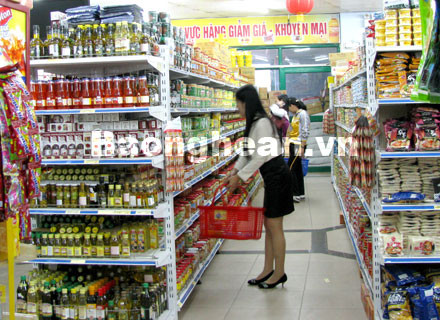
Be a smart consumer.
On the afternoon of February 14th, on my way home from work, I stopped at a large supermarket in Vinh City to buy groceries, including "smoked sausages" (200g pack of 4) priced at 36,000 VND. The packaging clearly stated an expiration date of February 17th, 2012. This meant the product was only 3 days away from expiring, and it was currently being sold at a 30% discount. There were still quite a few of these on the shelves, and in a nearby display case, several ready-to-eat processed foods such as chicken, pork, fish, and soup were on display, ready for customers to buy and eat on the spot. What was most noticeable was that this display case also sold smoked sausages, but they had been opened, no longer in their original manufacturer's packaging, and repackaged in a styrofoam dish wrapped in plastic, naturally without any labels or expiration dates. When I inquired about purchasing them, the salesperson informed me that a pack of 10 smoked sausages originally cost 85,000 VND, but was now discounted by 50% to 45,000 VND.
I hesitantly asked: "There are no labels here, is this product still within its expiration date?" Slightly flustered, the saleswoman replied: "We opened it when it was almost expired, don't worry, ma'am, the product is still good and safe. We have to sell it at a discounted price to recover our costs." Could the saleswoman's words be trusted, when a product nearing its expiration date is opened and resold under the guise of a "discount"?
That's just sausage. There are countless other products like chicken, pork, fish, shrimp, and processed meat products that can be recycled in a similar way. When fresh produce sells slowly, some supermarkets process it into ready-to-eat meals by cooking it with fragrant spices before selling it to customers. At this point, there's no way to know if the goods are still within their expiration date. Not to mention processed meat products like ham, sausage, and spring rolls, which can be repackaged with new labels after their expiration date. Not long ago, public outrage erupted when imported processed meat products at a large supermarket, after a long period of slow sales and expiration, were repackaged, cut into smaller pieces, and given a new life cycle. Consumers bear the consequences.
In a discussion with us on this issue, Mr. Nguyen Tai Dung, Deputy Director of the Department of Industry and Trade, stated: "For goods whose labels have been removed and are being 'recycled,' it is impossible to control product quality. With thousands of products sold in supermarkets, including hundreds of food products that require regular inspection and testing, this is very difficult to implement. Therefore, the method of checking product quality in supermarkets in the area is through legal regulations outlining the responsibilities of the supplier to the retailer (the supermarket)."
Furthermore, policy inadequacies allow supermarkets to easily circumvent the law. Due to the lack of mandatory regulations, many food items and fresh produce packaged directly in supermarkets do not require labels indicating the production date, packaging date, or even the expiration date. Decree 89/2006/ND-CP on product labeling, in Section 2, Article 5, clearly states: "Goods not required to be labeled are fresh, raw foods, processed foods without packaging, and sold directly to consumers." Despite this obvious inadequacy, the authorities are powerless to take action!
Mr. Dao Trong Dung, Head of the Provincial Food Safety and Hygiene Department, stated: There are currently 5 supermarkets selling food products in Vinh City. Each year, the provincial inter-agency inspection team conducts 3 regular inspections, in addition to surprise inspections regarding food traceability. In mid-2011, the Central Food Safety and Hygiene Department received information requesting the Department to oversee the recall and destruction of Taro jelly products from Newchoice Company containing dehp, a substance prohibited for use in food. In Vinh City, the Department has recalled and destroyed over 200 kg of Taro jelly sold at supermarkets and major distributors.
As for vegetables sold in supermarkets, the Sub-Department can only check the source of vegetables purchased by the supermarket from family A or B, and cannot determine whether the vegetables from that family are guaranteed to be free of pesticides. Ideally, until the authorities intervene, consumers should protect themselves by avoiding products without expiration dates, with faded expiration dates, or those with unclear origins.
Quynh Lan


