
"When Vietnam stands firm, China cannot encroach further."
.Major General Le Van Cuong, former Director of the Institute for Strategic Studies of the Ministry of Public Security, believes that our strength lies in our nearly 100 million patriotic people; when Vietnam
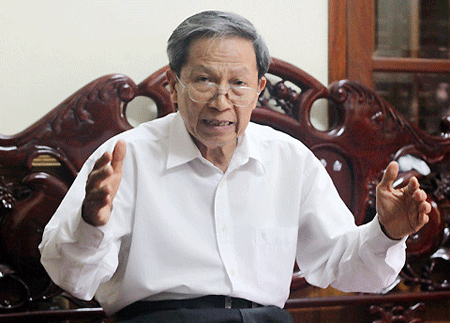
Major General Le Van Cuong
These are not the final figures for Chinese fishing vessels, but merely the initial numbers. Chinese fishing vessels with a tonnage of up to 3,000 tons will flood Vietnam's exclusive economic zone to demonstrate China's frequent and large presence in the South China Sea, implicitly turning Vietnamese waters into disputed territory and subsequently claiming them as its own.
China is gradually realizing its unjustified sovereignty and jurisdiction over the "nine-dash line" that it arbitrarily created with clear intentions. Knowing that our forces are still thin and our response is insufficient, China is therefore encroaching further.
Does China's establishment of the so-called "Sansha City" on Vietnam's Paracel Islands clearly demonstrate this ulterior motive?
This must be considered the second legally sanctioned invasion of our country by China. The first was in January 1979. This blatant invasion trampled on the United Nations Charter, went against the principle of peaceful coexistence between the two countries, and violated the 1982 United Nations Convention on the Law of the Sea.
We must have a strong voice to prevent China from encroaching further, just as if a robber comes to our house and tries to beat us under a blanket, we must shout loudly so that our neighbors know and come to our rescue. In many published articles, I have emphasized: "National sovereignty is sacred and inviolable."
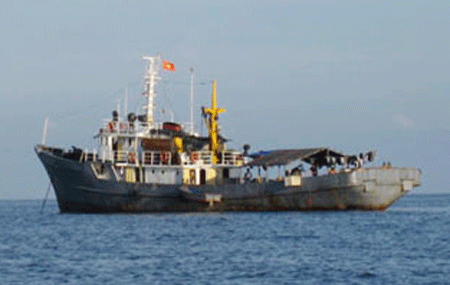
A Vietnamese fishing service vessel at Da Tay Island - Truong Sa (Spratly) Islands. Photo: Huynh Nga
The U.S. State Department announced on August 3rd that China's establishment of "Sansha City," including the deployment of military personnel, "runs counter to joint diplomatic efforts to resolve differences and risks escalating tensions in the region." What are your thoughts on this critical move by the U.S.?
The United States has expressed concern about the escalating tensions in the South China Sea, which could lead to conflict. China's aggressive and belligerent actions in recent years, beginning with the June 9, 2011 incident of cutting fiber optic cables in Vietnam's exclusive economic zone, are a cause for concern.
But most importantly, we must rely on our national strength and not allow China to encroach and do whatever it wants. The Vietnamese people.
To achieve this, that is, to protect our national sovereignty and territorial integrity, must we further strengthen our military power?
Even if China doesn't openly express such expansionist ambitions, Vietnam...
According to him, if ASEAN and China sign the Code of Conduct in the South China Sea (COC), will it resolve the disputes in the South China Sea?
First of all, the COC is still better than the DOC (Declaration of the Parties on the Conduct in the South China Sea) because it provides a basis for the world to condemn and for the international community to share a common voice. However, one should not place too much faith in the COC because even the 1982 United Nations Convention on the Law of the Sea is not respected by China. Additional binding provisions are needed to strengthen the argument and gain the support of a majority of well-intentioned countries in the region.
Establishing Vietnam's administrative boundaries at sea.
At the regular press conference on the afternoon of August 6th regarding the significance of ancient maps affirming Vietnam's sovereignty over Hoang Sa and Truong Sa in the modernization of administrative boundary records and maps according to Decision 513/QD-TTg dated May 2nd, 2012 of the Prime Minister approving the project "Completing the modernization of administrative boundary records and maps and building a database on administrative boundaries," Deputy Minister of Home Affairs Tran Anh Tuan stated that these are indeed very important documents in the struggle to protect territorial sovereignty.
According to Mr. Tran Anh Tuan, in implementing Decision 513, the Ministry of Interior, in coordination with the Ministry of Natural Resources and Environment, is conducting initial surveys and assessments. Regarding this, the Department of Local Government - Ministry of Interior stated that the first step of the project will be to reassess administrative boundaries in the East Sea and redefine administrative boundary disputes to gain the most comprehensive overview.
Based on the collected data, the previously existing administrative boundary records and maps will be revised. After approval, ministries and agencies will jointly disseminate this modernized administrative boundary record through various means so that people both domestically and internationally can better understand Vietnam's administrative boundaries.
According to NLĐ-M


