
2,000-year-old treasure found in the 'ancient Titanic'.
The Atlantis, often likened to the Titanic of ancient times, carried the oldest astronomical clock on Earth, along with many other precious treasures.
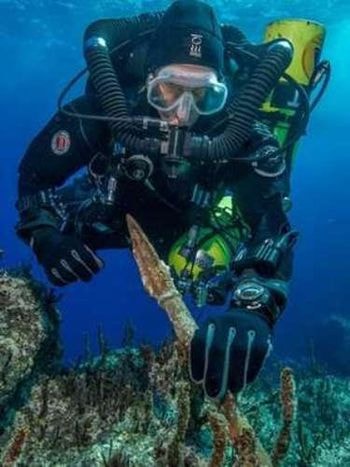 |
| The diver found a 2-meter-long spear, possibly from a statue. Photo: Live Science |
According to Live Science, Greek authorities have decided to extend the deadline by five years for international explorers to continue searching for the remains of the 2,085-year-old Antikythera shipwreck.
The ship was named after the sea region where it met with disaster around 70-60 BC, while traveling westward with countless treasures and goods from Minor in Asia to Rome.
During Phase I of the Return to Antikythera project (which ended in October 2014), underwater explorers found numerous sets of dishes, a main anchor, a massive bronze spear possibly part of a statue of a warrior or the goddess Athena, and many other valuable artifacts.
Thanks to the government's permission to extend the project, researchers will focus on previously surveyed sites to search for ceramic and metal artifacts. They hope to complete a detailed map of the shipwreck and recover valuable treasures from the vessel.
To prepare for phase two, which begins later this summer, scientists deployed an autonomous underwater vehicle (AUV) to survey the ship for 10 days. Recently, the AUV and metal detectors located numerous artifacts containing copper, lead, and iron. The AUV also approached the artifacts, taking photographs and collecting spatial data, including information about the relationships between the artifacts. Over the next five years, scientists will excavate sections of the Antikythera shipwreck.
Treasure discovered.
The Antikythera ship was discovered more than a century ago by fishermen from the island of Symi, Greece, while fishing for sponges off the coast of Antikythera, a small Greek island with a population of 45.
While diving, they accidentally discovered fragments of a ship. The diver retrieved the arm of a bronze statue from a depth of 40-50 meters on the seabed.
With the help of the Greek Ministry of Education and the navy, the sponge explorers discovered many ancient statues, including the hero Ulysses, Diomedes on horseback, Hermes, Apollo, and many other gods.
While analyzing these artifacts, the then Minister of Education, Spyridon Stais, discovered a device called the Antikythera Mechanism, which was actually an astronomical clock, considered to be the oldest analog computer on Earth.
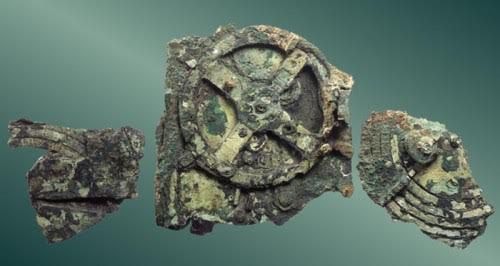 |
| The oldest computer on Earth. Photo: Live Science |
This device looks like a clock, but instead of hour and minute hands, its hands and knob indicate the rotation cycles of the planets, the date, and the timing of solar and lunar eclipses.
It tracked the paths of the Sun, Moon, and planets with astonishing accuracy. A Swiss writer once said it belonged to extraterrestrials. These treasures and artifacts are currently housed at the Archaeological Museum in Athens.
The Antikythera expedition began in 2012, a collaboration between the Greek Centre for Underwater Monuments Research and the Woods Hole Oceanographic Institution in Massachusetts, USA. The two institutions will continue their collaboration in the second phase with the assistance of the "Exosuit," a submersible provided by Woods Hole. Scientists describe it as Iron Man's suit of armor for underwater science.
At the end of Phase I, scientists had created a 3D map of the seabed and the ship. They also included areas with high concentrations of ferrous metals in the data. This data was then integrated into a Geographic Information System (GIS), which includes geographical data of the area dating back to 1900.
Researchers found two separate areas about 100 meters apart, which means the ship was broken in two when it hit the reef, or two ships shared the same fate.
"The evidence suggests this is the largest ancient shipwreck ever found," said Brendan Foley, an ocean archaeologist at the Woods Hole Institute. "It's truly the Titanic of antiquity."
The expedition uncovered a large number of valuable artifacts. “The Antikythera shipwreck helps us realize the diversity of goods it carried,” said Aggeliki Simosi, director of the Greek Center for Underwater Antiquities Research.
"This sunken ship is truly a floating museum," she said. The discovery of the ship confirms the existence of a trade route for valuables between countries in the eastern Mediterranean.
According to VnExpress


