
Difficult to implement
(Baonghean) On July 20th, the Ministry of Agriculture and Rural Development issued Circular No. 33/2012 regulating hygiene conditions and food safety for establishments trading in fresh meat and edible animal by-products used as food. The Circular takes effect from September 3rd, 2012. Following the issuance of the Circular, many public opinions have suggested that some of its provisions are impractical.
It's impossible to sell all the meat within 8 hours.
Investigating the markets in Vinh City, it was found that each pork vendor typically imports an average of 10-12 pigs, each weighing approximately 50-60 kg, daily to sell. Any meat not sold in the morning is stored in styrofoam containers filled with ice.
When asked about the regulation in Circular 33 that meat can only be sold for 8 hours at room temperature, Ms. Chung, a small trader at Hung Dung market with 12 years of experience in selling pork, said: "My stall sells the most, but it's impossible to sell 50-60 kg of meat in just 8 hours. We have to keep it on ice and sell it later in the day." When asked about the requirement for cold storage temperatures between 0-5 degrees Celsius, Ms. Chung said: "If the market management allows us to install freezers, we will comply immediately, because that is also our wish..."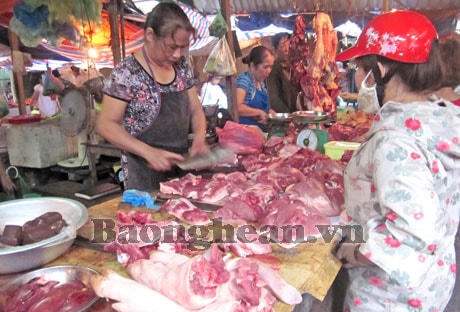
The stalls, with an area of only 2-3 square meters, are not suitable for placing freezers to preserve meat.
Regarding the feasibility of the regulation stipulating that meat can only be sold within 8 hours of slaughter, Mr. Tran Minh Hanh, Deputy Head of the Veterinary Department, stated: "If this can be implemented, it would be excellent, because in reality, fresh meat decomposes after 8 hours at room temperature. However, to properly implement the regulation, we need coordinated efforts from other specialized agencies and, above all, a policy in place to carry it out."
In reality, preservation is difficult to control, and quarantine is also very challenging. Veterinary authorities only inspect and stamp each finished pig early in the morning. Once the pig is cut into smaller pieces, customers cannot tell whether the meat they choose has been quarantined or not. Mr. Hanh added: "Currently, there are more than 30 licensed centralized slaughterhouses operating in the province. Despite the best efforts of veterinary officers, we still cannot ensure complete quarantine and stamping coverage. So how can we have the mechanisms and personnel to quarantine these slaughterhouses? We can't even manage the number of slaughterhouses." On the other hand, a small trader said: "Early in the morning, before customers arrive, veterinary officers come to the market to stamp the meat after we have received the goods." Thus, even the stamping itself is not in accordance with quarantine regulations and is merely a formality. A retail market in the city consumes about 600-700 kg of meat per day. Vinh has over 20 retail markets, but only more than 10 slaughterhouses in the city. Retail traders also stated that they do not source their goods from centralized slaughterhouses or from informal slaughterhouses. Furthermore, the Circular stipulates that those who slaughter, transport, and sell meat must have a health certificate. Ms. Thuy from Quang Trung market said: “I’ve been selling beef at this market for over 15 years, and no authorities have ever asked for those health certificates. If they fine me for not having a health certificate, then they should fine all the meat sellers at this market…”
Therefore, if the regulations in the circular are difficult to implement thoroughly in practice, will the relevant authorities have sufficient sanctions to enforce them once the circular comes into effect?
There needs to be a synchronization of responsibilities, sanctions, and competency requirements.
When asked about the regulations in the upcoming circular, traders at Hung Dung Market (Vinh City) said that if penalties are imposed, it will disrupt people's lives. Furthermore, authorities do not yet have the equipment to identify fresh meat that has been slaughtered for more than 8 hours. The authorities also lack sufficient personnel to conduct daily inspections in every location, and it is even more impossible to inspect all rural markets and informal trading points in alleyways.
Regarding this issue, Mr. Hanh also stated: "In reality, the spirit of the Circular has been and is being implemented, but when conducting inspections, we can only rely on our senses, such as examining the color of the meat of the slaughtered animal, the 'stickiness' of the meat, and checking by smell. When the regulations in the Circular come into effect, we need to be equipped with equipment to achieve high accuracy; only then will the penalties be convincing..."
Currently, the Veterinary Department has developed a plan for 2020 and proposed that the Provincial People's Committee allocate funds to the districts, plan the locations for market construction, and establish policies and mechanisms for slaughterhouses. With a comprehensive policy and mechanism in place, those who fail to comply can be dealt with immediately. Currently, Decree 40 on ensuring food safety and hygiene has set out penalties, but enforcement is not difficult because in reality, nearly 90% "violate the law." If strictly enforced, fines could reach 1 billion VND per day.
To properly implement the Circular, close cooperation and collaboration between the government and specialized agencies at all levels are necessary. The Circular is currently undergoing revision, therefore, consultation with specialized agencies is needed, along with the coordinated efforts of all levels of government, and a significant change in the trading practices and habits of the people is required.
Thanh Nga


