
The steel industry is facing numerous challenges.
A sluggish market, high inventory levels, coupled with intense price competition, the dominance of imported goods, and a lack of working capital, are causing domestic steel businesses to struggle.
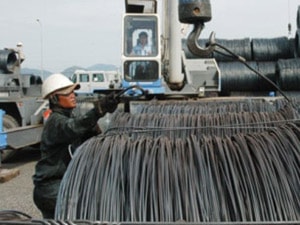
Steel is piled high in the yard of a Vietnamese steel plant in Ba Ria - Vung Tau province.
Intense competitive pressure
According to the Ministry of Construction, the total steel production of the entire industry last month reached approximately 270,000 tons, an increase of 13,000 tons compared to the previous month but a decrease of 80,000 tons (20%) compared to the same period last year. Steel inventory currently stands at around 330,000-350,000 tons, an increase of 50,000 tons compared to the same period last year. Meanwhile, according to data from the General Department of Customs, steel imports to date have reached 800,000 tons, a decrease of 11.6% compared to the same period in 2012. Although reduced, the amount of imported steel remains quite high compared to domestic steel production and consumption.
Several steel manufacturers and businesses in Vietnam have reported that a large quantity of Chinese alloy steel imported into Vietnam has been "disguised" as construction steel to benefit from a 0% tariff rate, then sold at prices lower than domestic construction steel prices, putting significant pressure on domestic producers. Furthermore, Chinese companies always have a large surplus of steel readily available in Vietnam at low prices, requiring buyers to deposit only 10%-30% for deferred payment. Meanwhile, to date, steel businesses have not been able to access low-interest loans, nor have they seen any impact on improving domestic market demand for steel products. “The real estate market remains sluggish, with almost no new projects being launched, even since the announcement of preferential loan packages for social housing projects. Therefore, despite steel companies implementing various measures to stimulate demand, they are still unable to sell their products,” said Mr. Ho Van Bao, Director of Bao Hoang Private Enterprise, a steel trading company on National Highway 22, District 12, Ho Chi Minh City. Faced with this situation, many steel companies have launched price reduction strategies to compete. In May alone, numerous companies had to lower their prices up to three times, to below cost, but the situation has not improved.
The steel industry is also facing a series of challenges due to anti-dumping duties imposed on Vietnamese steel exports by several countries in the Americas and Europe. Many countries have also implemented cumbersome and time-consuming procedures to restrict imports with the aim of protecting domestic businesses.
Product defense
A recent assessment by the Vietnam Steel Association (VSA) indicates that the biggest challenges and weaknesses of the steel industry today are limited capital, reliance primarily on loans, dependence on imported billets for raw materials, and outdated technology... leading to high production costs and consequently weak competitiveness.
According to statistics, nearly 30% of steel companies currently use outdated technology, and over 40% use average technology. Only about 30% use advanced and modern technology. Therefore, to survive, businesses need to gradually phase out outdated technologies due to rising energy prices, progressively improve production technology, reduce production costs, and increase competitiveness. These are practical solutions for both the present and the long term.
Furthermore, the steel industry needs to increase its investment capacity in steel billet production to enhance its self-sufficiency in raw materials and reduce dependence on imports. Regarding finance, steel companies report that although input interest rates are gradually decreasing, difficult access to capital has hampered business operations for many enterprises, especially small and medium-sized enterprises (SMEs). Many of these are in the steel industry. A recent survey shows that only 20% of SMEs have access to formal credit. To address the financial challenges facing the steel industry, Mr. Do Duy Thai, Chairman of the Board of Directors of Pomina Steel Company, believes that medium-term interest rates from banks need to continue to fall to have a significant impact on the industry's growth. He points out that recent times have shown domestic steel companies operating at a loss, while foreign companies thrive due to abundant financial resources, particularly the support they receive from their governments through low-interest loans.
According to VSA Chairman Pham Chi Cuong, in addition to support measures from the Government and ministries such as interest rate reductions and creating a healthy competitive environment, steel businesses must minimize costs, avoid excessive production leading to large inventories, and balance supply and demand appropriately. Furthermore, businesses should closely monitor market developments, develop flexible monthly and quarterly plans to suit market conditions, and focus on managing product output through the development of a distribution system. Emphasis should be placed on building strong relationships with distributors, such as supporting dealers in enhancing brand promotion, organizing regional customer conferences, and implementing flexible and transparently controlled market pricing policies. Businesses also need to stay updated on information, prepare, and implement safeguards for their products.
The Vietnam Steel Corporation (VSA) reported that its steel production and consumption from the beginning of the year to date reached approximately 500,000 tons, a decrease of 13.7% compared to the same period last year. Of this, construction steel is estimated at around 466,000 tons, a decrease of 14.7% compared to 2012. According to the VSA, the reasons for the sluggish steel market, besides the frozen real estate market, include pressure from the continued import of cheap Chinese steel into Vietnam.
According to SGGP – PH


