
It's difficult to find workers to harvest fallen acacia trees after the storm.
(Baonghean.vn) - Over 500 hectares of acacia trees in Thanh Chuong have been broken and fallen, and local households are rushing to harvest them, but the labor costs are almost equal to the purchase price of the acacia wood.
For more than 10 days now, many families in the mountainous region of Thanh Chuong have been harvesting fallen acacia trees themselves. Hiring workers after the storm is difficult and expensive, because there is a large amount of fallen acacia wood, and every plantation owner wants to harvest it quickly to sell it, as it will be unsaleable if left to dry out.
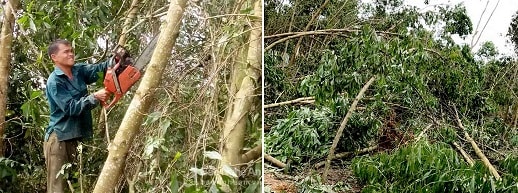 |
| Harvesting acacia trees in Thanh Lam - Thanh Chuong. Photo: Dinh Ha |
Mr. Kha Van Tam, from Ban Nhan Pa village, Ngoc Lam commune, is a rubber tree harvester, and the past few days have been the busiest time. His group consists of 12 people, both men and women. The group has one chainsaw for cutting the rubber trees, while other tasks such as peeling, carrying, and gathering are done manually. The work is hard, but on average, each person earns 200,000 to 300,000 VND per day.
The difficulty in this harvest lies in selective harvesting, as the acacia trees in some areas are not yet mature enough for harvesting. Therefore, the labor costs are higher than for a large-scale harvest.
Mr. Ngu Van Tham, the owner of a timber purchasing facility in Hamlet 10, Thanh Huong Commune, normally buys about 20 tons of timber, but these days he can buy over 100 tons. Mr. Tham said, "Many families have asked us to send workers to cut and clear the timber, but we can't meet the demand. Therefore, most households have to hire people and equipment to harvest the broken timber, but the labor costs are high..."
"The timber forest suffered damage exceeding 350 billion VND due to falling trees."
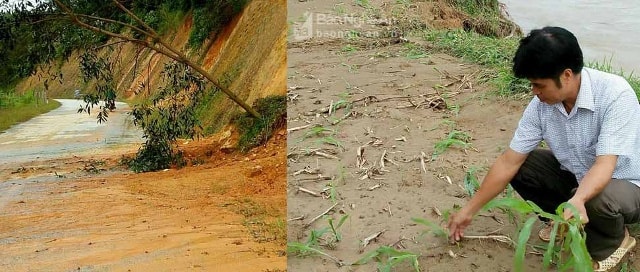 |
| Flash floods caused damage after the storm in Thanh Chuong. Photo: Dinh Ha. |
While residents were urgently dealing with the aftermath of Typhoon No. 2, the Lam River in Thanh Chuong district rose, causing localized flooding in several hamlets. More dangerously, flash floods occurred in Ngoc Lam commune, damaging over 50 fish ponds, 20 hectares of corn and cassava crops, and 10 hectares of tea plantations.
Dinh Ha
| RELATED NEWS |
|---|


