
Not grading first-grade students is a sound policy.
Grading first-grade students will be neither accurate nor fair because too many parents are having their children learn ahead of time.
The Ministry of Education and Training has just issued guidelines for implementing primary education tasks for the 2013-2014 school year to provincial Departments of Education and Training. Among these guidelines, one important point that is attracting public attention is that primary schools will no longer be allowed to grade first-grade students.
Speaking from the perspective of primary school management, Mr. Pham Xuan Tien, Head of the Primary Education Department (Hanoi Department of Education and Training), offered his opinions on the new guidelines.
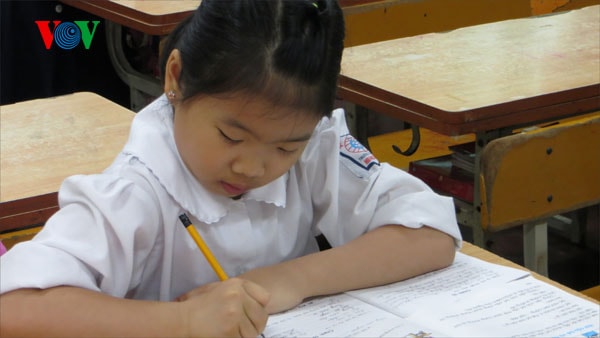
Children are naturally curious and eager to explore, so those who haven't studied the material beforehand will be very interested in discovering the knowledge the teacher is teaching.
PV:The Ministry of Education and Training has just issued new guidelines stating that primary schools are not allowed to grade first-grade students. What is your assessment of these guidelines?
Mr. Pham Xuan Tien:I fully support the Ministry of Education and Training's policy of not grading first-grade students.
Currently, before entering first grade, many parents hire tutors to teach their children in advance, so these children are better at reading, writing, and math than those who haven't had any prior tutoring. Therefore, grading first-grade students will not be accurate or fair. This has also created a trend where parents rush to have their children learn before first grade.
For preschool children entering first grade, it's a significant psychological transition, so grading their studies can create immense pressure. They'll compare their results with their peers and feel inferior, leading to a feeling of needing to catch up or being overloaded with material.
Children who study ahead of the curriculum until the end of the first semester will have "run out of material."
PV:Could you please explain the impact of children learning ahead of the first-grade curriculum?
Mr. Pham Xuan TienChildren who learn ahead of the first-grade curriculum experience significant psychological effects, leading to overconfidence. While the teacher is lecturing in class, there is a wealth of knowledge and skills that these children need to grasp. However, those who learn ahead of the curriculum often assume they already know everything, resulting in a lack of focus during class. Consequently, they fail to grasp the material and skills effectively, hindering their future learning.
According to many teachers, students who study ahead of the curriculum will run out of material by the end of the first semester, resulting in lower actual learning outcomes compared to students who haven't studied.
Children are naturally curious and eager to explore, so those who haven't studied the material beforehand will be very interested in learning what the teacher is teaching. They will focus on learning, absorb the knowledge thoroughly and deeply, and achieve better results than students who have studied the material in advance.

Mr. Pham Xuan Tien
PV:After careful consideration, the Ministry of Education and Training found that the new guidelines on not grading first-grade students are inconsistent with Circular 32 of the Ministry (which stipulates a combination of numerical and qualitative assessment) that is still in effect. What are your thoughts on this issue?
Mr. Pham Xuan Tien:Currently, primary schools are evaluating and grading students according to Circular 32. To eliminate grading for first-grade students, the Ministry of Education and Training needs to issue a revised Circular amending Circular 32, or the Ministry could issue a completely different Circular. This is crucial to ensure the official validity of a document issued by a state-regulated agency.
Student academic rankings cannot be abolished.
PV:What are your thoughts on the new regulations from the Ministry of Education and Training that may lead to the elimination of academic grading for students?
Mr. Pham Xuan Tien:Classifying students into categories such as Excellent, Good, Average, Weak, and Poor is perfectly normal. After a period of learning, teachers need to classify and assess students' academic abilities. This classification helps teachers adjust their teaching methods to meet the specific needs of each student.
For weaker students, teachers need to invest more in their teaching to help them gain momentum in their studies and personal development.
The assessment and grading of learning will also help parents see what level their child is learning at, so they can provide support to the school in teaching and caring for their child.
For the reasons mentioned above, in my opinion, abolishing student academic grading would be unreasonable.
PV:Hanoi is a locality where the practice of rushing through teaching and learning before first grade is relatively common and widespread. According to the Ministry's new guidelines, how will the Department of Education and Training implement and direct the districts and counties to stop grading first-grade students, sir?
Mr. Pham Xuan Tien:For many years, the Hanoi Education Department has emphasized that teachers should only grade according to regulations, such as: regular tests in Mathematics have two grading scales, Vietnamese Language has four grading scales, or periodic tests.
With regulations prohibiting teachers from giving grades arbitrarily and indiscriminately, and instead focusing on grading as a primary means of evaluating students, the Department of Education and Training has instructed schools to evaluate first-grade students through comments, with the aim of encouraging and motivating them in their studies and development.
If students have not met the required knowledge and skills standards, teachers have a responsibility to encourage them to strive harder in their studies. Attitudes such as criticizing or complaining about students are not permitted for first-grade teachers.
I think that after the implementation of a grading system for first-grade students, the practice of extra tutoring and supplementary classes ahead of the curriculum will significantly decrease in Hanoi in particular and other provinces and cities in general.
PV:Thank you, sir!
According to vov.vn - M.D


