
There is no justification for fabricating stories.
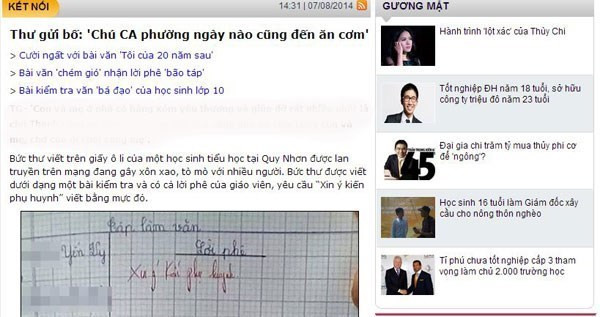
Recently, some newspapers have published false information that has affected the role and reputation of the press in society, and have been severely punished by authorities. However, some people have linked this phenomenon to so-called freedom of speech. So, in reality, is the truth as they claim?
 |
| Posting behavior |
| RELATED NEWS |
|---|
BBC and Dannews also expressed a similar viewpoint through the titles of their articles related to the event. It's not difficult to see that this is merely a justification for the fabrication and distortion of facts by some so-called "journalists" in Vietnam today.
From any perspective, freedom of the press and freedom of speech do not equate to journalists citing inaccurate sources, fabricating stories, or plagiarizing information from other newspapers.
In progressive journalistic systems around the world, fabrication and plagiarism are two serious and unacceptable offenses. Therefore, journalists who engage in either of these behaviors are usually immediately dismissed by their news organizations.
Furthermore, they also face many other consequences such as: being forced to publicly apologize to readers, returning any journalism awards they may have received. More seriously, if sued by an individual or organization for fabricating stories that negatively affect their reputation, the journalist and the newsroom will have to appear in court and pay substantial compensation. Not to mention, the journalist's career may be permanently ruined, and their name may become a "bad example" for a long period of time.
This is no exception, even for the American press, which is known for supporting "excessive freedom" and, theoretically, is a country without press laws!
According to a list compiled by polotico.com and journalism.about.com of 10 notorious journalists for "fabricating stories," three of them were nominated for or received the Pulitzer Prize – America's most prestigious journalism award. These individuals subsequently lost their jobs and some even had to return the award along with a public apology.
The first Pulitzer Prize-winning journalist to be implicated in a scandal was Louis Seibold. In 1921, Seibold conducted a fabricated interview with U.S. President Woodrow Wilson. At the time, Woodrow Wilson was in a coma, and Seibold had no choice but to write a fictional interview with the help of the First Lady and others. This made him inextricably linked to public opinion, even after his death.
Next, there is the case of journalist Janet Cooke, who had her 1981 Pulitzer Prize revoked for a "fabricated" report. Cooke wrote an article titled "Jimmy's World," describing the lives of impoverished black children amidst drug trafficking, and published it in the Post.
This is a touching article, except that everything Cooke wrote was entirely from his imagination. In reality, no 8-year-old child named Jimmy had such a life, although some later tried to defend him. From then on, Cooke was considered a "pathological liar"!
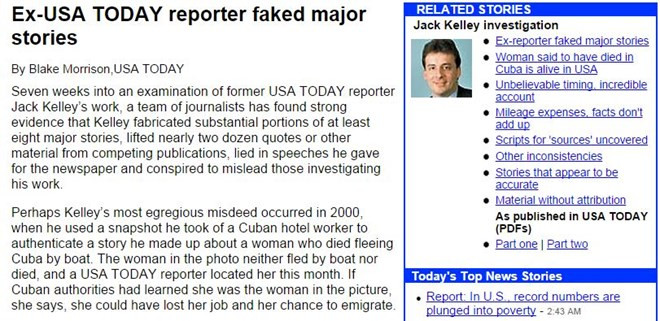 |
Another notorious case mentioned is that of Jack Kelley, a veteran foreign correspondent for the renowned newspaper USA Today, who was nominated for the Pulitzer Prize five times. In 2004, he was accused by his colleagues of fabricating at least eight of his reports and plagiarizing articles from numerous other news outlets.
Many journalists also claim that hundreds of Jack Kelley's previous articles were more or less plagiarized, contained slanderous and fabricated information. More dangerously, Jack Kelley, a former war correspondent, deceived American readers about the situation in countries such as Cuba, Pakistan, Afghanistan, Egypt, Russia, and Yugoslavia...
Despite his claims of not having done anything wrong or stolen anyone's information, in the eyes of many colleagues, Jack Kelley remains "a disgrace for betraying public trust."
Not included in the aforementioned list of notorious individuals, Narciso Contreras, a Pulitzer Prize-winning freelance photojournalist, also had his collaboration with the Associated Press (AP) terminated for altering certain details in his Syrian battlefield photographs. Although these alterations did not significantly affect the content of the images, AP resolutely ended its working relationship with Contreras. They stated that: AP's reputation is paramount, and any violation of journalistic ethics (even the smallest) is unacceptable. Contreras had previously apologized for his actions and hoped for forgiveness from readers.
Even the tabloid newspapers in America, which consider fabrication a survival tactic to attract readers' attention, have paid a heavy price for seemingly harmless articles.
The Global Times was twice taken to court and fined because of reporter Mike Barnie. Mike was known for distorting the words of others. In 1973, the Global Times lost $40,000 after Mike was accused of fabricating statements in interviews. In 1991, this reporter continued to cause trouble for the newspaper after arbitrarily adding to the words of a Harvard professor. Mike Barnie wrote that the professor liked Asian women because Asians knew how to be "submissive"; ultimately, the Global Times had to pay $75,000 in compensation!
In 2004, Carl Cameron embarrassed Fox News by fabricating a story that Senator John Kerry was a "narcissist who constantly takes care of his face and nails." In reality, John Kerry was a well-groomed person; however, Cameron's attributions to Kerry lacked any evidence!
A similar situation occurred with Kerry's opponent at the time, then-President George Bush. CBS was forced to apologize to George Bush after a scandalous fabrication by CBS reporter Dan Rather, who allegedly created a false transcript. According to this fabricated source, George Bush was supposedly able to avoid participating in the Vietnam War thanks to his family connections in Texas.
This was a malicious article intended to discredit President Bush. And Rather's silly mistakes in "manufacturing" the draft turned it into a joke and a journalistic disaster, damaging CBS's reputation.
In recent years, with the explosion of social media, many media corporations in the US have quickly imposed strict rules on their reporters regarding their use or activity on personal websites, blogs, Facebook, Twitter, etc.
Every message or piece of information that appears on a journalist's personal page is tantamount to the journalist speaking on behalf of the newspaper, and therefore they are fully responsible for the words, videos, and photos they post.
In 2010, the Washington Post announced the suspension of popular football commentator Mike Wise following a "joking" tweet. The commentator had posted on his personal page that Pittsburgh Steelers quarterback Ben Roethlisberger was only suspended for five NFL games for misconduct, instead of the six announced by the league.
Almost immediately afterward, Mike Wise deleted the comment and apologized for his joke. But because the sharing on Twitter happened so quickly, the news instantly reached the Washington Post. They demanded a public apology from Mike Wise and suspended him for a month. But things didn't stop there; many readers responded, wanting Wise to be fired. Some comments were so harsh that if the Washington Post didn't fire Mike, it would no longer be a trustworthy newspaper!
Based on events reported in the American press, perhaps some people in Vietnam should redefine the meaning of the word "freedom" as they mistakenly believe.
Freedom of the press and freedom of speech in any country, no matter how advanced, must be based on honesty and respect for the truth. The foundation for the existence and development of journalism is truth. Journalists work to protect and serve that truth. Therefore, it is surprising when some people try to justify plagiarism, fabrication, distortion, and fabrication by claiming it stems from a lack of understanding or the inability to verify information! No matter how you look at it, these actions all share the same essence: they are lies.
Unfortunately, while in many Western countries, particularly in the US, it is journalists, sometimes even colleagues of the plagiarists, who uncover plagiarism and fabrication, in Vietnam, in several recent cases, those involved seem indifferent to the publication of false information.
The truth only became clear when public opinion analyzed and exposed the fraudulent nature of the letter. To date, the individuals directly involved in publishing the letter remain silent, offering no apology to readers, nor any official disciplinary action against the authors who fabricated the story. Such a way of working cannot exist in a professional journalistic environment.
While it's too early to conclude whether journalistic trends, particularly those involving fabrication and online information theft, are dominating some news outlets, recent negative events and phenomena in journalism serve as a warning that journalists may disregard their social and professional roles, and that society may neglect the role of the law, lacking disciplinary measures and strict, specific penalties for the press.
According to Nhan Dan Newspaper


