
Lam Son Historical Site and King Le Temple Festival
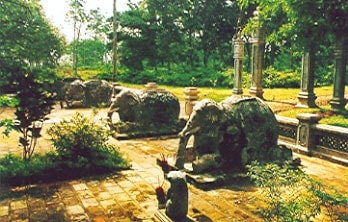 |
| Stone elephants stand guard at Lam Kinh Palace. |
Le Loi passed away on August 22nd, 1433 (the year of Quy Suu). The imperial court bestowed upon him the temple name Le Thai To, and then commissioned the hero Nguyen Trai to write the Vinh Lang stele inscription to commemorate his achievements.
In Thanh Hoa province, the name of the national liberation hero Le Loi is associated with the Lam Son historical site (1), a fairly large area in Xuan Lam commune, Tho Xuan district. This historical site includes the tombs, stele houses, and palaces of the kings and queens of the Le dynasty such as: Lam Kinh Palace, Le Thai To Mausoleum and Temple, Le Thai Tong Mausoleum, Le Thanh Tong Mausoleum, Le Hien Tong Mausoleum, Le Tuc Tong Mausoleum, Queen Ngo Thi Ngoc Giao Mausoleum, Queen Nguyen Thi Ngoc Huyen Mausoleum,... It should be added: Lam Kinh Palace now only has a few walls, column foundations, steps and some stone animals. The palace was built on a rectangular plot of land, 314m long, 254m wide, surrounded by a 1m thick wall. Among the stone steles at Lam Kinh, the Vinh Lang stele, which tells about Le Loi's merits, is 2m79 high, 1m92 wide, and is erected on the back of a stone turtle 3m46 long, 1m49 wide. Dragon figures run along both sides of the stele, following the motif of a dragon and worm...
Every three years, in Xuan Lam, Tho Xuan, Thanh Hoa, the King Le Temple Festival is solemnly organized by people from within and outside the province to worship King Le Thai To on his death anniversary (August 22nd of the lunar calendar). Here, after the ceremonial part, there are many festive activities, such as folk singing, reenactments of old stories like "Defeating the Wu," "The Vassals Come to Court," etc., which are very popular with locals and visitors.
"The country of Dai Viet during the early Le Dynasty (15th century - early 16th century) became a powerful country in the Central European peninsula (2). That is the pride of the Vietnamese people, both yesterday and today. Although much has been destroyed, the Lam Son historical site in Thanh Hoa province - an attractive historical and cultural site for many tourists not only from within the country - has and will continue to provide historians and ethnographers with rare and valuable documents and artifacts on the path to rediscovering the civilization and heroism of our ancestors!"
(1) According to Professor Vu Ngoc Khanh in the book Nguyen Trai in Thanh Hoa (Culture and Arts Publishing House, Hanoi, 2003, p. 206), in 1430, the feudal state allowed the place name Lam Son to be changed to Lam Kinh.
(2) Concise History of Vietnam. Multiple authors. Professor Luong Ninh is the chief editor. National Political Publishing House, reprinted with additions, Hanoi, 2005, p. 206.
Yen Nhi


