
The marching song lives on.
As if by a twist of history, the Regiment's 40th anniversary began in the spring of 1968, the spring of the Tet Offensive, marked by the historic Tet Offensive and Uprising. That spring, precisely on February 8, 1968, a regiment of infantry was formed in Nam Dan – the Soviet-era homeland of Nghe Tinh – by order of the General Staff to promptly contribute to the general offensive and uprising.
As if by a twist of history, the Regiment's 40th anniversary began in the spring of 1968, the spring of the Tet Offensive, marked by the historic Tet Offensive and Uprising. That spring, precisely on February 8, 1968, a regiment of infantry was formed in Nam Dan – the Soviet-era homeland of Nghe Tinh – by order of the General Staff to promptly contribute to the general offensive and uprising.
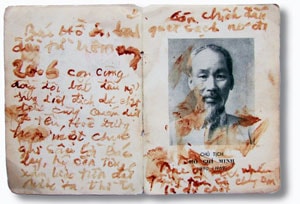 |
The photograph shows President Ho Chi Minh with the oath of allegiance written in blood by soldiers during the battle to destroy Hill 544. |
That was the 27th Regiment—the Soviet Nghe Tinh Regiment. Like other units in Military Region 4, it was formed by simultaneously marching and receiving troops, organizing and structuring its forces. The 27th Regiment, with its infantry battalions and artillery companies, was assembled during the march southward, simultaneously completing its unit formations… Yet, just a week after landing on the southern bank of the Ben Hai River, the regiment's first infantry detachment fired its first shots, completely wiping out a US reconnaissance platoon in Gia Binh village, Gio An commune, Gio Cam district. This victory boosted confidence and created a favorable position for the regiment's units in the encirclement of Con Tien, closing in and threatening the McNamara electronic barrier. During a month of continuous fighting, the regiment successively annihilated two companies of American "flying cavalry" at Cam Vu village (Gio Cam) and immediately followed that with a devastating battle that shattered the offensive of mixed American and South Vietnamese units at Song intersection, right at the gateway to Dong Ha.
Victory, and with it came the beginning of a long and arduous journey amidst the gunfire, where the character of the regimental soldiers was revealed and shone brightly. Recognizing something "unusual" about the Liberation Army's fighting force, which was directly and further widening the gap in the strategic defense line on Route 9, the enemy simultaneously deployed four tank battalions and American "flying cavalry" brigade troops from Khe Sanh to Gio Cam to push forward and relieve their key positions threatened by the Liberation Army. Fire tests gold; in the fierce, unequal battle between a small battalion of the 27th Regiment (then codenamed Phan Rang) and four tank battalions, from within the encirclement of the "elite" American forces, outnumbered dozens of times, the regimental soldiers, using mobile offensive tactics, annihilated more than 150 American "flying cavalry" troops. Fighting the enemy for every tree and every nook and cranny in one battle line, a squad of the regiment suffered casualties one after another, and their ammunition dwindled. In this dire situation, squad leader Cao Nhu Thiem, with wounds all over his body, fought alone with his rifle until the last bullet. Taking advantage of the fact that only Thiem was left wounded and out of ammunition, the Americans rushed forward to capture him. Seeing the liberation soldier covered in wounds, after a brutal beating, the enemy commanders called in an interpreter and forced Thiem to reveal his unit's designation. Without a single groan before the enemy, Thiem defiantly said:
- I know the unit's designation to fight the Americans, not to reveal it to the invading army!
Knowing they could not subdue the liberation fighter, the American soldiers dragged him against a banyan tree in Gia Binh village and opened fire. In his final moments, Cao Nhu Thiem turned his face towards the North and shouted: Long live the Vietnam Labor Party! Vietnam will surely win! Long live Uncle Ho…
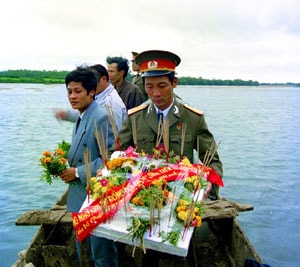 |
The flower-releasing and incense-burning ceremony, performed by soldiers of the 27th Trieu Hai Regiment during their pilgrimages to former battlefields, has now become a traditional flower-releasing festival for the people and soldiers of Quang Tri. |
Yes, that day was March 26, 1968. The day when the unwavering spirit of the Liberation Army soldiers struck fear into the hearts of even the most aggressive American invaders. Through the accounts of the defeated South Vietnamese soldiers returning to Dong Ha, recounted with reverence, the people of Dong Ha were deeply moved and proud of the courageous Liberation Army soldiers. And through the shining example of the unwavering fighting spirit of Cao Nhu Thiem, a young Party member and son of the Soviet-era Nghe Tinh region, a long series of events began, embodying the character and glorious traditions of the regiment's soldiers.
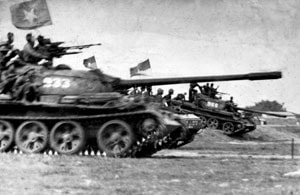
The regiment is 40 years old! Each year is woven into the musical notes of the song "The Soviet Flag Flies"—a traditional regimental anthem. Without the melody and rhythm, the lyrics become pages of a war diary, recording the regiment's famous battles on the Route 9 battlefield in Quang Tri. From the "search and destroy" campaign against enemy mechanized infantry with the renowned tank battles at Sap Da Mai, Tan Kim, Mieu Bai Son, Ho Khe, Da Bac... in 1969. Following that, the campaign to disrupt enemy transportation on Route 9 from Dong Ha to Lao Bao, intercepting and destroying hundreds of enemy vehicles transporting troops, fuel, and weapons during the Route 9 Southern Laos campaign in 1971.
In particular, the campaign to encircle and destroy Hill 544 (Pulơ), a particularly important "eye" in the McNamara electronic barrier system, involved months of bombing and artillery fire with the motto "Encircle - encroach - attack - destroy - annihilate." The officers and soldiers of the regiment demonstrated their qualities as regimental soldiers with a glorious victory, leveling Hill 544. This victory became a classic combat motto of our army, and Western news agencies assessed it as: "With the encirclement and destruction of Hill 544 (Pulơ), the North Vietnamese units created a Dien Bien Phu in the South."
|
The regiment, part of a combined arms force, advanced straight into Saigon on April 30, 1975. |
Another memorable victory for the regiment took place on Hill 182. An infantry platoon of the regiment engaged two companies of American "leather-collar" soldiers. Soldier Tan was wounded and blinded in both eyes. When his comrades tried to help him back to the rear, Tan resolutely stood his ground:
- Let me stay at the outpost with my comrades. I'm blind and can't see the enemy to shoot, so you guys can point them in the direction of the enemy so I can throw grenades. As long as we're here, we'll hold out; I absolutely cannot leave the outpost now.
As long as there are men, there is a battlefield! Inspired by the example of soldier Tan, the soldiers in the platoon supported each other in battle, repelling dozens of enemy attacks with courage and fighting spirit that had been heightened, as platoon leader Hoa said:
- Hill 182 had been eroded down to 180 meters by bombs and shelling, but thanks to the heroic actions of the soldiers defending the outpost today, Hill 182 has been raised to 1,800 meters!
In early 1972, during the regiment's fifth spring on the Route 9 front in Quang Tri, history once again placed upon the regiment the crucial responsibility of firing the opening shot for the general offensive to liberate Quang Tri. From a special situation, the opening battle, 20 minutes before the "G" hour, was achieved by the regiment's officers and soldiers in a remarkably effective victory. They crushed the relief operation of the 56th Regiment of the puppet army, capturing nearly 600 prisoners. Remarkably, along with other units firing in different directions, after this crucial opening shot that opened the western flank, the regiment, together with the main army, advanced deep into the enemy territory to liberate Trieu Phong and Hai Lang districts, participated in the liberation of Quang Tri town, and subsequently held its ground, repelling enemy counterattacks on the eastern flank of the Quang Tri citadel during the 81-day and 81-night campaign to defend the citadel. With its impressive record of victories, the regiment was awarded the title of Heroic Unit of the Armed Forces by the Party and the State. And that joy was doubled when the regiment, which had contributed to the liberation of the two districts of Trieu Phong and Hai Lang, was given a new name by the people and soldiers of Quang Tri - the heroic Trieu Hai Regiment.
Recalling the days of forgetting to eat and nights of forgetting to sleep on the march towards the goal of liberating Saigon, many soldiers of the regiment could not forget one afternoon stopping in Dong Xoai with a vow to fight to the death for the goal of liberating Saigon.
Sergeant Pham Quang Hung, a soldier from Hanoi, recalled: "That day, after leaving the Day River on March 16, 1975, we spent more than half a month clearing the way and advancing at lightning speed under the direct orders of the General Staff… On the afternoon of April 12, 1975, the entire unit assembled in the rubber forest of Dong Xoai. Following orders from the regiment, officers from platoon commanders upwards gathered to hear the briefing on the campaign command's orders, which had been translated into specific orders for each unit's flank and wing. Amidst the exhilarating atmosphere of battle, Regiment Commander Nguyen Huy Hieu, after quickly sketching the momentum of the liberation army's rapid advance towards Saigon from various directions, concluded impressively:
- The regiment's order is to penetrate deep! Soldiers penetrate deep, squads penetrate deep, platoons, companies, battalions, regiments, and I too will penetrate deep! This is the opportunity, the honor, and the responsibility of the regiment before the fatherland. Even if, in this campaign, the entire regiment may only remain as a name in a war museum, even if we sacrifice ourselves, each soldier of the regiment must sacrifice himself facing Saigon!
Yes, right at the gates of Saigon 35 years ago, a battle order was issued like a sacred oath - an oath to fight to the death, for the decisive battle to advance towards Saigon and completely liberate the South by the heroic soldiers of the 27th Trieu Hai Regiment.
Immediately after leaving Dong Xoai, the entire regiment, like a whirlwind, swiftly attacked the Lai Thieu and Tan Uyen districts, the enemy strongholds on Highway 16, Vinh Binh Bridge, Binh Trieu... opening a deep penetration route to directly attack the heart of the enemy's supply lines and military bases, then joining other allied forces in overwhelming joy - liberating Saigon, liberating the South. And in the ecstatic joy of complete victory, many soldiers burst into tears when they looked back at their unit's formation and saw that not all their beloved comrades were still there - those who had forever traveled along the road to victory, returning straight to the museum in the heart of the Fatherland with their vow to fight to the death, facing the city of Saigon.
The regiment is 40 years old! Yes, exactly 40 years of continuous connection, the etchings of the liberation war have shaped the portrait of the heroic 27th Trieu Hai Regiment. In the excitement of preparing for the traditional reunion, good news came from the Division commander: In 2007, for another year in a row, the 27th Regiment successfully completed its assigned tasks.
Le Ba Duong


