
Political crisis in Thailand: Nature and trends
1. Nature
In 2010, in Bangkok, hundreds of thousands of "Red Shirts"—supporters of the Puea Thai Party, which backed former Prime Minister Thaksin Shinawatra, who was ousted in 2006—took to the streets to protest and disrupt the normal functioning of government agencies. The "Red Shirt" protests against the Democrat Party government, led by Prime Minister Abhisit Vejajiva (with Suthep as Deputy Prime Minister), paralyzed Bangkok's transportation system, hindered the normal operation of government agencies, and culminated in a blockade of Bangkok's main airport. Clashes between the military and the "Red Shirt" protesters in 2010 resulted in devastating consequences, with over 90 deaths and hundreds of injuries on the streets of Bangkok. That was Bangkok in 2010.
- The nature of the current political crisis in Thailand.
In late 2013 and early 2014, Bangkok reenacted the political tragedy of 2010, only with a reversal of roles for the key figures. In 2010, the Democrat Party was in power with Abhisit as Prime Minister and Suthep as Deputy Prime Minister, while the "Red Shirts" supporting the Puea Thai party occupied the streets and paralyzed government offices. Conversely, from late 2013, supporters of the Democrat Party took to the streets, surrounding government buildings and demanding the dissolution of the Puea Thai government led by Prime Minister Yingluck.
Thus, in 2010, the Puea Thai (For Thai People) party mobilized protesters demanding the overthrow of the Democrat Party government.
Three years later, starting in October 2013, it was the Democratic Party's turn to mobilize protesters demanding the overthrow of the Pheu Thai Party government.
It seems that the younger generation is truly formidable!
Although the number of deaths on the streets due to clashes between the parties has only reached 9 so far, compared to over 90 in 2010, the conflict between the Democratic Party and the ruling Pheu Thai Party appears to be more intense, reflecting a life-or-death confrontation (compared to 2010).
The current situation in Thailand can be summarized in seven words: Chaotic, abnormal, and difficult to control.
The chaos is clear. What's abnormal is that the people (in this case, Suthep and his associates) mobilized a large crowd to surround government offices and agencies, preventing officials from carrying out their duties. They even called for the arrest of Prime Minister Yingluck, ministers, and cabinet officials, even though the Prime Minister had not committed any serious crimes (such as signing agreements or contracts with foreign countries that infringe upon national sovereignty and territorial integrity, or making mistakes in domestic policy leading to particularly serious consequences for security, the economy, and society...). Suthep's actions are unconstitutional, disrupt the political and social life of the country, and are undemocratic.
As a Democrat and leader of the People's Democratic Reform Committee (PDRC), Suthep is discarding the most basic principles of a true democracy, and his actions are full of elements of unforgivable rebellion.
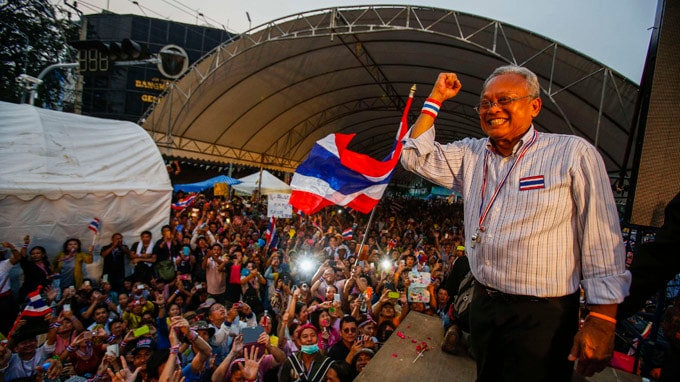 |
| Suthep, the leader of the protest movement. |
Objectively speaking, Prime Minister Yingluck and some MPs from her Pheu Thai Party have also made some mistakes during their past two years in power, such as introducing an amnesty bill (which was rejected) that the opposition argued would pave the way for Thaksin (Yingluck's brother) to return home without serving a prison sentence for corruption (in February 2010, the Supreme Court sentenced Thaksin to prison and confiscated assets worth $1.4 billion). The National Anti-Corruption Commission (NACC) is investigating Prime Minister Yingluck and dozens of MPs from her Pheu Thai Party in their attempt to amend the Constitution to reconsider the entire Senate from a semi-appointed (half-elected) system to a fully elected (100%) system. If convicted, Pheu Thai Party MPs would be banned from politics for five years. The National Anti-Corruption Commission is also investigating and potentially prosecuting 15 officials, including the former Minister of Commerce, for corruption related to a rice subsidy program for rice farmers that resulted in a large surplus of unsold rice in the country.
This means that the Pheu Thai Party government, led by Prime Minister Yingluck, is not yet a truly clean and impartial government. However, the mistakes of Prime Minister Yingluck and her associates over the past two years do not meet the necessary and sufficient conditions for her removal, and cannot justify Suthep's unconstitutional actions that plunged Thai society into chaos. In 217 countries and territories worldwide, similar actions to Suthep's are prosecuted in criminal courts.
ButRegarding the causes of the current political crisis in Thailand.
Economically, Thailand is a developing country with an average income of approximately US$5,000 per year. In developing countries like Thailand, four processes typically occur simultaneously: 1. Industrialization; 2. Urbanization; 3. Rapid widening of the wealth gap; and 4. Widespread bureaucracy and corruption.
The political crises in Thailand in 2010 and 2013-2014, from an interest perspective, were essentially the same. They were social manifestations of a sharp conflict of interests between the two largest communities in Thai society: the peasantry and urban poor (the majority) and the affluent middle class – the ambitious class in a country with a developing economy at a lower-middle income level (around US$5,000 per person per year). This rising class has relatively close ties to the Royal Court and military generals and officers. On the Thai political stage, there are two major political parties representing the interests of these two communities: the Pheu Thai Party, representing the interests of the peasantry and urban poor (primarily in the North and Northeast) through populist policies; and the Democrat Party of Abhisit and Suthep, representing the affluent middle class in Bangkok and southern cities.
From an economic perspective, the political crisis in Thailand is the result of a clash, or rather a conflict, of economic interests between two major social classes.
Politically, Thailand has a pluralistic, multi-party political system modeled after North America and Western Europe. Thailand differs from the G7 developed countries in three ways: 1. Its economy is at a much lower level of development than the G7; 2. Unlike the Emperor of Japan, the King of Malaysia, the King of Brunei, and the King of Cambodia, King Bhumibol of Thailand held real power and dominated the political scene in Bangkok; 3. The Thai military, especially the army, plays a significant role in Thai politics (from 1932 to the present, the Thai military has carried out 18 successful and unsuccessful coups).
As long as the king and the military still play a significant role on the country's political stage, a truly proper system of separation of powers is not possible. In other words, Thailand only has a half-baked system of separation of powers and a political system that is still learning to be democratic (50% monarchy and 50% democracy!). In this "half-baked" democracy, with an incomplete legal system and a majority of the population lacking respect for the law, political and social conflicts are easily likely to erupt.
Ultimately, the intense political disputes and conflicts between Yingluck's Pheu Thai Party and Abhisit-Suthep's Democrat Party reflect the conflicting economic interests between the two major communities in Thailand's developing society.
2. Trends.
Where is Thailand headed?
The people of Thailand, and the international community in general, are considering and making various predictions. Before making predictions in the form of possible scenarios, a clear understanding of several issues related to the development trends of Thai politics is necessary.
Firstly, Suthep's actions were unconstitutional and should be prosecuted criminally (no country would condone such actions). On December 2, 2013, the Thai Criminal Court issued a ruling to arrest Suthep on charges of "sedition." On January 16, 2014, the Thai Criminal Court held an appeal hearing and upheld the arrest warrant for Suthep on charges of "sedition," with the warrant remaining in effect for 20 years (from January 16, 2014).
Secondly, who has the authority to postpone the February 2, 2014 election?
Prime Minister Yingluck has no authority, and the National Election Commission also has no authority, to postpone the February 2, 2014 election.
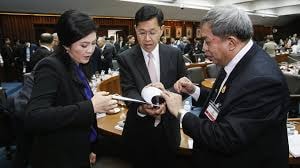 |
| Prime Minister Yingluck Shinawatra during a discussion about the elections at the Royal Air Force headquarters. |
In Thailand, only King Bhumibol and the Supreme Constitutional Court have the authority to issue a ruling postponing the February 2, 2014 election. King Bhumibol had already approved (at the request of Prime Minister Yingluck) holding the election on February 2, 2014, so he will not retract his decree. But what about the Supreme Constitutional Court?
Prime Minister Yingluck insisted on holding elections on February 2, 2014.
The National Election Committee (5 members), since taking office in mid-December 2013, has consistently proposed postponing the election to May 2014. What is the National Election Committee's true intention in postponing the election? It remains unclear.
What was the military's attitude towards the February 2, 2014 election? They also didn't reveal any "secrets."
In the first half of January 2014, the Thai government organized a broad, public forum on the February 2, 2014 election, and the majority of attendees supported the election (the National Election Commission did not attend this forum!).
Thus, the Supreme Constitutional Court is at a crossroads (the King, the Government, the Army, and the National Election Commission). The Supreme Constitutional Court must weigh its options, but it is highly unlikely that it will rule to postpone the February 2, 2014 election.
Based on the above understanding, we can consider three possible scenarios with different probabilities.
- Firstly, from now until February 2nd, 2014,Nothing unexpected happened that would require military intervention, and the election (February 2, 2014) took place as planned, openly, transparently, and fairly. Following the election, Thailand will proceed with constitutional amendments, democratic reforms, and gradual social stabilization.
This is the best-case scenario that the majority of Thai people, and the international community in general, desire.
- Secondly, from now until February 2nd, 2014, Suthep is determined to embark on a dangerous "all or nothing" gamble, continuing to incite violent protests, even proactively creating bloody conflict and plunging Thailand into uncontrollable chaos. There will be no elections; to stabilize the situation, the military will have to intervene, leading to the following consequences: 1. Dissolution of the Yingluck government; 2. Arrest of Suthep and several key figures responsible for the bloodshed; the Democrat Party may be dissolved, and many Democrat Party members banned from politics for at least five years; 3. The military will take control of the country during a transitional period of about one year (maximum one and a half years).
- Thirdly, either King Bhumibol or the Supreme Constitutional Court will issue a ruling to postpone the election until May 2014. Between now and the election, Thailand will remain in a state of political and social instability, but it will be under control.
All three scenarios are possible.
Forecasting from now until the end of 2015 is easier than forecasting from now (January 22, 2014) to the beginning of February 2014. Forecasting for 10 days is as difficult as walking on a tightrope, but it's necessary, even if it might be wrong.
Considering the factors influencing Thai politics, a preliminary assessment can be made as follows: the first scenario has a 30% probability of occurring, the second scenario has a 50% probability, and the third scenario has a 20% probability.
In a developing economy, a multi-party political system, a half-hearted separation of powers with the military and the royal court playing a significant role on the political stage, and a society attempting democracy modeled after Europe and America, political and social instability will continue to occur frequently, fluctuating between periods of stability and outbreaks, then back to stability again…
As a nation that considers Buddhism its state religion, why is it always unstable, even chaotic? What is the role of Buddhist doctrines and precepts? Researchers should delve deeper into explaining this issue.
Hanoi, January 22, 2014.
Le Van CuongBut
Major General, former Director of the Institute of Strategy - Ministry of Public Security


