
The 'contaminated' egg crisis in European countries.
Following the Netherlands, Belgium, Germany, Sweden, and Switzerland, France and the United Kingdom are the latest two countries to be affected by the pesticide-contaminated egg crisis.
The UK Food Safety Authority said yesterday that although the number of imported eggs is very limited (around 21,000) and the risk to public health is low, the country is accelerating investigations into the distribution of imported eggs, as well as recalling related products.
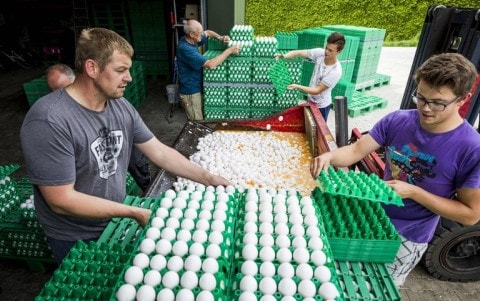 |
| Dutch farmers destroy eggs suspected of being contaminated. Photo: Reuters |
On the same day, the French Ministry of Agriculture announced that 13 batches of eggs suspected of being contaminated, imported from the Netherlands in July, had been delivered to food processing companies in western France. Investigations are underway to assess the situation (related products and destinations of the eggs) and to recall the affected products for analysis.
The "tainted" egg scandal broke last week in the Netherlands after authorities discovered high levels of the pesticide fipronil in samples of chicken feces, blood, and eggs. Fipronil is a chemical commonly used in agriculture to control pests, but its use in processing animals intended for human consumption is prohibited.
According to the World Health Organization (WHO), high levels of the toxic substance fipronil can cause damage to the liver, thyroid gland, and kidneys if ingested in large amounts over time.
Dutch authorities immediately closed 180 suspected farms, destroyed and recalled a large quantity of hens and eggs sold in stores and warehouses, and stated that it was difficult to determine whether the "contaminated" eggs had been sold to consumers during that period. The crisis subsequently spread to Germany, Switzerland, and Sweden. Tens of millions of chicken eggs were recalled and destroyed.
German Agriculture Minister Christian Schmidt said: “Even if we assume that the risk to acute health is impossible, the unauthorized use of the insecticide fipronil on laying hens is unacceptable. This practice must stop immediately.”
Some poultry farmers in the Netherlands affected by the crisis have begun culling their birds. According to the Dutch Agricultural Organization, more than 300,000 contaminated chickens, all in their egg-laying years but excluded from the processing and distribution chain due to the crisis, have been culled. Millions more egg-laying chickens are at risk of the same fate if farmers believe they are no longer profitable due to a lack of market demand.
In many Dutch supermarkets, egg aisles have shrunk and are even empty following the recent recall. The Dutch agricultural sector has estimated the damage caused by the "tainted" egg scandal could amount to millions of euros, and the government yesterday pledged an emergency relief plan.
Previously, representatives of the affected farms in the Netherlands, Belgium, and Germany had demanded compensation once responsibility was clearly established. These farms all stated that they had used the services of ChickFriend, a Dutch company specializing in farm disinfection. This company is suspected of fraudulent use of Fipronil in an antiparasitic product with the trade name DEGA 16.
German Agriculture Minister Christian Schmidt said: “The German government has detected the insecticide fipronil in some poultry products. This is a chemical banned for use in animals intended for food in Europe.”
From what we know so far, this contamination is due to the farms using a parasite killer called Dega 16. This is a completely herbal and approved product, but it appears to have been adulterated with Fipronil, which is banned for use in poultry and livestock.
The Netherlands and Belgium have also launched criminal investigations into the matter. According to European media, another supplier, Poultry-Vision of Belgium, is also under investigation, having previously purchased large quantities of fipronil from Romania.
In Belgium alone, 51 suspected farms were closed today, including 22 breeding chicken farms. Of these, 21 farms were found to have residues of the pesticide Fipronil in chicken droppings, blood, and eggs, but these levels were significantly lower than the regulations of the European Union and the Belgian Food Safety Authority.
Last weekend, the agency admitted to detecting the fipronil problem in poultry farming since June, but only notified neighboring countries on July 20 due to confidentiality requirements for the investigations. Following criticism, particularly from Germany, the Belgian Ministry of Agriculture requested the Belgian Food Safety Authority to submit a report detailing the incident and pledged full transparency.
According to VOV
| RELATED NEWS |
|---|


