
Persistently clinging to fertile land and abundant harvests.
(Baonghean)While farmers in many localities are tending to abandon their fields, in Tan Son commune (Quynh Luu district), people are still persevering through difficulties, clinging to their fertile land for production. For the farmers here, the fields are truly precious, the main source of income to improve their family's living standards.
Tan Son is one of the nine semi-mountainous communes in Quynh Luu district. In 1964, following the government's policy, people from the lowland and coastal communes migrated here to develop the economy. Previously, this area was covered only in reeds, sedges, and wild plants. Terraced rice paddies were scarce, steep, fragmented, and scattered. The land was barren, making production difficult; during the dry season, there was a lack of water, preventing rice growth. During the rainy season, the swampy areas flooded, destroying the rice crops. With their industrious nature and unwillingness to accept poverty, they were determined to transform the hilly and low-lying fields into rice, potatoes, and other crops to ensure food and clothing. Then, the people began reclaiming the fields by using ox carts to excavate soil in the highlands, fill in the lowlands, and level the land to create flat fields. After years of land reclamation and transformation, many fields in Tan Son are now flatter, and the internal field transportation and irrigation systems have been planned and built quite synchronously, meeting the production requirements of the people.
While in many other localities, farmers are abandoning their fields and leaving them fallow, the situation in Tan Son is completely the opposite. Vice Chairman of the Tan Son Commune People's Committee, Vu Quang Trung, affirmed: In Tan Son, the situation of abandoned fields, as seen in other localities, is completely nonexistent. Furthermore, many families are hoping to receive more land for production but are unable to do so. Some households, due to limited land, have rented or leased additional land from other families and public land from the commune for cultivation. Thanks to the diligence, hard work, and dynamism of the people, all the land is fully cultivated. Currently, the entire commune has over 650 hectares of rice land. Of this, 350 hectares are used for two rice crops, over 200 hectares for one rice crop and one other crop, and about 100 hectares are reclaimed land and public land. On average, each person is allocated 500 m2 (according to Decree 64). Despite being a semi-mountainous commune, Tan Son's rice yield consistently ranks among the highest in Quynh Luu district. The average yield in the winter-spring season is 60 quintals/hectare, while in the summer-autumn season it is 40 quintals/hectare.
Why do farmers in Tan Son commune still persevere in farming? First, it's because the commune's fields have been improved and planned to meet production requirements. Initially, the fields in Tan Son commune were extremely fragmented and small. On average, each household received 4-6 plots in 4-5 different areas, with small plot sizes. Furthermore, the irrigation and drainage systems were not synchronized, making irrigation difficult. After the land reallocation process according to Directive 02 of the Provincial Party Committee, the fields became less fragmented.
Following the land consolidation under Directive 08 of the Provincial Party Committee, small plots of land were merged into larger ones. On average, each household owns 1.75 plots, spread across 1-2 farming areas. The commune has established public land areas that were previously scattered across various farming areas; it has planned five main production zones, including a 2-crop rice production zone (302 ha), a 2-crop rice and 1-crop vegetable zone per year (80 ha), a 2-crop vegetable and 1-crop rice zone per year (60 ha), a specialized vegetable and crop zone (25 ha), and an industrial crop zone (200 ha). Among these, there are two high-income farming areas totaling 150 ha producing high-quality commodities.
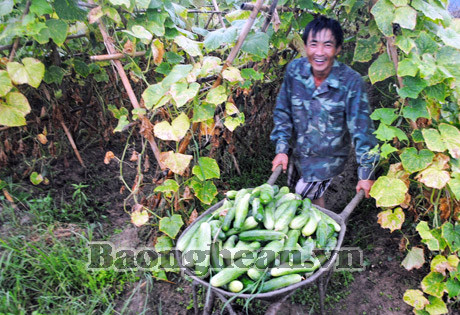
Mr. Le Dinh Hoi, from Hamlet 3, Tan Son Commune, Quynh Luu District, converted his rice paddy land to grow cash crops, resulting in higher income.
Although Tan Son is a semi-mountainous area, its development has focused on agriculture, primarily vegetables and other crops. A significant portion of the population originates from Quynh Luong commune, a traditional vegetable-growing area in Quynh Luu district. Upon moving here, they brought their vegetable farming skills with them, leading to the strong growth of vegetable crops in Tan Son's fields. However, it wasn't until 1980 that the movement to cultivate vegetables on land previously used for two rice crops truly flourished. Initially, people only produced vegetables in the winter season, such as sweet potatoes and corn. Gradually, seeing the high returns, people converted areas of high-lying land with limited water resources during the summer and autumn seasons to vegetable cultivation. Many new crops were introduced, such as tomatoes, kohlrabi, cabbage, and green beans.
The area for vegetable cultivation is increasing, forming specialized commodity production zones spanning tens of hectares. Each year, the commune has approximately 372 hectares of vegetables, 211 hectares of corn, nearly 100 hectares of peanuts, and 192 hectares of other crops. Compared to lowland communes, the area and production of vegetables supplied to the market annually by Tan Son are comparable. “Compared to rice cultivation, the value of vegetable farming is 3 or 4 times higher. Farmers cultivate three consecutive crops each year, never letting the land rest. Even now, families who have finished harvesting rice are starting to prepare the land to plant green beans, eggplant, and zucchini. With stable income, everyone is enthusiastic about production and working hard to improve their family's living standards,” said Mr. Ho Thanh Truc, Head of the Agriculture Committee of the commune.
While harvesting his last crop of cucumbers, Mr. Le Dinh Hoi from Hamlet 3 smiled and shared: “We were surprised to see news reports about farmers abandoning their fields in many places. As farmers, we live off our land, and we raise our children and send them to school. If we abandon our fields, what will we live on? But if we only cultivate rice, the income isn't much, so our family has started growing cash crops on the higher, more cultivated land. Thanks to this, our annual income is quite high, around 80 million VND/year. Compared to working as a factory worker, as the news reports say, earning only around 2 million VND/month, our fields are still as precious as gold.” Mr. Hoi's family was allocated 5 sao (approximately 0.5 hectares) of rice land under Decree 64.
Because the rice paddies are located in low-lying areas and are frequently flooded during the rainy season, only two rice crops can be grown per year. He discussed it with his wife and decided to lease an additional 10 sao (approximately 10,000 square meters) of public land from the commune to grow vegetables. Of that, 5 sao are located on higher ground, allowing for year-round vegetable cultivation. The remaining 5 sao are used for two rice crops and one vegetable crop. Standing beside his cucumber field, nearing the end of the harvest season, Mr. Hoi said: “This plot is 450 square meters. This summer-autumn season, my family didn't grow rice but switched to growing cucumbers. After three months of care and harvesting, we earned nearly 7 million dong. If we had grown rice, we would have only managed a little over 200 kg of rice at best, equivalent to about 1.2 million dong.”
As for Ms. Pham Thi Hue's family in Hamlet 4, when asked if they would accept land offered for them to cultivate, Ms. Hue immediately nodded in agreement. Her family owns 3.5 sao (approximately 350 square meters) of rice paddies, with 2 sao in the lowlands allowing for only two rice harvests per year, and 1.5 sao in the higherlands, enabling them to cultivate two rice crops and one vegetable crop per year. Some years, they cultivate two vegetable crops and one rice crop. The family consists of the husband, wife, and three children. The children are grown; some are studying far away, others have started their own families. She said: "Thanks to these few sao of rice paddies, my husband and I have been able to raise our children and provide them with a good education. Currently, the family wants to receive more land to cultivate, hoping to earn more income to support our youngest child studying in Hanoi and cover household expenses." She was asked if she knew that people in some localities are abandoning their rice paddies. Ms. Hue confidently asserted: "In other places, people abandon rice farming because they don't know how to intensively cultivate it, only producing rice as a monoculture crop. But here, besides rice, people also grow other crops, and every household does it in the winter. Some families even rent land from elderly people who have moved away to continue farming. Farmers must rely on their land; our ancestors taught us that fertile land is a 'gift from heaven' bestowed exclusively upon farmers."
People like Mr. Hoi and Ms. Hue have significantly boosted agricultural production in Tan Son, creating substantial commodity value. This, in turn, has led to the development of service and trade sectors. Initially, each household produced and sold their own products. Later, due to the large volume of goods and high demand for agricultural products, many people boldly borrowed money from banks, purchased cars, and invested in organizing collection and distribution.
Currently, the commune has about 20 vehicles used to transport goods for sale throughout the province. The commune has formed dozens of cooperative groups, each with about 10 households, operating smoothly and efficiently from production to procurement and distribution. In addition, hundreds of people in the commune are responsible for finding and regulating markets in various districts and towns both within and outside the province. The vegetables and fruits produced by the farmers are sold as soon as they are harvested, eliminating the fear of unsold produce that would have to be thrown away, unlike in other areas.
The case of Tan Son shows that the view that agricultural production, specifically rice cultivation, is inefficient is not thorough or comprehensive. For decades, farmers in Tan Son commune have trusted and relied on their fields, considering them the main source of family income. Thanks to the dynamism in crop restructuring, proactive seasonal planning, and the close and responsible guidance and involvement of the government, the income of farmers in the commune has continuously increased. In 2010, the average per capita income in Tan Son commune was 12 million VND, in 2012 it was 16 million VND, and in 2013 it is projected to reach nearly 18 million VND. The value of production from crop cultivation accounts for nearly 50% of the total agricultural value of the commune. These results are being "born" from the fertile land that Tan Son farmers have been cultivating for decades.
Pham Bang


