
Respecting the elderly is a beautiful cultural trait.
(Baonghean) - "Respecting elders and yielding to juniors," and "Respecting the elderly brings longevity" are traditions and beautiful cultural aspects of the Vietnamese people. Through these traditions, future generations have the opportunity to show gratitude to their predecessors, for children and grandchildren to express filial piety to their parents and grandparents, and for the whole society to take responsibility for helping the elderly, those who are lonely and without support. This also serves as motivation for the elderly to continue contributing their talents and intellect to their homeland and country…
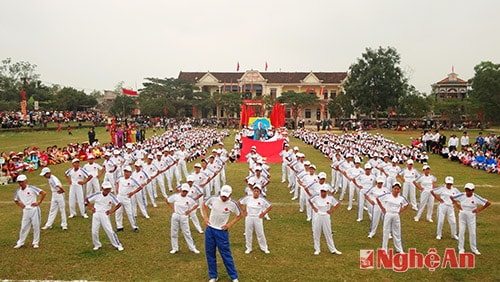 |
| A group exercise performance by the elderly of Nam Thanh commune, Yen Thanh district. Photo: Van Vinh |
After a life-threatening illness, researcher of Sino-Vietnamese studies Bui Van Chat is no longer as agile as he was a few years ago. Although confined to bed and having difficulty moving around, as long as his mind remains sharp, he remains dedicated to ancient inscriptions and poetry. People admire him because, despite prolonged hospital treatment, he still tries to silently recite a few Chinese characters every day. He knows that this helps him not forget the characters and reminds him of the many unfinished works he still has. Even after being discharged from the hospital, although his family still keeps an oxygen tank by his bedside in case his condition worsens, he becomes engrossed in each character and each translation whenever the pain subsides.
During his time in the hospital, friends, classmates, and representatives from various departments visited and offered encouragement. He was grateful that, even though he had to perform all daily activities in bed during his illness, his five children stayed by his side, taking meticulous care of him. This concern and worry motivated him to be strong and recover quickly so that he could continue working with his friends in the Han Nom Club on important projects such as research on the Imperial Decrees of Nghe An, the couplets of Nghe An, and the inscriptions of Nghe An...
In our province, many people who previously held important positions and responsibilities are now retired but are still willing to contribute their energy and intellect to many important provincial projects. Some of them are researchers, cultural figures, and artisans. Others are active members of associations such as the Gardening Association, the Senior Citizens Association, the Folk Literature Association, the Musicians Association, the Former Youth Volunteers Association, and the Veterans Association. In the highland districts, the elderly are trusted by the villagers and elected as village elders and heads. After retirement, cadres and Party members take on responsibilities as secretaries, village heads, or participate in various organizations and associations at the ward and commune levels. It can also be seen that thanks to this older generation, many organizations and governments have been able to harmonize with each other, with the elderly teaching and passing on their experience and knowledge to the younger generation. Conversely, younger generations, with their respect for the elderly and their appreciation for those who came before them, have provided additional motivation and strength for the elderly to continue striving and contributing until their last ounce of strength remains.
Over the years, the Project to Promote the Rights of Disadvantaged Elderly People in Vietnam has been implemented in the province, with Thanh Chuong being one of the leading and most effective localities. In particular, the activities of the young people in the intergenerational club who help and care for the elderly and lonely have received strong support and positive response from the general public.
Speaking about caring for the elderly in Nghe An province, Mr. Tran Huu Ich, Chairman of the Provincial Association of the Elderly, proudly stated that last year the Provincial Association of the Elderly received a commendation flag from the Central Association for its many achievements. Besides the results achieved in gathering members and building various movements, the Association of the Elderly has made many efforts in caring for and promoting the role of the elderly. On average, the province organizes birthday celebrations for over 90,000 members of the Association of the Elderly each year.
Local authorities have mobilized over 2 billion VND to give gifts to the elderly on holidays and Tet (Lunar New Year); supported over 5,000 elderly people in replacing their temporary houses; and established over 3,365 clubs of various types in 447 communes, attracting 169,998 elderly people to participate. Most members of the Elderly Association have actively participated in physical exercise, sports, and cultural and artistic activities. In some localities such as Nam Dan, they organized "Singing Contest for the Elderly" and a kite-flying club for the elderly; Quy Hop, Anh Son, and Quynh Luu organized wall newspapers for the elderly, and many commune associations published poetry books… Many grassroots associations have shown great interest in coordinating with health centers, hospitals, and pharmaceutical companies… to organize regular health check-ups, health communication, and health counseling; many places have received free medicine. Nearly 60,000 elderly people throughout the province receive monthly social welfare allowances, in accordance with state policies and regulations.
The above results show that, despite many difficulties, the care for the elderly in our province has received genuine attention in recent years. This reflects the tradition of "respecting the elderly brings longevity," which has been inherited and promoted for generations.
My Ha


