
Timely remedial measures for spring crop production.
(Baonghean) - To date, spring rice in our province has been sown and transplanted for 15-20 days and is currently in the vigorous tillering stage. However, due to prolonged cold spells, many rice fields have experienced slow growth and poor tillering. Strengthening timely care and supplementary measures for spring rice production to help the rice plants grow well and achieve high yields is a pressing issue for localities.
In the Cua rice fields of Minh Thanh commune, Yen Thanh district, many areas of sown rice are showing signs of yellowing leaves and frost damage in patches. Ms. Phan Thi Thao from Hamlet 8, who was thinning seedlings, shared: "My family cultivates 3 sao (approximately 0.3 hectares) of rice, of which 2 sao (approximately 0.2 hectares) of sown rice have suffered significant frost damage. We are focusing on thinning and replanting. Because we no longer have reserve seedlings, we have to accept a wide spacing to cover the entire area." Nearby, Ms. Phan Thi Vinh added: "We sowed 1.5 sao (approximately 0.1 hectares) before Tet (Lunar New Year), thinking we could enjoy the spring festivities without worry. But unexpectedly, the severe frost caused the plants to die and some to survive, resulting in uneven growth. Many patches of land had to be tilled and replanted with seedlings from other fields, which was very laborious."
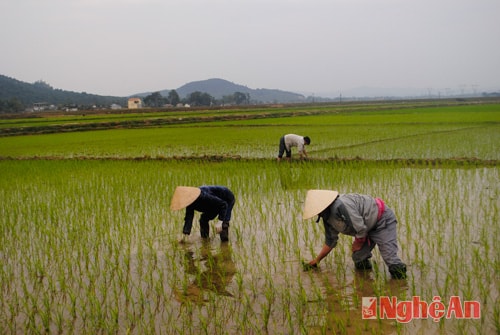 |
| Caring for the spring rice crop in Minh Thanh (Yen Thanh). |
Mr. Phan Phuc Hao, Chairman of the Minh Thanh Commune People's Committee, acknowledged: The commune had emphasized the planting schedule, especially prohibiting direct sowing, but due to complacency and a desire to complete planting early, out of over 220 hectares, approximately 40 hectares were directly sown. Currently, most of the transplanted rice is developing quite well, while the directly sown area has been affected by the cold weather, with rice dying due to frost and slow tillering. The commune is focusing on directing farmers to replant and fill in the areas where the directly sown rice has died. To date, over 60% of the directly sown area has been replanted. Another reason for the frost damage to some areas of Minh Thanh's spring rice crop is the lack of water. Minh Thanh, being a semi-mountainous commune, has long faced difficulties in water resources, mainly relying on water from reservoirs and dams. The commune is mobilizing forces to continue dredging canals and ditches along the Ho Lim and Ho Cau rivers to ensure water supply for the high-lying fields in the Cua and Thong Che areas.
This spring, Yen Thanh district planted 12,700 hectares of spring rice, including some communes that still used direct seeding, such as Minh Thanh, Thinh Thanh, and Quang Thanh. Due to severe cold weather, some areas of direct seeded rice died. Mr. Pham Van Duong, Head of the Agriculture Department of Yen Thanh district, said: For the direct seeded areas, the district directed that thinning and replanting should only be done on warm days with an average temperature above 15 degrees Celsius. Thinning and replanting should only be done in areas with significant crop loss or excessive density. In general, thinning and replanting should be limited because the rice plants will self-regulate: sparse areas will have more tillers, while dense areas will have fewer tillers, avoiding unnecessary thinning and replanting. To ensure good growth and development of the rice plants during this period, the district directed localities to advise farmers to implement technical measures such as focusing on weeding and soil aeration, creating good soil aeration, and changing the water 1-2 times. Soil aeration helps increase oxygen in the soil, promoting root development. Applying easily absorbable phosphorus fertilizer helps the rice roots develop healthily. It is especially important to regulate water resources for rice irrigation. During this stage, the rice needs to have a water level of 2-3 cm in the field to keep it warm. Avoid letting the field dry out or having too much water, as this will affect the tillering process and the rice plant's ability to stay warm.
In Do Luong district, taking advantage of the warm weather, people everywhere are focusing on caring for their spring rice crop. Mr. Bui Huu Thin from Hamlet 10, Van Son commune, Do Luong district, shared while spraying herbicide on his rice: "All three plots of rice were sown, but due to the cold, some plants died. We have finished thinning and replanting, but the replanted rice plants are showing signs of yellowing, black roots, and slow growth, and some areas have even died." Mr. Le Dinh Tri, Chairman of the People's Committee of Van Son commune, Do Luong district, added: "Van Son has over 211 hectares of spring rice, and 100% of it was sown. To overcome the problem of slow growth due to the severe cold, the commune has directed farmers to thin and replant on over 65% of the area, focusing on proper irrigation to keep the rice plants warm." Although located at the headwaters of the Van Trang pumping station system, due to many elevated areas, the water dries up when pumping stops, significantly affecting the growth of rice plants during this period of severe cold weather.
This spring, the entire Do Luong district planted over 7,500 hectares of rice, mainly by direct seeding. The district directed localities to thin out over 70% of the area and implement timely technical measures to care for the spring rice crop. In addition to weeding and stirring the mud, regular field inspections are necessary to monitor for pests, diseases, and rodent damage. The district focuses on regulating water according to technical regulations, maintaining a water level of 3-5 cm to promote tillering and protect the rice from cold. Furthermore, farmers are advised to supplement with root-stimulating agents, such as SOGAN super root-stimulating agent, mixing 1 packet per 12-16 liters of water. As the weather warms up, it is advisable to supplement with foliar fertilizers such as: Dau Trau 502 foliar fertilizer (mix 1 packet/8-10 liters of water, spray per 1 sao) or Magnisal foliar fertilizer (mix 1 packet/16-20 liters of water, spray per 1 sao) to help spring rice recover after severe cold weather. However, irrigation water supply remains challenging, especially in communes like Giang Son, Bai Son, Tru Son, and Nhan Son, which are located at the end of the water source, resulting in many areas still experiencing drought.
To increase the cold resistance of spring rice, the Department of Agriculture and Rural Development has requested localities to implement good rice care measures: For transplanted and direct-sown rice fields, when the rice has 2-3 leaves, maintain a water level of 2-3 cm on the field surface to prevent rice from dying due to lack of water; use post-emergence herbicides as directed; do not apply topdressing when the average day and night temperature drops below 15°C; supplement with superphosphate fertilizer if the temperature remains below 20°C for an extended period, combined with supplemental foliar fertilizer application. For newly direct-sown rice (without true leaves), maintain sufficiently warm water to prevent the field surface from drying out; when the weather warms up, promptly thin out seedlings to ensure sufficient density.
After the weather warms up, focus on early topdressing with high-content NPK compound and complex fertilizers specifically formulated to promote root development, greening, and tillering of rice plants. Inspect and assess the situation of crops damaged by cold weather (if any), especially for direct-sown rice fields, to guide farmers in preparing short-day reserve seeds and to plan for registration with seed suppliers to proactively address the situation promptly when necessary. For early-sown areas that are likely to flower before April 20th, focus on early care and topdressing to promote rice growth and development, effectively control pests and diseases, and closely monitor to evaluate and learn from experience for subsequent seasons. Manage and operate the irrigation system to provide sufficient water for crop care, ensuring warmth for the rice plants while using water economically and efficiently. Ensure sufficient water for spring rice cultivation and balance water supply for the summer-autumn and main crop production plans. Regularly inspect the fields to detect and control pests and diseases affecting crops in a timely manner; especially rice blast disease…
Text and photos:Van Truong


