
Kungfu Fighting: 10 Minutes to Become a Legend
At the recent Toyota Classics 2014 concert in Ho Chi Minh City, the entire audience at the City Theatre rose to their feet and danced as violinist Vasko Vassilev played the famous disco piece, "Kungfu Fighting." Many cheered with delight at hearing a timeless disco song reinterpreted in a classical style…
This is just one testament to the enduring vitality of Kungfu Fighting, which for decades has been considered one of the best disco songs in the world. On December 21st, Kungfu Fighting will turn 40 years old.
10 minutes for a legend
In the spring of 1974, the renowned Indian music producer, Biddu Appaiah, walked into the Pye Records studio in London looking quite exhausted. He had been racking his brains for days trying to figure out who to sing Larry Weiss's latest song, "I Want To Give You My Everything." This was a crucial single release for Pye Records, as they believed it would be a hit of the year. More importantly, the song would be on side A, while side B remained empty.
Suddenly, Biddu remembered Carl Douglas, a 22-year-old Jamaican singer who specialized in backing vocals and had performed the title track of the same name for the film Embassy, which he had released two years earlier, very well. Douglas had a strong, sustained voice and a "voice that seemed to conduct electricity, easily making listeners cringe." The only problem was, at that time, Carl Douglas was nobody and nothing in the vast world of music.
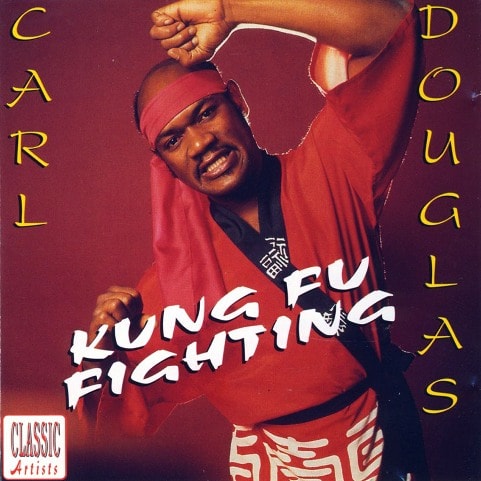 |
| Carl Douglas and the single Kungfu Fighting |
After thinking it over once more, Biddu Appaiah finally called Carl Douglas. On the other end of the line, Douglas immediately agreed. This engineering student wouldn't hesitate to do anything as long as he could get music contracts. The next day, Douglas showed up as scheduled. After receiving instructions and carefully reading the sheet music, Douglas quickly recorded the song "I Want To Give You My Everything." Everyone in the studio was very satisfied. There was only one problem: the back-side track was currently missing. Usually, the back-side track of a single plays a less important role compared to the front-side track, but this time, even a "prelude" song was absent.
Quite casually, Biddu Appaiah asked Douglas, "Do you have any lyric ideas? I have four or five songs but haven't written any lyrics yet and I'm completely stuck." Carl Douglas's eyes widened and he said, "Give them to me, I have a few ideas but no melody in my head." So Appaiah immediately gave his compositions to Douglas.
As if struck by lightning, exactly 10 minutes later Douglas handed Appaiah a complete composition, both music and lyrics. The song was titled "Kungfu Fighting." Biddu Appaiah stared at the score, unable to believe the result exceeded his expectations. Douglas sang a test version while explaining that he wrote the lyrics after suddenly remembering two children fighting with kung fu in the streets. At that time, Chinese martial arts were fashionable in England and America. Carl Douglas wanted to incorporate kung fu into the composition, and he cleverly added the words "hoos" and "haas," like a martial artist assuming a stance. These two words boosted the song's power, balancing the entire weight and creating a sense of excitement for the listener.
The song was completed in 10 minutes, and Carl Douglas needed exactly that much time to sing it. Biddu Appaiah was delighted, choosing a funk, disco-influenced arrangement for the song. Douglas's powerful vocals, combined with the lively arrangement featuring varied organ sounds and a fast-paced electric guitar, transformed "Kungfu Fighting" into an incredibly energetic and catchy song.
After recording, Biddu Appaiah played it for Robin Blanchflower, the owner of Pye Records. Blanchflower immediately stood up and said, "No need to think about it anymore, this song will be on side A." It only took 10 minutes to completely change the project with "Kungfu Fighting." At that moment, Biddu Appaiah thought to himself, "This song is going to sell 20,000 copies."
But he was wrong, at least for the first five weeks…
Late success
Kungfu Fighting became Pye Records' most important single and was released on December 21, 1974. Everyone involved in the project hoped Kungfu Fighting would be a hit. Surprisingly, for five consecutive weeks, no one paid any attention to the song. Only a few dozen copies were sold, and radio stations were silent. The British and American markets were already buzzing with disco, coupled with Bruce Lee's blockbuster films and a high kung fu craze, yet no one seemed interested in Kungfu Fighting.
After five weeks of silence, one day, Robin Blanchflower's assistant reported: "All the dance floors are playing 'Kungfu Fighting,' and everyone is absolutely obsessed with it." Just a few days later, 'Kungfu Fighting' was constantly being mentioned as dance floors created a craze, and radio stations immediately jumped on board to avoid being left behind. From there, 'Kungfu Fighting' beat all the hottest songs on the market, climbing to the number one spot in both the UK and the US, and then spreading worldwide.
After five weeks of gloom, Carl Douglas suddenly became a music hero overnight. The song propelled the Jamaican singer to stardom. It's worth noting, however, that this was the only hit song in Douglas's life, yet it was enough to provide him with a comfortable life for the rest of his days.
Kungfu Fighting became a flagship disco hit and one of the greatest disco songs of all time. It was played on radio stations for months on end, and record labels included it in numerous disco compilations. Contrary to initial predictions, it eventually sold 11 million copies, far exceeding expectations.
This song was subsequently used in numerous television shows and films. Most notably, it was used in the movie Kungfu Panda (2008) with vocals by Cee-Lo Green and Jack Black, which later became another hit.
Carl Douglas is now 72 years old and still lives comfortably thanks to the royalties from Kungfu Fighting. Looking back, he is still secretly grateful for Biddu Appaiah's call; but Biddu himself must also thank fate for prompting him to think of Douglas. In just 10 minutes, they and Kungfu Fighting, making a total of three, became a legend.
According to TT&VH


