
Signing a consent form before vaccination is against the proper procedure.
Vaccination procedures are usually very strictly regulated, but after several recent incidents related to vaccines, questions about vaccine storage, quality, and the qualifications of vaccination staff are causing concern among many people.
In particular, according to some media reports on July 30th, a parent complained that the Mekong Obstetrics and Gynecology Hospital (Ho Chi Minh City) required family members to sign a "Voluntary Registration Form for Newborn Vaccination" before administering the Hepatitis B vaccine, which has further increased public concern and confusion about this vaccination.
 Vaccinating children helps to combat many infectious diseases.
(Photo: Duong Ngoc/VNA)
Worried about having to sign vaccination papers?
Following the recent incident in which three newborns died at Huong Hoa District General Hospital (Quang Tri province), Dr. Nguyen Van Binh, Director of the Department of Preventive Medicine, acknowledged that the Ministry of Health's initial conclusions regarding the three cases revealed several errors in the vaccination process. These included storing vaccines together with other medical biological products, failing to retain vaccine vials after injection, and administering injections in a patient room instead of a dedicated vaccination room.
Concerns regarding vaccinations have resurfaced after a parent in Ho Chi Minh City expressed outrage because the Mekong Obstetrics and Gynecology Hospital required a signed consent form before vaccinating their child against Hepatitis B.
Regarding the incident at Mekong Obstetrics and Gynecology Hospital, the voluntary vaccination registration form for newborns clearly states: "After hearing the nurse explain the benefits and possible side effects of the Hepatitis B vaccination, I agree to vaccinate... me. Our family takes full responsibility for this decision." At the bottom, the family must sign this commitment form.
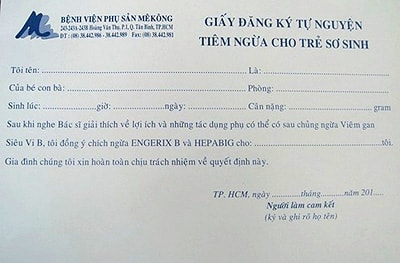
Sample form for voluntary vaccination registration for newborns at Mekong Obstetrics and Gynecology Hospital. (Photo: Contributor/Vietnam+)
Following the announcement that parents would have to sign a commitment form, many have expressed concerns.
Ms. Nguyen Hoang Hoa (from Nghia Tan, Cau Giay, Hanoi) said: “When I read the information about a hospital forcing family members to sign a commitment form before vaccinating newborns, I was really upset. Recently, there have been many cases of children dying after vaccination, causing people to worry. If I have to sign such a commitment form to vaccinate my child, it's like people are being held fully responsible if something bad happens after vaccination.”
Mr. Nguyen Dinh Van (Ba Dinh, Hanoi) commented that if all hospitals implemented this voluntary registration process, people would no longer want to have their children vaccinated. Mr. Van argued that if the content of the voluntary registration form is strictly followed, and an adverse event occurs, the responsibility would not lie with the healthcare sector, but the people would have to face and bear the consequences themselves.
When asked about concerns surrounding the issue of "Voluntary Vaccination Registration Form for Newborns," Deputy Director of the Central Obstetrics and Gynecology Hospital, Vu Ba Quyet, stated that the hospital currently does not require family members to sign a voluntary vaccination registration form before vaccinating their children. According to Mr. Quyet, requiring family members to sign a commitment form before vaccination is contrary to established procedures and goes against reality.
The head of the Central Obstetrics and Gynecology Hospital clarified that vaccinating infants against Hepatitis B within 24 hours of birth is part of the national expanded immunization program. At the hospital, only if the child's family disagrees with the vaccination after birth will they be required to sign a consent form to waive the vaccination.
According to Mr. Quyet, the recent incidents of children dying after vaccination serve as a wake-up call for vaccination centers to reconsider the strict regulations governing immunization.
When asked about this issue, the Director of Hanoi Obstetrics and Gynecology Hospital also stated that at the hospital, family members are not required to sign any commitment form when vaccinating children.
Vaccination is mandatory under the law.
Regarding the information about requiring people to sign commitment forms, which has caused public concern, the Director of the Department of Preventive Medicine, Nguyen Van Binh, affirmed that the hospital's requirement for people to sign commitment forms before vaccinating their children is unnecessary. What is important is that the health sector is responsible for organizing vaccinations effectively and conveniently for the people, and it is the responsibility of the people to have their children vaccinated within the eligible age range.
Mr. Binh explained that the vaccination program in the National Expanded Immunization Program is part of the Law on Prevention and Control of Infectious Diseases. Because this is a very large-scale program, the state provides free vaccinations, not only protecting children but also ensuring that the disease does not spread to the community. It is precisely because of this commitment to ensuring the health of the community that the state and the National Assembly passed the Law on Prevention and Control of Infectious Diseases.
According to Article 29 on the mandatory use of vaccines and medical biological products: “Children and pregnant women must use mandatory vaccines and medical biological products for infectious diseases included in the Expanded Immunization Program. Parents or guardians of children and all citizens are responsible for complying with the requirements of competent health facilities regarding the use of mandatory vaccines and medical biological products.”
Mr. Binh explained that the Law on Prevention and Control of Infectious Diseases stipulates that parents and guardians of children eligible for expanded immunization programs are responsible for bringing their children to vaccination centers. Specifically, within the community, parents must take their children to vaccination facilities for immunization. Furthermore, the health sector has the responsibility to organize immunization activities effectively.
In response to the question of who is responsible in the event of an error, the head of the Department of Preventive Medicine stated that the Law on Infectious Diseases clearly stipulates that during the implementation of expanded immunization programs, if adverse events occur that seriously affect the health or cause loss of life of vaccinated individuals, the State is responsible for compensating the affected parties. During the immunization process, if errors occur that cause serious consequences, such as issues with vaccine quality, storage, transportation, or organization of the immunization, the individuals or organizations involved must bear responsibility. However, the State is primarily responsible for this issue, and only then will an investigation be conducted.
Mr. Binh emphasized that, based on the strict regulations of the Law on Prevention and Control of Infectious Diseases, the health sector hopes that mothers, for the benefit of their children and the community, will bring their children to vaccination sites on schedule to better protect their children's health.
According to Vietnam+ - LT


