
Part III: Lau Restaurant - Northern Market
Part I:To Vinh
Part II:Dedicated people
My planned talk didn't happen. The brothers discussed it amongst themselves, consulted with respected elders, and the meeting turned into an exchange about the glorious past and the development of the Truong Thi - Ben Thuy Special Historical and Cultural Relic Area. Mr. Che picked me up on his motorbike and took me to Mr. Thanh Dong's house. His house is in Block 8, Truong Thi Ward.
 |
Mr. Thanh Dong was ill, so his wife, Ms. Bong, opened the small iron gate, made of a few crudely welded iron bars. The woman from Quang Binh, with her broad forehead, cheerful smile, and short, stocky build, was very familiar to me:
- He's sick, uncle. When did you come in? My spine is hurting, uncle! Hearing my voice, he told me, "That's your voice, uncle," but he couldn't get up yet, urging me to come out. Yesterday, my nephew Hai took Dad to the doctor and they even said he has a prostate tumor. He didn't seem worried at all, he said it's his age to get sick, just let it be. I'm trying to snatch some time to read and write. Oh... come inside, uncles.
Mr. Dong had a long beard, and his white hair still stood up on his forehead. When he visited a house with grandchildren, he respectfully addressed them as "uncle" and referred to himself as "younger sibling," but if it was just the elderly couple, he still addressed them as "older sibling" and referred to himself as "younger sibling," maintaining the same close and affectionate relationship as before.
Mr. Dong adjusted his posture, sitting upright, and the sickly appearance he had before vanished. He now resembled the editor-in-chief of a newspaper, and later the deputy head of the military district's propaganda department.
- You've successfully transitioned from a presenter to a meeting organizer. It's the work of many people, the wisdom of many people, the aspirations of many people. Some might let things go, let them pass, or forget about it, but people from Vinh, from Nghe An, will never forget, right? He chuckled softly, changing his tone.
- Do you think Vinh is changing quickly? I think Vinh is rising from ruin even faster than Phu Dong. Ten years after the liberation of the South and the reunification of the country, it was still struggling to find its footing. But more than twenty years after the reforms, Vinh is expanding day by day. It's becoming more modern every month, every year. But I must warn you, Uncle. People are using construction as an excuse to forget, and for the immediate benefit of a few individuals, perhaps a group of people, they are erasing the traces of a revolutionary era, a time of bombs and fire. The press must speak out, the arts must speak out. The voice of the press, of literature and art, always represents the people, the culture, and what endures. To give an example, the Quan Lau restaurant, which has existed since the time of Truong Thi, recently had a project planned to swallow it up.
Both Chế and I felt uplifted. I sat beside him, unable to hide my joy.
- Are those the remains of the Truong Thi Railway Factory, sir? Sir, back when Vinh was fighting, I led a reconnaissance team to find backup positions in case the main battle was fiercely contested, so we'd have a place to maneuver. We searched all over the Truong Thi area for the location of the Truong Thi Railway Repair Factory, but we couldn't pinpoint it precisely.
Mr. Dong smiled happily; it was the first time I'd seen him smile like that since he arrived at the house. Looking at his face, I knew he was suppressing pain.
- You know, coming from the North to Vinh, you first encounter Quan Hanh, then Quan Bau, Quan Banh, and near Ben Thuy, there's Quan Gio. Going towards Cua Dong, you'll find Quan Lau. Quan Lau is the location of the Truong Thi Railway Factory. There's also the Bac Ky Market there. The name sounds a bit strange, making newcomers curious to learn more. I've read some documents and understand it like this: Quan Lau - Bac Ky Market are two separate place names combined into one. According to reliable documents, after World War I (1914-1918), the French colonial government expanded its exploitation of Indochina. Vinh - Ben Thuy became the largest industrial city in North Central Vietnam and Central Laos.
I read a document provided by the director of the Nghe An Provincial Library which contained the following reliable figures: Some statistics show that the number of workers in Vinh - Ben Thuy before and after World War I was around 8000 people.
Although the number of workers in each factory was not recorded at the same time, with some variations over time, the total number of workers in Vinh - Ben Thuy was generally around 7000. This number is close to the statistics in the French yearbook. The proportion of workers in each sector is as follows:
- Workers in the transportation sector: over 3500 people, accounting for approximately 50%
- Workers in the forestry and fisheries processing and match production sectors: approximately 2500 people, accounting for about 30%.
- Workers in other trading companies and factories: approximately 1000 people, accounting for 14%
According to statistics, by 1925 the Truong Thi - Ben Thuy industrial zone had 25 factories and enterprises and 35 trading companies owned by the French, Vietnamese, and Chinese.
The statistics also show that in Vinh - Ben Thuy during this period, there was a large workforce of industrial workers (according to Karl Marx's classification). This workforce was most concentrated in the transportation sector, with the majority of mechanical transport workers in the District 1 Railway Department (Hoang Mai, Ngoc Lam), the Truong Thi Railway Repair Factory, and the Depot. The Truong Thi Railway Repair Factory, established in 1908, had 3,700 workers at that time.
After World War I, the factory was modernized, with state-of-the-art machinery imported from France, replacing manual labor. The number of workers decreased to 1,700. The depot in Vinh station had 400 workers, in addition to 550 mechanics repairing automobiles in private companies owned by French, Vietnamese, and Chinese people at three overhaul facilities: Pham Van Phu, Bach Thai Dao, and the Xa Ma Nan workshop.
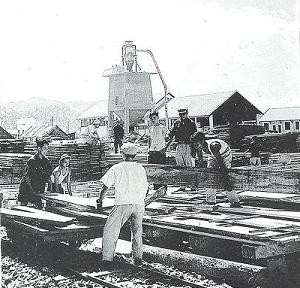
The earliest workforce in Vinh - Ben Thuy was in the fields of timber processing and match production. The timber processing workforce began to appear in 1897 when the Central Vietnam Forestry and Trade Company built a sawmill and wood processing factory. In 1904, the factory had 7 Europeans and 400 Vietnamese. The Lao Xieng sawmill, belonging to the Lao company, initially had 3 Europeans and 60 Vietnamese. In 1922, the Indochina Forestry and Match Company (SIFA) established the XI RI sawmill with 300 workers. The Ba Dinh sawmill had 100 workers. The Thai Hop sawmill had 120 workers. The Adriantich sawmill had 500 workers. In addition to those working at the sawmills, approximately 750 workers in Vinh - Ben Thuy were employed at the XI FA match factories.
The same document also states the following: “The vast majority of workers in factories in Vinh - Ben Thuy come from farming backgrounds in the surrounding districts and near Vinh city. In the case of the Truong Thi Railway Factory, a large portion of the workforce consists of workers from Northern Vietnam who were recruited from vocational schools and technical schools in Hanoi and the surrounding areas.”
Professional sawmills and carpenters were recruited from renowned craftsmen in neighboring districts, such as carpenters from Thai Yen, Duc Tho, Ha Tinh, and carpenters and masons from Vang village, Hung Nguyen, Nghe An.
A memoir by a worker from Vinh - Ben Thuy records: "Without land to cultivate, many farmers from the surrounding areas came to work as factory workers. In Yen Dung Ha village and De Cuu street, there wasn't a single family without someone working in the factory. There were families where both parents, wife, and children were workers in the Match Factory."
The case of Yen Dung village, where the French chose to build the Truong Thi railway repair factory, can be cited to demonstrate the close relationship between workers and their families, and their connection to village culture. Yen Dung village had 1,300 acres of rice fields. In 1902, the French took 102 acres to build the factory. In 1918, they took another 300 acres to build an airport. In 1929, they took another 300 acres. Besides the temple's 40 acres and landlords' 300 acres, the remaining area was less than 300 acres.
People from villages around Vinh - Ben Thuy flocked to the city to become workers. The French Indochina Economic Yearbook (1923-1929) indicates that by 1929, Vinh - Ben Thuy had over 7,000 workers. Compared to the population of Nghe An at that time (1,016,000), the number of workers accounted for about 7%. However, compared to the population of Vinh - Ben Thuy city (approximately 18,000), the workforce accounted for 38% (to reiterate, the workforce accounted for 38% of the population). Compared to Da Nang, Quang Nam had one of the largest worker populations in South Central Vietnam, with about 4,600 people. This number was not as large as Vinh, and they were not concentrated but scattered throughout Hoi An, the Bong Mieu gold mine, and the plantations.
Returning to the place name Quán Lau and the name Ghép Quán Lau - Chợ Bắc Kỳ (Quán Lau Market - Northern Market), one might think that this market primarily served the 3,700 workers of the Trường Thi railway factory, or perhaps most of the approximately 8,000 workers in Vinh - Bến Thủy (the French yearbook reported over 7,000 workers). The lives of these industrial workers depended on their meager wages. They would go to the market in the morning for a quick meal. Lunch and dinner were eaten at roadside stalls, what is now called "street food." There was a natural, mechanical concentration of industrial workers in Quán Lau - Chợ Bắc Kỳ.
The revolutionary leaders keenly grasped the close ties between the peasants (wives, children, families, and neighbors) and concentrated a large force of workers with a certain level of political awareness to propagate and rally their forces. Looking at me and Mr. Che, Thanh Dong's sharp eyes revealed: "The location of Quan Lau demonstrates the keen vision of the Soviet movement's leaders. From the directions of Highway 1, peasants from Nghi Loc and Dien Chau poured in; from Hung Nguyen, Nam Dan, and Do Luong flowed in through the West Gate; from Ben Thuy came people from Nghi Xuan and Duc Tho. This historic gathering of forces culminated in a massive rally on May 1st, 1930. For the first time, the worker-peasant alliance emerged as a huge revolutionary force, marching to Ben Thuy, where the XI FA match factory and many other factories and enterprises were located, to give speeches, hold rallies, demand the right to live, and hoist the Party flag on lampposts at the intersection. The French colonialists brutally suppressed the movement, shooting and killing Tran Canh Binh and Nguyen Don Nhan." The uprising of the masses, the armed nature of the struggle for independence, freedom, and democracy, and the survival of the people were demonstrated in this great worker-peasant demonstration.
Mr. Thanh Dong looked directly at the two of us:
- To talk about building the Vinh - Ben Thuy tradition, we must start from the Soviet era of 1930-1931. Vinh is now a Class I city, and in the future, it will develop even more extensively, both in area and influence, throughout the North Central region and as a gateway to the sea for the Central region of our neighboring country, Laos. Therefore, it is necessary to affirm the position of Truong Thi - Ben Thuy, where the remaining traces on the ground, Quan Lau, can be considered unique. You should go to the air defense unit protecting Vinh and see the military topographic map; it still records the place name Quan Lau, and the place name of the Truong Thi factory area is still highlighted in bold. In short, raising the issue of building the Truong Thi - Ben Thuy Special Historical and Cultural Relic Area is very appropriate. It commemorates an entire era of revolution and resistance against foreign invaders. It honors the heroic spirit of the people of Vinh - Ben Thuy. It honors the culture of Nghe An province, and the culture of the Central region, a convergence of cultural essence from many regions. This is a great task, a responsibility before history, and a leader, someone holding such a weighty position, cannot let it slip away. I am now a veteran, an ordinary citizen, 78 years old (in Vietnamese, 79), my strength has diminished, but my pen is still steady, and if further discussion is needed, I will still contribute my opinion.
Dao Thang


