
A small memento with the hero Ya Tho Tu
(Baonghean) - On May 19, 1959, at the 4th Military Region Command in Vinh City, we were attending a celebration of President Ho Chi Minh's birthday when we received news that the 2nd Pathet Lao Battalion, commanded by Mr. Ya Tho Tu, had withdrawn from the Plain of Jars. Immediately, several units of the Military Region and the Nghe An Provincial Military Command marched rapidly to the Vietnam-Laos border to meet the 2nd Battalion. After 12 days and nights of fighting the enemy and finding a way through many deep streams and high mountain passes, enduring many hardships, hunger, and thirst, on June 1, 1959, the entire 2nd Battalion and their families gathered in Hoa Binh village, Muong Xen (Ky Son).
(Baonghean) - On May 19, 1959, at the 4th Military Region Command in Vinh City, we were attending a celebration of President Ho Chi Minh's birthday when we received news that the 2nd Pathet Lao Battalion, commanded by Mr. Ya Tho Tu, had withdrawn from the Plain of Jars. Immediately, several units of the Military Region and the Nghe An Provincial Military Command marched rapidly to the Vietnam-Laos border to meet the 2nd Battalion. After 12 days and nights of fighting the enemy and finding a way through many deep streams and high mountain passes, enduring many hardships, hunger, and thirst, on June 1, 1959, the entire 2nd Battalion and their families gathered in Hoa Binh village, Muong Xen (Ky Son).
Mrs. Tho Tu endured a difficult trek through the jungle, but her pregnancy became difficult, causing her to fall behind. Mr. Tho Tu, busy commanding his unit, had no choice but to leave his wife and children behind, entrusting them to the protection of Laotian guerrillas who would escort them later. The guerrillas were all captured by the enemy, leaving Mrs. Tho Tu alone to take her children to the other side of the Nam Mo River near Muong Xen. Exhausted and starving, she didn't know what to do when a boat from the Vietnamese volunteer army arrived in time to pick her up and take her to Vinh to give birth.
I first met Ya Tho Tu at the Vinh City Liaison House, at a Vietnamese banquet celebrating the victory of the 2nd Battalion and the Lao revolutionary armed forces. The banquet table was set; on the Lao side were comrades Khamtay Siphandon, Kaysone Phomvihane, and many leading officers of Lao army units and the command staff of the 2nd Battalion. On our side were generals from the Ministry of National Defense and the 4th Military Region Command.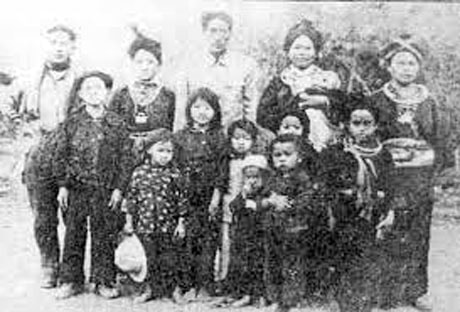
Son Hung (left), Thao Tu (middle) with their family.
I gazed intently at Tho Tu and recalled hundreds of stories and anecdotes about him. I imagined him to be a majestic, imposing figure with slanted eyes and thick eyebrows. But unexpectedly, Tho Tu, despite his tall stature, had a gaunt face with a high nose bridge and bright, gentle eyes.
Later, the 120th Regiment of the 4th Military Region handed over the entire barracks in Xuan Thanh to the 2nd Pathet Lao Battalion, which stayed there for a period of time for study, training, equipment, reorganization, and preparation to return to fight for the liberation of Laos. Knowing that I was a former Vietnamese volunteer soldier who fought against the French in Central and Lower Laos and had a special relationship with the family of President Souphanouvong, Tho Tu received me warmly like a brother. He said, "I consider Prince Souphanouvong as my father. So we are brothers." When the Hmong people say, "We are brothers," they don't hide anything from each other. Outside, it was drizzling and chilly. By the fire in the middle of the earthen floor of the bamboo house, we roasted cassava roots together and listened to Tho Tu's stories. He was very sad and felt sorry for his wife because the arduous march to escape the encirclement had caused her to have a miscarriage; she gave birth in Vinh but the child died. Then he told stories about the Hmong people fighting the enemy, and about the Vietnamese brothers who helped him in the fight. He recounted that when he formed the Coong Pat Chay (Lao guerrilla) to fight the French, shortly afterwards, an official named Phia Hom also formed a unit of Lao Lum people who revolted against the French. Upon hearing this news, the Vietnamese volunteer army sent Ngo The Son to Laos to contact the two men, calling on the Lao and Vietnamese tribes to unite against the French. Phia Hom, Tho Tu, and The Son, having lived near each other for some time, came to know each other and considered each other like family. The three went to a temple on a mountain and swore an oath by pricking their fingers together. They swore that the Lao Lum, Lao Sung, and Vietnamese people would unite to fight the French to the end; to live and die together, to face danger, hardship, hunger, and thirst without abandoning each other; and that if anyone survived, they would have the duty to guide the wives and children of the deceased to safety.
Then Vietnam called Son back to take on another assignment. Son returned to Vietnam, missing Tho Tu terribly, and immediately sent his sworn brother, Viet Son Hung, to live alongside and assist Tho Tu. Tho Tu cherished the Vietnamese volunteer soldier Thao Hung (Viet Son Hung) as much as he cherished Ngo The Son, and married his beautiful youngest sister, Ymo, to Hung. Thao Hung lived and fought in Lao units just like a Lao...
Shortly after our parting in Xuan Thanh, I heard on Pathet Lao radio that the Lao People's Revolutionary Party and the Lao Resistance Government had honored Tho Tu and the 2nd Battalion as Heroes of the Lao Armed Forces. In February 1961, I received news that the hero of Lao legends, Ya Tho Tu, had died.
In Hanoi, Mr. and Mrs. Ngo The Son kept their vow to Tho Tu, caring for Tho Tu's wife and children as if they were their own family. The Vietnamese-Lao relationship between Thao Hung and Ymo resulted in 10 children, both sons and daughters, all of whom grew up, received a good education, joined the revolution, worked for the Government and the National Assembly, and became engineers, doctors, PhDs, and officers in the Lao army.
The children of Tho Tu whom we welcomed at the Nam Mo River when the 2nd Battalion retreated in 1959, under the patronage of their foster father Ngo The Son and educated in Vietnamese schools, are now high-ranking officers in the Lao army, such as Kham Beng, Anong, and Pani, who is now the President of the Lao National Assembly.
Several years ago, Mr. Ngo The Son passed away in Ho Chi Minh City, and before that, Thao Hung also died in Xieng Khouang. Now, in Noong Het, Tho Tu's hometown, the graves of Tho Tu - a hero of the Lao armed forces - and Thao Hung, a Vietnamese volunteer soldier, are buried side by side.
Mrs. Tho Tu, the famous Hmong guerrilla fighter of Xieng Khouang in the past, has become a compassionate old woman. All day long she searches for plants, leaves, roots, and tubers to make traditional Hmong medicines, using them to help those suffering from incurable diseases. When I visited, she clasped my hand tightly and said, "If you Vietnamese children are sick, just tell me. I'll find the plants and leaves to cure you." If anyone asks if she remembers her husband, she smiles sadly and says, "Tho Tu? That man... he was... really..." Then she quietly wipes away her tears with a handkerchief.
Tran Cong Tan


