
Memories with Truong Sa
(Baonghean) - More than a year ago, the ship HQ561 left Cam Ranh military port, cutting through the waves to begin its voyage to take us to Truong Sa.
For the first time on a long sea voyage, and to Truong Sa at that, we young reporters all felt a strange mix of emotions. We were excited, nervous, anxious, and deeply moved. Trying to overcome and forget the terrible seasickness in the middle of the ocean, we were transferred from the HQ561 ship to the islands to visit the people and soldiers of Truong Sa. Names that have become legendary, like Da Lat, Len Dao, Co Lin, Sinh Ton, Truong Sa Dong, Truong Sa Lon... suddenly felt so familiar and close. On our first visit to Truong Sa, we young reporters were captivated and delighted to capture images of the steadfast soldiers at sea, the fishermen making a living in the open ocean, and the children learning their lessons on the waves.
 |
| The author with the soldiers from Nghe An on Truong Sa Island. |
For journalists who have worked in the Spratly Islands, the most enjoyable experience is working under extraordinary conditions. On the ship's deck, on the CQ boat, under the scorching sun that burns and burns the skin, they race against the tide to capture beautiful moments of the engineering soldiers. Reporters have to seize every hour and minute to take notes, film, and take photos, while also knowing how to find a 2G signal to transmit news and articles back to the newsroom in a timely manner... Then, the next day, upon arriving at another island, all the journalists, young and old, excitedly turn on their laptops and phones to show each other their articles sent the previous day, like children showing off their new clothes. In the midst of the vast, stormy archipelago, being able to check information online, to view and discuss their work, who wouldn't be delighted...
At every island I visited, I met soldiers from Nghe An with their distinctive accents, their tanned but muscular and resilient faces. They tried to talk as much as possible, enthusiastically recounting stories of their hometowns and families to their fellow countrymen. When leaving the islands, besides hugs and firm handshakes, the soldiers all said, "If you ever have the chance to travel through our hometown on business, please come visit us, journalist"... I still vividly remember the story of Nguyen Van Hung, a soldier who steered a boat on Truong Sa Dong Island, originally from Phuc Tho, Nghi Loc district.
The day we arrived on the island was also the day Hung's first child turned three months old. A few months after getting married, Hung received orders to go to Truong Sa Dong. Although he called every day, Hung hadn't been allowed to go home on leave to hold his child. That day, before saying goodbye, the young soldier sent four cans of canned meat as a gift for his child. This was his standard ration, which he had set aside. Along with the cans of meat, Hung also sent a dried square-shaped sea almond and a sea snail, carefully stored in his backpack. "The gifts from a soldier in Truong Sa are just these, but they carry so much love. We miss our wives and children, we miss our families, but we always strive to complete our assigned tasks, guarding every inch of the sea, every coral reef, and every inch of the airspace of our homeland," Hung confided.
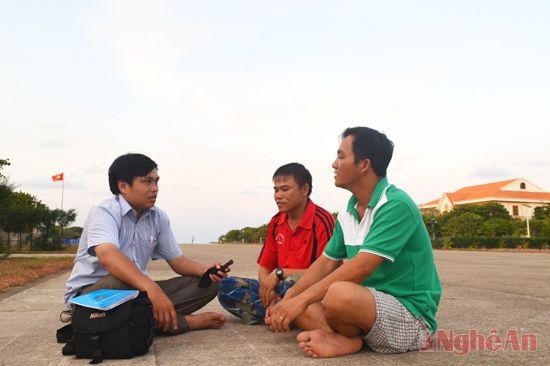
On Truong Sa Lon Island, we met a family from Dien Chau district. When we visited this fellow countryman's family, he was very surprised and spoke enthusiastically about his fishing village of Dien Bich, his arduous journey to settle in Truong Sa, and the warm, close bond between the soldiers and civilians amidst the stormy seas. That day, while I was excitedly talking about my hometown in Nghe An, my vision suddenly blurred, and I saw the house wall as if it were about to collapse. The homeowner immediately reminded me in his thick Dien Chau accent, "The journalist is feeling seasick." It turned out that, having struggled to maintain balance on boats and ships for so long, he had lost his balance upon arriving at Truong Sa Lon Island and being in contact with the mainland for so long. I had had the opportunity to visit many islands near the shore, to the homeland of the heroic Hoang Sa Naval Squadron, and to sail with fishermen from Quynh Luu in the shared fishing grounds of the Gulf of Tonkin, but when I heard the Truong Sa fishermen explain their seasickness, I was still surprised.
It's only now that I realize, for so long, that being a journalist, traveling and interacting with many people, meant I already knew and understood a lot. But going to Truong Sa (Spratly Islands) made me realize how small I am and how much more I need to learn, experience, and improve myself...
Text and photos:Nguyen Khoa


