
Techniques for cleaning and disinfecting livestock pens.
(Baonghean) - As we know, in recent years and currently, the situation of livestock and poultry diseases in our country has been extremely complex. Dangerous diseases such as foot-and-mouth disease in livestock, avian influenza H5N1, H7N9, etc., have been continuously emerging, developing, and spreading, causing great losses to livestock farmers and the livestock industry in terms of economics, human lives, society, and the ecological environment. One of the three risks leading to disease outbreaks in livestock farming is an unsafe farming environment. Therefore, in response to and contributing to the successful implementation of the nationwide Disinfection and Sterilization Month launched by the Ministry of Agriculture and Rural Development from February 22, 2014, aimed at limiting diseases, increasing productivity, raising income, improving the economic, social, and environmental lives of livestock farmers and the community, we would like to introduce some technical requirements for hygiene and disinfection of livestock barns and equipment as follows:
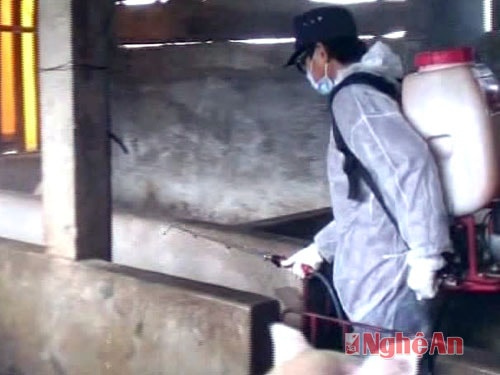 |
| Disinfectant spraying in Lang Son commune (Anh Son district). |
1. Objects requiring cleaning, disinfection, and sterilization:
- Livestock barns and all livestock equipment and supplies.
- Items and vehicles entering and exiting...
2. Timeframe for cleaning, disinfection, and sterilization.
- Sweep and clean the inside and outside of the livestock pens daily.
- During periods without disease outbreaks: Disinfectant spraying should be carried out once every two weeks or once a month.
- During an outbreak: Disinfect with spraying twice a week, continuously until the outbreak is over.
- After each batch of animals is sold, the pens must be cleaned, disinfected, and left empty for over a week before raising new animals.
3. Requirements for disinfection:
- Livestock farmers need to choose disinfectants with a broad spectrum of action (effective against many types of pathogens), suitable for the target of disinfection, and with low toxicity to humans and the environment.
- Use according to the manufacturer's instructions, avoiding direct spraying onto the animal.
- Workers must be aware of the dangers of pathogens and disinfectants, use full personal protective equipment when working, and strictly follow disinfection procedures.
4. Principles of hygiene and disinfection:
- Mechanical cleaning (removing feces and other contaminants) is necessary before disinfection.
- Disinfection and sterilization must be carried out from clean areas to dirty areas.
- Only use disinfectants after the surface has been cleaned…
- After spraying, allow the area to dry completely before use.
5. Steps for cleaning, disinfecting, and sterilizing.
a/. For empty pens.
Step 1: Clean the animal enclosures.
- Collect all manure and waste for composting using biological preparations in the absence of disease outbreaks, or bury it 0.5m – 1m deep in the ground in case of disease outbreaks. Clean dust and cobwebs from ceilings, animal enclosures, etc.
- Use clean water to scrub all floors, walls, feed troughs, water troughs, and livestock equipment. Then, wash with soap or a 2-3% concentration of NaHCO3 salt mixed with water. After 1-2 hours, when the surfaces are dry, proceed with spraying disinfectant.
Step 2: Spray disinfectant.
The disinfectant is sprayed to thoroughly wet the surface in the following order:
- Spray the ceiling, partitions, and walls from top to bottom. Then spray the insecticide on the barn floor, feed troughs, water troughs, etc.
- Before resuming farming, carry out a second disinfection and sterilization process similar to the above. Wait at least 12 hours before releasing livestock and poultry into the barn.
b/ Regarding livestock farming equipment:
- Remove all livestock equipment from the barn. Wash the equipment thoroughly with water before disinfecting it.
- Soak feeders and waterers in a disinfectant solution according to the manufacturer's instructions.
- Instruments that cannot be washed or disinfected can be fumigated with a mixture of formaldehyde and potassium permanganate.
c/ For means of transport:
- This includes: vehicles transporting feed and livestock equipment, which should have manure, garbage, and waste collected and swept inside, and then washed with clean water, soap, and detergent;
- Spray disinfectant on the floor and sides of the vehicle (both inside and out), and wait at least 60 minutes before loading goods onto the vehicle.
d/ Disinfecting and sterilizing livestock and poultry enclosures:
- It is required to select disinfectants that do not irritate the skin of livestock, poultry, and people who come into contact with them.
- Calculate the volume of the animal enclosure that needs disinfection: (length x width x height)
- Use a pressurized sprayer to apply the disinfectant according to the manufacturer's instructions.
e/ Disinfection and sterilization of water sources used:
- Drain all the old, contaminated water from the tank, rinse the tank with clean water, and disinfect the entire tank volume with a 2-3% concentration of Chloramine B. After 60 minutes, rinse again with clean water and pump new water into the tank.
The above are some important technical requirements for hygiene, disinfection, and sterilization. We hope everyone will pay attention and implement them properly to achieve the best results in their livestock farming.
Quang Phung(Anh Son Agricultural Extension Station)


