
Memories of an old soldier...
At the Museum of Military Region IV, Major Ngo Thi Nga showed me some recently acquired war relics. These included a padded jacket, a military uniform, a canteen, and a Third-Class Soldier's Medal belonging to Mr. Tran Van Trong (born 1933, Block 3, Doi Cung Ward, Vinh City). Behind the faded fabric of the jacket and the dented canteen lying there, I sensed the life of a soldier, both arduous and glorious in its victories…
(Baonghean)At the Museum of Military Region IV, Major Ngo Thi Nga showed me some recently acquired war relics. These included a padded jacket, a military uniform, a canteen, and a Third-Class Soldier's Medal belonging to Mr. Tran Van Trong (born 1933, Block 3, Doi Cung Ward, Vinh City). Behind the faded fabric of the jacket and the dented canteen lying there, I sensed the life of a soldier, both arduous and glorious in its victories…
Along the march
The owner of the artifacts recently brought to the Museum of Military Region IV is a man with gray hair and wrinkled skin, but still sharp-minded and healthy. He greeted us and recounted his story of participating in the resistance against the French, beginning with his time in Hue as a liaison for the National Guard. Mr. Trong is from Huong Phong, Huong Hoa, Thua Thien Hue. From a very young age, he had to work for landlords, single-handedly tending a herd of nearly 30 buffaloes from dawn until dusk. One day, the poor boy met a National Guard soldier who told him stories of combat and asked him to be a liaison. He bravely left his entire herd of buffaloes in the forest and followed them to join the revolution. That was in 1948, when Tran Van Trong was not yet 15 years old.
“Back then, we just went like that. We weren't old enough, so we weren't soldiers yet. We left in 1948, but it wasn't until October 10, 1949, that we were officially recognized as soldiers and issued uniforms and equipment. For that whole year, we just ate the soldiers' meals, worked as messengers, and followed the older soldiers around,” Mr. Trong said.
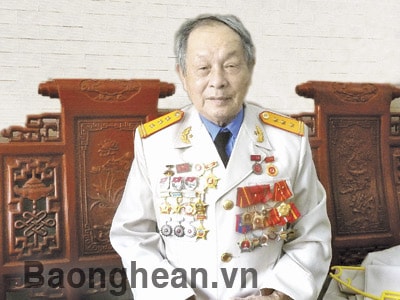
Mr. Tran Van Trong
During that period, there were three regiments in Binh-Tri-Thien: Regiment 101 in Thua Thien Hue, Regiment 95 in Quang Tri, and Regiment 18 in Quang Binh, which later merged to form Division 325 of Military Region 4. Tran Van Trong fought in Regiment 101. Participating in the war against the French during the most difficult, arduous, and fierce years of our people's resistance, the young soldier Tran Van Trong went through dozens of battles: Thanh Lam Bo, Thanh Thuong, Duong Hoa, An Gia, Bo Trach… “In the Thanh Lam Bo battle, we captured a French officer, a lieutenant. After that victory, I was awarded a medal, the one I recently donated to the museum.”
Mr. Trong continued, saying that in 1953, his unit went on a campaign in Central and Lower Laos to coordinate with the Dien Bien Phu Campaign. They roasted salt to eat along the way, packed meat in bamboo tubes, and carried guns and ammunition on their shoulders, each person carrying 4-5 kg of supplies. “What I remember most is the trip through Huong Son, Huong Khe (Ha Tinh), along Highway 12, there's a pass called Phu Ac Pass, I still remember it to this day. If you leave the top of this pass at 12 noon, you won't reach the bottom until 12 midnight. As soon as we got down, we received a telegram saying that two battalions of North Korean Foreign Legion soldiers had arrived and were stationed 4-5 km away from us. So, without rest, the soldiers marched 4 km to fight the enemy, without preparation or fortifications – it was a full-scale assault. We won the battle, capturing four 75mm cannons and hundreds of prisoners. Later, we dismantled two of those cannons and sent them to the Dien Bien Phu battlefield.”
After fighting for about five days, the regiment received orders to liberate Ta Khet commune in Khammouane (Laos). They marched and fled, through the night. The weather was extremely harsh, sunny during the day and freezing at night. By the time they reached Ta Khet, the enemy had already retreated. The General Staff ordered Regiment 101 to continue its march toward Central and Lower Laos. This continued intermittently, sometimes participating in direct combat, sometimes dispersing into small squads to build bases and participate in elections for the neighboring country.
In April 1954, during the fierce Battle of Dien Bien Phu, the 101st Regiment received orders to withdraw, along with the mission of escorting two Laotian liberation battalions to Phong Xa Ly and Sam Neua. Upon reaching Huong Khe, Ha Tinh province, they were handed over to the Laotian authorities. At that time, Dien Bien Phu had been a great victory, the Geneva Accords had been signed, and his unit was ordered to be stationed in Dong Hoi. With a large number of soldiers, they couldn't stay in civilian houses indefinitely, so the soldiers went into the forest to cut wood for building houses. At that time, they told each other, "We only have two years, so let's cut small trees, not too big ones. Because after two years, there will be negotiations for the national general election, and it would be a waste to abandon them." No one could have imagined that the national resistance would continue for another 20 years.
For his part, young soldier Tran Van Trong was sent to study culture, and later sent to China to train as a pilot, becoming a tenacious and courageous soldier of the Vietnamese Air Force at that time.
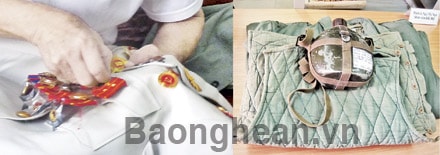
Battlefield relics donated to the Museum of Military Region IV.
I had the opportunity to meet President Ho Chi Minh three times.
The most precious memories for veteran Tran Van Trong are his three encounters with President Ho Chi Minh. Although each time was brief, just enough to hear a few words of advice from the President and to gaze upon the Father of the Nation in person, it was something "not everyone is lucky enough to have." His first encounter with the President was in 1955, when Mr. Trong was sent to study in Hanoi. After three months of study, there was a dress rehearsal to welcome the Central Committee of the Party and President Ho Chi Minh back to the capital from Viet Bac. That day, the soldiers were rehearsing at Bach Mai Airport. After getting dressed, they were ordered to stop to meet with visiting superiors. “We only knew he was our superior, but we didn't know who he was. Exactly at 4 p.m., we suddenly heard a loud commotion from behind, and everyone shouted, ‘Long live President Ho Chi Minh!’ At that moment, there was no longer any formation; everyone rushed out to greet him. He said, ‘Children, gather back into your old formations. Tomorrow is the parade, a very important day. You must show yourselves as a victorious army. Many compatriots and international guests will be watching. Now, those of you who are on the right, step forward first. Tomorrow, when you pass the reviewing stand, you will be looking straight ahead, so you won't be able to see me. Therefore, today you should step forward so you can see me clearly.’ We only met for 10 minutes. He led all the soldiers in singing a song of unity, and then hurried away. It was so brief, yet the image of him, his attention to even the smallest details, will stay with me for the rest of my life and I will never forget it,” Mr. Trong recounted.
Two years later, Tran Van Trong studied diligently day and night and was selected as one of 120 trainees to go to China to train as a pilot. Before their departure, the 120 outstanding soldiers were informed that a superior officer would be visiting. As before, they didn't know specifically which superior officer would be visiting. Gathering at house number 3, Pham Ngu Lao Street, Hanoi, at approximately 6:45 AM, General Nguyen Chi Thanh himself arrived and said, "Comrades, get ready." Then, precisely at 6:00 AM, everyone lined up neatly, looking towards the gate, and saw a tall, thin, unassuming figure approaching. “We recognized it was Uncle Ho. Meeting and talking with us, he spoke in a very simple yet sincere and profound way. He urged us to study hard. He said our task of studying abroad was extremely important, to serve the long-term resistance war. Later, when the young soldiers had become seasoned in combat, they cherished those moments even more, and remembered Uncle Ho's words of advice even more.”
The third time he met Uncle Ho was when the soldiers who had been sent to training years earlier had returned and become real pilots. In 1964, when the US fabricated the Gulf of Tonkin incident and launched a bombing campaign against North Vietnam, air force soldiers like Mr. Trong fought bravely, courageously, and with unwavering determination. Every battlefield is fierce and important, and the air battlefield is no exception. Although our aircraft could not compete with the modernity of the US Air Force, we fought with patriotism, resourcefulness, and determination to defeat the enemy. That year, while on duty at Noi Bai Airport, Tran Van Trong had the opportunity to meet Uncle Ho, along with other high-ranking leaders of the Party and State, including Le Duan, Truong Chinh, and To Huu…
In 1985, after fulfilling his duty to the country, Tran Van Trong retired with the rank of Lieutenant Colonel, deciding to spend the rest of his life in Nghe An province. This is the hometown of his wife, Dang Thi Huong Nhan (born in 1933). They met in battle and became husband and wife. She was also a performing artist who served soldiers on other battlefields. After peace was restored, they were fortunate enough to be reunited, but his sworn brother – the husband of Ms. Nhan's older sister – had passed away. Out of loyalty and a sense of duty, he stayed to care for his wife's sister and offer incense to his sworn brother, so he did not return to Hue. Nearly 30 years have passed, during which he actively participates in the Veterans Association and other Party and mass organization activities in his neighborhood and ward, living a simple life and raising his children to be successful.
Of the 120 comrades in the Air Force unit from those years, more than 80 have passed away. Those who remain are now of advanced age. War memories are preserved in black-and-white photographs, military uniforms, and medals for outstanding soldiers, liberation fighters, and glorious soldiers. He donated some of these mementos to the Museum of Military Region IV, keeping the rest as personal keepsakes, a way to cherish the past war years and live a peaceful life worthy of his fallen comrades.
Text and photos: Ho Lai


