
Memories of the legendary Christmas tree formation at AC Milan
The club, which recently celebrated its 117th anniversary, is the elder sister of Italian football in Europe. They are loved all over the world and had a great decade at the beginning of the 21st century with the magical playing style that was the trademark of Carlo Ancelotti.
AC Milan was founded on December 16, 1899, just one week before Christmas, when twinkling Christmas trees heralded the arrival of the holiday season. 102 years after its founding, AC Milan brought back to San Siro the legendary defensive midfielder of the Sacchi era, Carlo Ancelotti, to lead the team. The man from Reggiolo created the team's third successful cycle with a Christmas tree-shaped formation (4-3-2-1). This formation is a powerful reference to AC Milan's founding day, when the song Jingle Bell echoed through the streets.
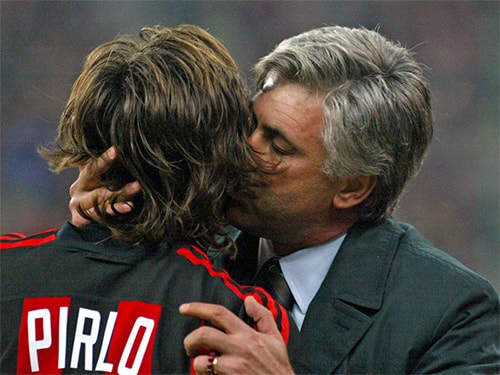 |
| With Ancelotti, Pirlo, and the "Christmas tree" formation, Milan experienced some of the most vibrant and exciting periods in their 117-year history. |
To create this groundbreaking tactical approach, Ancelotti embarked on a journey that began with the most important figure in Carlo Ancelotti's empire. That figure was the cornerstone of AC Milan's tactics for the first 10 years of the 21st century, yet he remained too quiet and unassuming to be in the spotlight – Andrea Pirlo.
At the 2000 European U21 Championship, Pirlo emerged, playing just behind a striker like a classic number 10. He arrived at Inter Milan during their turbulent years and was loaned to Brescia. At this smaller club, he was moved 15 meters back by a masterful coach, Carlo Mazzone. This historical turning point provided a major inspiration for the tactical system that later propelled Milan to dominance: a deep-lying playmaker would be the "gateway" to the formation known as the "Christmas tree."
At that time, Ancelotti had just been called in to replace Turkish coach Fatih Terim at the start of the 2001-2002 season. With the instincts of a former defensive midfielder, he recognized that Pirlo possessed a quality that could create a new dynasty he was about to build: the ability to orchestrate play from just above the defensive line, and Pirlo was the foundation of that project. Thanks to his perfect long-range passing ability, coupled with his brilliant game reading, Pirlo could initiate attacks immediately after a pass. Everything became much easier for Milan, because Andrey Shevchenko and Pippo Inzaghi were excellent at receiving those crosses.
The formation that Milan used to win the 2002-2003 Champions League was a 4-3-1-2 with a back four of Kaladze, Maldini, Nesta, and Costarcurta. Pirlo, Gatusso, and Seedorf formed the midfield, while Rui Costa played as an attacking midfielder behind Pippo and Sheva. Ancelotti fielded three creative players simultaneously: Pirlo, Clarence Seedorf, and Rui Costa – two playing in an advanced position and one dropping deeper. Therefore, for this artistic midfield to function effectively, Ancelotti needed the second most important player in the "Christmas tree" formation – Gennaro Gatusso.
Gattuso wasn't simply about providing space for Pirlo to orchestrate the attack; he was also the one who "pumped blood" into the entire midfield. Gattuso's fighting spirit allowed Seedorf to comfortably combine with Rui Costa. Thus, a great Milan was born, with a midfield that functioned like a perfectly aligned chain of gears.
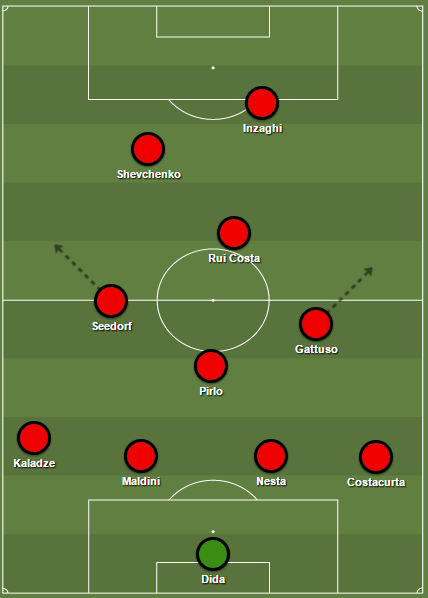 |
| Rui Costa, Seedorf, Pirlo, and Gattuso were the building blocks upon which Ancelotti constructed and maintained his Christmas tree formation throughout his eight years managing Milan. |
In the 2003-2004 season, Milan brought a young Brazilian to San Siro to gradually replace Rui Costa, who was past his prime, and what they got was more than that – a genius. Kaka – that's the name of the young man – three years later, pulled Milan's struggling team straight to the 2006-2007 Champions League title.
With Kaka, the Christmas tree formation became a 4-3-2-1, the defense underwent a major shake-up with Stam and Cafu moved to play alongside Nesta and Maldini, while Kaka positioned himself slightly further forward than Rui Costa, playing just below Sheva. Before the Gerrard-Torres partnership took England by storm, Kaka and Sheva had already achieved something similar five years earlier in Italy. With their high performance, Ancelotti won his only Scudetto in the 2003-2004 season.
In 2006, the Calciopoli scandal broke out, Shevchenko moved to England, and Rui Costa returned to Portugal. On the pitch, things started to work against Ancelotti's system as Pirlo began to be scrutinized and neutralized. To remedy this, Massimo Ambrosini – a highly combative midfielder – was brought into the starting lineup. The Christmas tree formation was then switched to a 4-3-2-1, but Seedorf played deeper than Kaka, because the Brazilian midfielder was not as straightforward as Rui Costa.
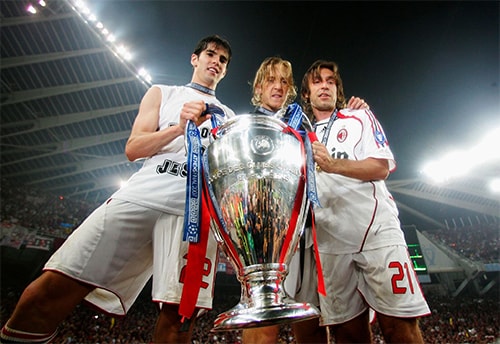 |
| After a glorious period culminating in the Christmas tree of Ancelotti, Kaka, Ambrosini, and Pirlo, Milan gradually lost its brilliance and is currently in a dark shadow. |
Kaka, with his intelligent, skillful, yet highly effective style of play, possessing the ability to shoot from long range, create chances, and score goals, played a role far beyond that of a typical attacking midfielder. The 10 goals of the Brazilian angel in the 2006-2007 Champions League winning campaign embodied the best that Milan under Ancelotti had achieved in the final days of their empire.
Then, winter arrived and Christmas music ceased to play. The red and black empire built by Ancelotti crumbled one by one with the footsteps of Kaka, Maldini, Ancelotti (2009), and Pirlo (2011). It closed behind a beautiful "Christmas tree" with glorious achievements and heroic names that will never fade from the memories of football lovers.
According to VNE
| RELATED NEWS |
|---|


