
Strange graveyard of poetry
When we think of cemeteries, many of us shudder at the thought of them, as they evoke feelings of sorrow, grief, and profound separation. However, visiting the Pure Land of Thai Binh in Bau Nang commune (Duong Minh Chau district, Tay Ninh province) brings a very gentle and poetic feeling, because almost all the graves here are inscribed with a poem, expressing affection for the deceased.
When we think of cemeteries, many of us shudder at the thought of them, as they evoke feelings of sorrow, grief, and profound separation. However, visiting the Pure Land of Thai Binh in Bau Nang commune (Duong Minh Chau district, Tay Ninh province) brings a very gentle and poetic feeling, because almost all the graves here are inscribed with a poem, expressing affection for the deceased.
Sincere regards to the departing person.
I must say, I was very surprised when I read the poems inscribed on the tombstones in the Pure Land of Supreme Peace. Not because they were beautiful, but because they were so moving, expressing the feelings of those who remain and those who have passed away. From the circumstances of children weeping for their fathers, siblings mourning their brothers, close friends weeping for each other... all seem to burst forth from the very pain of separation between the living and the dead in the most authentic way. The poems of wives weeping for their husbands include:
A marital bond spanning decades.
He left, and I stayed, my tears flowing endlessly.
The long nights filled with sorrow and heartache.
Farewell to the marital bond from this moment on.
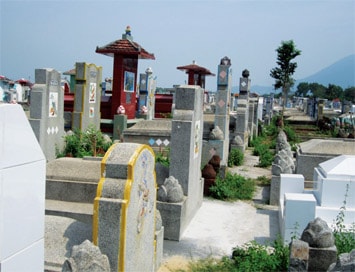
A corner of the poetic cemetery.
Without hidden meanings, cryptic language, or ornate words, these verses are simply choked words that deeply touch the hearts of those who leave and those who remain. It is the poignant situation of a father mourning his child, expressed through verses brimming with the sorrow of an elderly man remembering his young son:
The old bamboo weeps for the young shoots.
The voice of a child is no more.
A minute of risk due to digital networks.
All that remains is tears to bid farewell to my child.
Looking up at the portrait, tears streamed down my face.
All the sisters shed tears of sorrow.
Azaleas mourn their ill-fated friend.
You two are still here, where am I?
According to Mr. Pham Van Loc, who has nearly 40 years of experience as a cemetery caretaker, most of the poems inscribed on the tombstones at Cuc Lac Thai Binh are patchwork, taken from folk songs, ballads, the Tale of Kieu, Luc Van Tien, Nguyen Khuyen, etc., then adapted to suit the feelings and emotions of the characters. Besides sincere feelings of kinship such as parents and children, husband and wife, siblings, grandparents and relatives, Cuc Lac Thai Binh also features moving poems from the living to the deceased, imbued with a poignant story. It's the story of a young man and woman in love. Because the young man had to go to the city to take an exam, on their farewell night, the girl gave him her virginity. Unfortunately, the young man fell ill and died in the city, and only after that night did the girl discover she was pregnant with his child. She was ostracized by the villagers and scorned by her parents and siblings because she was pregnant out of wedlock. Feeling bored and not knowing where to go, she went to the boy's grave and wept.
The wind carried the mustard plant to the sky.
The dill remained to endure the bitter words.
And as if to make him understand the suffering of the mother and child in this world, she inscribed that poem on her lover's tomb. Even more tragic and heartbreaking is the story of a man who promised his beloved village girl that he would leave to become rich, promising to return and marry her when he had enough money. Unexpectedly, years later, upon returning to his hometown with wealth and happiness, he found his lover's grave overgrown with grass. Overwhelmed with grief, he inscribed a few lines of poetry expressing his boundless sorrow:
A piece of beauty buried in the dust and wind.
The path of immortals is fraught with sorrow for those who have stumbled.
A hundred years is indeed a matter of destiny.
In another life, they will find each other and build a bridge.
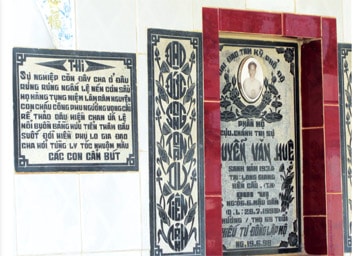
Some poems in the Land of Bliss and Peace
Peace in the eternal realm
With an area of over 60 hectares and thousands of graves, according to local elders, the Pure Land of Thai Binh has existed for a very long time. Initially, it was just a wild, mountainous area at the foot of Mount Ba Den, with few visitors and only a few graves. In 1972, it was planned and built into a cemetery for the souls of Cao Dai-Hoa Hao followers in Tay Ninh. Gradually, due to demand, the "population" of this cemetery has increased. Today, it is also the eternal resting place of deceased people from the surrounding area outside the Cao Dai religion. Ms. Pham Thi Hien (29 years old), a street vendor right in front of the cemetery gate, said: unlike many other cemeteries, the Pure Land of Thai Binh always has a more peaceful feel. Perhaps the main reason is the touching poems inscribed on these tombstones. Many graves have as many as 7 or 8 poems carved into them. It's all there, encompassing all aspects of life, all the hardships and injustices, all the boundless sorrows—it's all poured into poetry. Perhaps that's why this place attracts so many visitors.
During nearly a day spent wandering through the cemeteries searching for poems at the Pure Land of the Pacific, I seemed to learn and understand more about many of the people who have found peace in this eternal resting place. The poems written by the living for these souls partly reflect their lives and destinies during their lifetimes. They were as painful as a woman who, during her life, had to live as a singer like Dam Tien (in the Tale of Kieu). Even after death, many amorous patrons, captivated by her beauty and talent, felt pity and sorrow for the unfortunate fate of this singer, inscribing these words upon her graves:
A hundred years later, the stone monument will wear away.
The oral tradition of a thousand years still stands firm.
Perhaps, after all the struggles, gains, and losses of a lifetime, nothing is more peaceful, serene, and comforting than resting in a tranquil countryside, at the foot of the legendary Ba Den Mountain, surrounded by masterful poetry.
To add a touch of poetic serenity to this deathly cemetery, each poem is accompanied by a beautiful landscape painting. The authors of the poems and the people who carved the inscriptions on the tombstones shared with us that each tombstone with a poem now costs 100,000 dong. This money is not royalties for the poems, but simply payment for the work of the craftsmen who arranged the letters, printed them onto the stone, and decorated them. Because the "Peaceful Paradise" cemetery is so famous for its poetry, the workers have compiled a collection of over 300 poems, all with themes of remembrance and longing. When a family needs a poem, they can choose or modify one to be used on a tombstone, depending on the circumstances and relationship with the deceased. Perhaps both those who remain and those who have passed on to the afterlife will smile at the sight of a poem, a bridge connecting the two worlds with sacred feelings.
Leaving the graveyard of poetry, my heart still lingers on something about the meaning of life and death in this world. It seems that both the deceased and the living sometimes need poetry to help us live better, more beautifully, and, if we depart, find more peace.
According to DaHoanket


