
Bringing glory to the history of our homeland.
(Baonghean) - Following the directions of Mr. Le Viet Mien, former Secretary and Chairman of the People's Committee of Ben Thuy Ward, I went to Tinh Dieu motorbike repair shop. It's a small shop located on Nguyen Van Troi Street in Ben Thuy Ward (Vinh City). The shop owner, with more than half his hair gray and a simple, honest face, put down his wrench and greeted me. It turned out to be an acquaintance; I had met him before when I first learned about the Le Viet family in Ben Thuy. And this time, too, I returned to the old land of De Thap - Hung Thuy to further enrich my understanding of a family with outstanding members who made many contributions to the Nghe Tinh Soviet movement in the early decades of the 20th century.
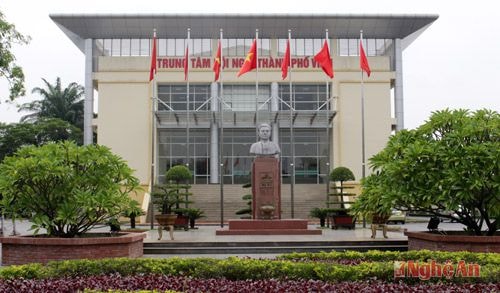 |
| The statue of Comrade Le Mao at the Vinh City Party Committee. |
The motorcycle shop owner and his family "legacy".
The owner of the motorcycle repair shop is Mr. Le Viet Tinh. When asked why his shop is named Tinh Dieu, he smiled and said, "Tinh is how people in Nghe An call it, and Dieu means red. Business needs red, needs luck." Then, from Nguyen Van Troi Street, he led me to his house in Block 10, Ben Thuy Ward. There, Mr. Tinh told me that he is the grandson of martyr Le Viet Cuong and the son of martyr Le Viet Hoang. Martyr Le Viet Cuong was the first Secretary of the Workers' Party Branch of the Vinh Power Plant, which was established shortly after the Party was founded. Along with other Party branches in the area at that time, the Vinh Power Plant Party Branch, under the direct leadership of Secretary Le Viet Cuong, repeatedly organized struggles against the French colonialists and their collaborators, causing them confusion and fear.
Under the leadership of the Party cell, the workers of the Lamp Factory joined the movement to demand higher wages, shorter working hours, and to prevent contractors from beating and oppressing workers, culminating in the Soviet Uprising of 1930-1931. On the night of May 30th and the morning of May 1st, 1930, while Mr. Le Viet Cuong was secretly holding a meeting to prepare for a workers' strike, the enemy discovered and suppressed it. Five people were killed by the enemy, including the Party cell secretary, Le Viet Cuong. Mr. Le Viet Tinh said that in 2007, when his family renovated their house, they unexpectedly discovered a small bunker under the floor. Mr. Tinh said that when he was a child, his grandmother and father told him about the secret hiding place of Mr. Le Viet Cuong and his comrades, but he didn't know the exact location. After discovering the bunker, Mr. Tinh has preserved it intact until now. Leading me to see the cellar, Mr. Tinh affirmed that this is a family legacy, a legacy of his lineage, with educational significance for future generations. Recently, on May 11, 2015, Mr. Le Viet Cuong's wife (Mr. Tinh's grandmother), Nguyen Thi Hai, was posthumously awarded the title of Heroic Vietnamese Mother by the State. This is also a tribute from today's generation to those who have contributed to the country.
A family of like-minded people
But the story of Mr. Le Viet Tinh's family is just a small "slice" of the Le Viet clan's contributions to the revolutionary homeland of Ben Thuy. During my research and gathering of information and documents, I visited the banks of the Lam River, near the foot of the old Ben Thuy bridge. This area was formerly the Ben Thuy Wood Factory. Eighty-four years ago, this stretch of river witnessed the sacrifice of a loyal son of the Party, Comrade Le Viet Mao (commonly known as Le Mao). According to historical records and accounts from members of the Le Viet clan: on the night of May 2nd, 1931, while secretly operating, Comrade Le Mao was unexpectedly discovered and captured by the enemy. During questioning, Le Mao pretended to be an employee of Mr. Sarly.
The enemy demanded that Comrade Le Mao escort them to their master's house. On the way, upon reaching the riverbank, taking advantage of the darkness, he jumped into the river to escape, but the enemy shone their lights on him and shot him dead. The body of the Secretary of the Vinh-Ben Thuy Provincial Party Committee then perished in the waters of his hometown, the Lam River. According to historical documents, Comrade Le Mao was born in 1903 in De Thap Street (now Ben Thuy Ward). At the age of 14, he was already a worker at the Ben Thuy Match Factory. In 1925, Le Mao joined the Phuc Viet Society – a patriotic organization that was the precursor to the Indochinese Communist Federation. In 1929, Le Mao participated in the founding of the Nghe An Red Workers' Union, becoming the first Secretary of the Vinh-Ben Thuy Provincial Party Committee. Le Mao was one of the key leaders of the Central Committee of the Central Region, directly leading and contributing to the victory of the Nghe Tinh Soviet movement of 1930-1931 in Vinh-Ben Thuy. In October 1930, Comrade Le Mao was elected to the Central Executive Committee of the Party.
The Soviet-Nghe Tinh Museum currently preserves a special artifact: a file on Le Viet Thuat, also known by various other names such as Nguyen Van Muu, Danh, and Nhien – one of the most influential communist party members in the 1930s. This file was compiled by the French colonial security agency in the final days of 1931. The file contains a secret telegram that reads: “Vinh, December 7, 1931. The Chief of Security of Central Vietnam has just presented to the Governor of Southern Vietnam in Saigon, and forwarded to the Resident Commissioner of Central Vietnam in Hue and the Security Agency of Hue. Le Thuat, a member of the Central Committee of the Central Vietnam Regional Party Committee, was arrested with two women at 7 am this morning by the Vinh Security Agency. Le Thuat is a very important leader.”
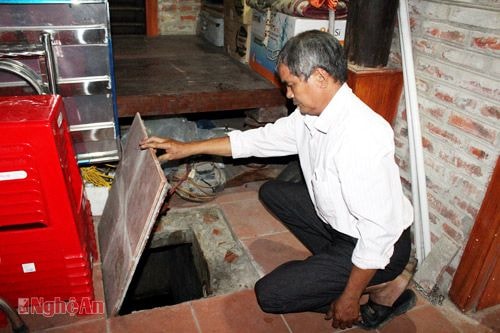 |
| Mr. Le Viet Tinh introduces Mr. Le Viet Cuong's secret bunker. |
Born in 1902, Le Viet Thuat was the son of Le Viet Hien. He left home to join the revolutionary movement at a very young age. The story of Le Viet Thuat heating a coin (some say a plowshare) until its surface was red-hot is still passed down within the Le Viet family to deceive the enemy. Le Viet Thuat also disguised himself as a fish and fish sauce merchant many times to carry out revolutionary activities. As Secretary of the Central Vietnam Regional Party Committee, Le Viet Thuat was one of the most influential figures and the driving force behind the patriotic and revolutionary struggle in Nghe An in the early 1930s.
With the help of Mr. Le Viet Tinh, we arrived at the border area between Blocks 11 and 12 of Ben Thuy Ward (near Ben Thuy Kindergarten - PV). Mr. Tinh said that this area used to be a canal, densely forested, and was the hiding place of the Secretary of the Central Vietnam Regional Party Committee, Le Viet Thuat. This was during the late 1931 period when the French colonialists were relentlessly suppressing, searching for, and terrorizing a series of Party cadres and members, leading to arrests, murders, and imprisonment. Le Viet Thuat alone continued to hold his ground in this key area, directing all activities of Party organizations and branches in Vinh - Ben Thuy and the Central Vietnam Regional Party Committee. Unfortunately, he was exposed and captured by the enemy on December 7, 1930. Afterwards, with the integrity of a communist soldier, he committed suicide in prison.
As one of the largest clans in the Ben Thuy ward area, the Le Viet clan has 6 branches (now 5 remaining due to one branch lacking a male descendant). Le Mao belongs to branch 2, while Le Viet Thuat belongs to branch 5. Both are roughly the same age, and Le Viet Thuat calls Le Mao his elder brother. According to Mr. Le Viet Tinh, the Le Viet clan originated from Nam Dan district and moved to Vinh in the late 17th and early 18th centuries. Currently, the clan has 493 male members and thousands of descendants. Throughout history, the Le Viet clan has had descendants who have contributed to their homeland. The clan's genealogy records the names of 25 ancient civil and military officials, shining examples of virtue and talent. The clan's main ancestral temple still preserves the original imperial decree from the Nguyen dynasty for Mr. Le Doan Phong – a general who rendered meritorious service during the Trinh-Nguyen conflict. After his death, he was posthumously bestowed the divine title: "Cao Bá Doãn Phòng, the great general who supported the nation and strengthened the country, a mid-level deity."
Continuing the family and clan tradition, the descendants of the Le Viet clan have continuously strived to uphold the heritage values of their ancestors. Mr. Le Viet Tinh stated that, from the period of the resistance against the US to the present day, at least five members of the Le Viet clan have held the positions of Party Secretary and Chairman of the People's Committee of Ben Thuy Ward. Mr. Tinh mentally calculated: "Mr. Le Viet Yen, Mrs. Le Thi Doai, Le Viet Hieu, Le Viet Sam, Le Viet Mien. It's nothing extraordinary, but it's still a contribution from the descendants to their homeland." Indeed, this is not merely a "prestigious family," but above all, a clan that has made significant contributions to the national liberation struggle. History will forever remember their contributions.
In Vinh City, two streets and three schools are named after outstanding members of the Le Viet family: Le Mao and Le Viet Thuat. Additionally, the city has a ward named after the first Secretary of the Vinh-Ben Thuy Provincial Party Committee: Le Mao. This is truly a source of pride not only for the descendants of the Le Viet family but also holds significant meaning for the historical development of Nghe An today.
Van Nhi


