
The first-ever announcement of standards for traditional fish sauce.
On January 15th, in Ho Chi Minh City, the Vietnam Association of Seafood Processing and Export (VASEP), in collaboration with traditional fish sauce associations nationwide, announced for the first time a set of standards for traditional Vietnamese fish sauce.
This standard has 7 parts, clearly outlining everything from the scope of application, raw materials, technical requirements, testing methods… to labeling and transportation. Specifically, the raw materials used to process traditional fish sauce are sea fish, sea salt, water, sweeteners, and flavor enhancers. Traditional fish sauce is classified into 3 grades, based on total protein content as follows: "Special" grade has a total protein content of N TP ≥ 35g/l; "Premium" is 25g/l ≤ NTP < 35g/l and "Grade 1" is 15g/l ≤>< 25g/l. Containers holding fish sauce for sale must at least state "traditional fish sauce" and the total protein content.
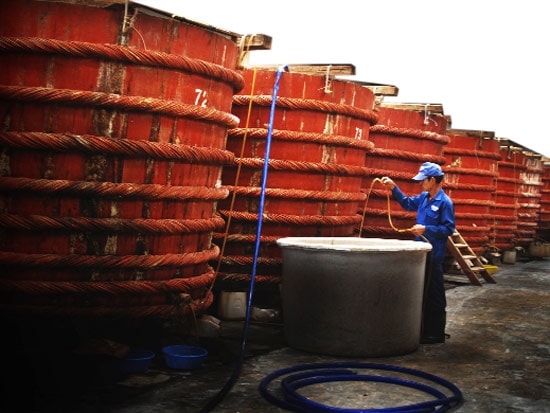 |
| Traditional fish sauce. (Illustrative image) |
According to Mr. Vu The Thanh, a food safety expert from VASEP and a member of the drafting team, this set of standards was compiled in accordance with Decree 127/2007/ND-CP detailing the implementation of some articles of the Law on Standards and Regulations. The standards only apply to fish sauce products produced from the natural fermentation of a mixture of fresh sea fish and sea salt that meets the required standards.Fish sauce intended for food use must be aged for a minimum of 9 months or more. Diluted fish sauces that reduce salt content and add additives such as colorings, flavorings, thickeners, and preservatives are not within the scope of this regulation.
According to Mr. Truong Dinh Hoe, General Secretary of VASEP, the goal of this set of standards is to preserve the unique flavor of Vietnamese fish sauce products and introduce them not only to Vietnamese consumers but also to the world. Therefore, the standards are basically drafted based on the standards that traditional fish sauce producers have been implementing for a long time, only adding some elements to ensure suitability with new production conditions. The issuance of this set of standards is a strong commitment to quality from traditional fish sauce producers in Vietnam, helping consumers better understand the quality and feel secure when using the product.
The Vietnamese fish sauce market is currently valued at approximately US$501 million, with over 70,000 tons produced in 2015. A bottle of industrially produced fish sauce costs around US$1-2, while traditional, high-protein, pure fish sauce can reach up to US$9. Statistics from the General Statistics Office also show that Vietnamese people consume over 300 million liters of fish sauce annually, 75% of which is industrially produced, with the remainder being traditional. With lower production volumes and slightly higher prices, traditional fish sauce is becoming more selective in its consumer base and targeting niche markets, leading to a shrinking market share. Traditional fish sauce faces numerous obstacles in its survival and market share recovery, particularly due to the rapidly dwindling supply of anchovies.
Notably, the recent incident involving Vinatas publishing misleading information about the results of a survey, confusing the arsenic content naturally present in seafood with that of arsenic trioxide (a highly toxic substance) found in fish sauce, has seriously damaged the brand reputation of this product in both domestic and international markets.
In this context, traditional fish sauce associations from Phu Quoc, Phan Thiet, Nha Trang, Ho Chi Minh City, and several traditional fish sauce businesses in the North have joined forces to form the "Traditional Fish Sauce Club," under the auspices of VASEP. The establishment of a set of standards for traditional fish sauce, along with this club, is considered essential for traditional fish sauce businesses to cooperate, overcome difficulties, and develop in the future.
According to H.Chung/baotintuc


