
Binh Minh Fishing Village
When people think of fishing villages, they often picture large families with four or five children or more. However, there is one fishing village where, for over 10 years, no one has had a third child or more; couples only have one or two children to raise well. That is Binh Minh fishing village, Phuc Tho commune, Nghi Loc district.
(Baonghean)When people think of fishing villages, they often picture large families with four or five children or more. However, there is one fishing village where, for over 10 years, no one has had a third child or more; couples only have one or two children to raise well. That is Binh Minh fishing village, Phuc Tho commune, Nghi Loc district.
The Bình Minh fishing village covers a total area of 6.5 hectares with 90 households and nearly 500 inhabitants, including 111 women aged 15-49 and 76 couples of childbearing age. Of these, 83 households make their living from fishing. With limited land and a large population, the villagers' livelihoods mainly depend on fishing, harvesting, transporting, and trading seafood. In the past, the outdated custom of having both sons and daughters, and the strong desire for male heirs to continue the family line and provide labor for the seafaring industry, were deeply ingrained in the villagers' thinking. The limited awareness among the people, especially couples of childbearing age, regarding reproductive health care and family planning is the reason why the birth rate and the rate of having a third child or more have reached a "record" in Nghi Lộc district. Unstable living conditions, coupled with large families, lead to persistent poverty and illiteracy year after year.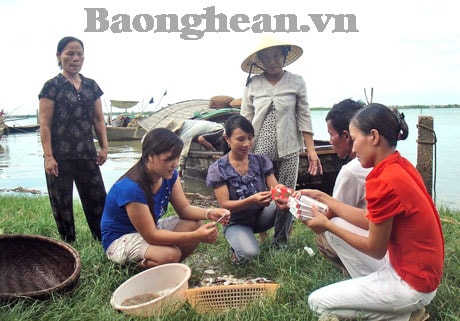
Take the opportunity to advise fishermen on the use of modern fishing gear when their boats return.
Recognizing family planning as an effective measure in the fight against poverty and illiteracy, the village Party Committee, under the direction of the commune Party Committee and government, directly guided mass organizations such as the Front Committee, Farmers' Association, Women's Association, Youth Union, and Senior Citizens' Association to coordinate and promote the implementation of population and family planning policies to every target group and family. They issued resolutions and established village regulations encouraging each family to have only one or two children to ensure proper upbringing. Subsequently, through Party members and other members, this was widely disseminated to all villagers. The criterion of having a third child or more became an important criterion in evaluating and ranking Party members, collectives, and individuals, as well as in the assessment of culturally exemplary families.
Besides the role of the Party Committee, mass organizations – a decisive factor in the success of the population/family planning program here – also include local population officials and collaborators. In addition to providing direct counseling to individuals and households, the commune's Population Committee, in coordination with the women's association, integrates population and reproductive health/family planning awareness campaigns into the activities of mass organizations and villages every three months.
Ms. Pham Thi Yen, a population collaborator and head of the women's association in the fishing village, said: "For a couple to adopt contraception and not have a third child or more, besides the wife's support, the husband's consent is also necessary. But persuading the husbands is the hardest part. Many husbands react strongly: 'Go home, we'll give birth and raise the children, what does it have to do with you? We're fishermen, and if we don't have sons to go to sea, what will we eat?' But gradually they understood." Ms. Yen said that the current results are thanks to a persistent approach, using the method of "going door to door, checking on each individual," directly taking individuals to sterilization centers, inserting intrauterine devices, and implementing other methods such as contraceptive injections, using condoms, and taking birth control pills.
Since 2002, the fishing village of Binh Minh has had no violations regarding having a third child or more. Along with not having a third child, many couples also space out their pregnancies by 3 to 5 years to allow for better care of their children. Currently, the fishing village has 15 couples of childbearing age with two children of the same sex, of which 7 couples have two daughters, but to date, none of them have had a third child.
Mr. Hoa and Mrs. Thuy are fishermen with two daughters. When we asked Mrs. Thuy if she intended to have a son to go to sea with her husband, she smiled and said, "I think all children are the same. What's important is investing in their education so they can earn a living later. We've decided not to have any more children so we can have the health and time to work and support our two daughters' education."
In 2011, Binh Minh fishing village had 7 students admitted to universities and colleges, a higher rate than other hamlets in the commune. Notably, women in the fishing village have learned to take better care of themselves – the rate of reproductive tract infections has decreased significantly compared to before. From an average of 5-6 children per family, the number has now dropped to only 2-3, and over 50% of couples of childbearing age in the fishing village use modern contraceptive methods. These results have brought practical benefits to poverty reduction efforts. Currently, the number of wealthy households in the fishing village accounts for 52%, while the number of poor households has decreased to below 5%. Furthermore, the fishing village has the first concrete road system in the entire commune.
Mr. Nguyen Cong Nam, Chairman of the People's Committee and Head of the Population and Family Planning Committee of the commune, said: Binh Minh fishing village is one of the first units in the commune to successfully implement the Party and State's population and family planning policy. To achieve this result, the commune's People's Committee annually includes population work as one of the key tasks in the socio-economic development of the commune, considering it an important indicator to evaluate the level of task completion of departments, organizations, and Party branches. According to him, directing the commune's Population and Family Planning Committee to coordinate with other sectors to diversify communication methods; replicating the model of clubs that do not have a third child or more... are important activities that have contributed to Binh Minh fishing village achieving encouraging results in population and family planning work.
There aren't many fishing villages like Binh Minh – for over 10 consecutive years, no one has had a third child or more, making it one of the first fishing villages in Nghi Loc district to be recognized as a Cultural Village by the Provincial People's Committee. It is suggested that the Party Committee and government of Phuc Tho commune, as well as Nghi Loc district, need to take more proactive measures to maintain this exemplary model and replicate it throughout the district.
T. Hien - K. Chung


