
The fishing village of Loc Tho perseveres in clinging to the sea.
(Baonghean) - The weather forecast predicted storms and strong winds. Ideally, they should have moored their boats in the creek, grabbed some food, and enjoyed a drink while watching the World Cup. But the fishermen of Loc Tho village (Phuc Tho commune - Nghi Loc district) still sailed out to the fishing grounds. Partly out of courage, partly because they missed the sea, and partly because, it seems, no one wanted to leave the sea these days. Besides, each family earns a million dong a night just by doing this, so why not go...?
Lộc Thọ is the village's official name (previously known as Cổ Đại and Văn Hiến), and the central location of the old village was now Hamlet 17, Phúc Thọ. One morning, while waiting for fishermen to return from their night fishing trip to discuss their business, I was shown around the fishing village by Hamlet Head Nguyễn Võ Tùng. The internal village roads are widely paved with concrete, and several hundred meters more will likely be completed in 2014. Meanwhile, houses are rapidly rising in height, with construction almost always underway. It's likely that in a few years, Lộc Thọ will be as developed as the towns of Vinh or Cửa Lò. The poor households are all working hard to escape poverty, with several households getting out each year. Having achieved a decent standard of living, the people of Lộc Thọ are beginning to invest in infrastructure, improve their spiritual lives, and re-evaluate their rich and unique cultural values, both tangible and intangible.
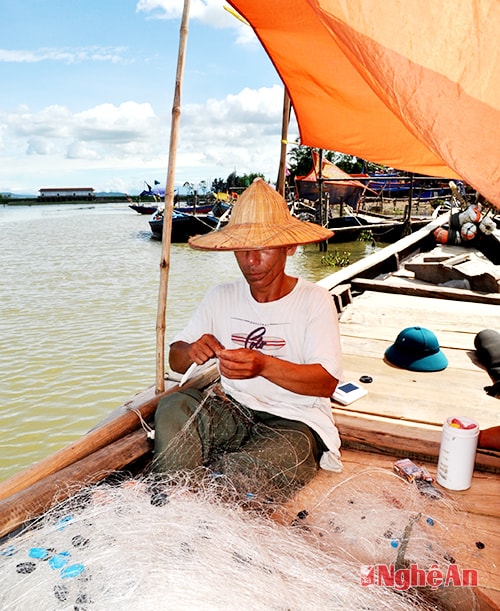 |
| Fishermen in Loc Tho mend their nets in preparation for a new fishing trip. |
This fishing village, nestled at the mouth of the Lam River for generations, once boasted a communal house, three temples, and a shrine, all hundreds of years old, with grand and elaborate architecture, and several large-scale annual festivals. Sadly, these tangible and intangible values, swept away by the upheavals of the anti-American war, have left only regrets in the memories of the older generation. Today, on the site of the old communal house, a village cultural center has been built, modeled after the ancient communal house's architecture. Facing the river, a newly planted mangrove forest has replaced the green of the ancient trees that once shaded the bustling fishing harbor. Where the Trung Temple used to stand in the center of the village, ancient flame trees and banyan trees remain, their intertwined roots and trunks bearing the marks of time, bearing witness to centuries of the unique life and development of this fishing village. The village also preserves two ancient square wells, with the inner sides of the well walls lined with thick layers of ironwood planks, and the bottom of the wells also lined with four layers of ironwood planks. These wells are still maintained and used by the villagers.
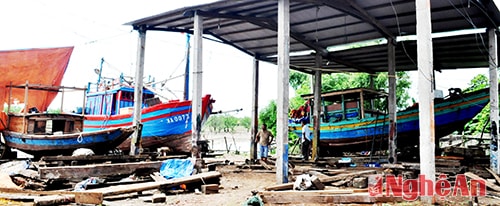 |
| Shipbuilding facilities in Loc Tho fishing village. |
I offered this brief explanation of the "cultural relics" of Loc Tho village because I caught the hesitant expression of Mr. Tran Van Hue, now 70 years old (he was born in 1944). Mr. Hue's house is one of the few low-lying, single-story houses commonly seen in fishing villages during the early days of the "revolution" from a life of constant struggle and hardship to settling on land. The old man complained of fatigue, his breath becoming hoarse with age, but his face and eyes lit up as he reminisced: “The village used to have temples and shrines like this, but everyone lived on the decks (of fishing boats). They only came ashore for trading, spiritual activities, and two annual festivals: the full moon of the first and sixth lunar months. When I was nine or ten, I witnessed the village festival with its flags, drums, palanquins, and ceremonial attire, men and women in their colorful robes, so joyful… What a pity! If only we had preserved everything until now, the village would have become even richer thanks to tourism!” I believe what Mr. Hue said, because with a strip of land in the estuary area only a few hundred meters wide and nearly a kilometer long, there are three temples, a large communal house with well-known royal decrees, and festivals full of the spiritual beliefs of a fishing village, located right next to the tourist waterway along the Lam River, a few kilometers from Cua Hoi... if preserved, it would certainly be an attractive tourist destination, a new opportunity for the villagers to prosper...
It was past 9 a.m. The fishing boats were gradually returning to the mouth of the Dừng stream. The boats had gone out to sea since midnight! The shrimp, crabs, and grouper had all been sold at Cửa Hội wharf. Fishermen anchored their boats and climbed onto the rickety bamboo bridges that stretched across the mangrove swamps into the village. Fisherman Trần Văn Sinh said that last night he and his wife watched the first World Cup match before heading out to sea to fish in the Nồm and Láp islands. They caught 7 kilograms of mantis shrimp, which they sold fresh, earning 700,000 dong. After deducting fuel costs, they made a profit of over 500,000 dong. That was because the weather forecast predicted storms; if they hadn't gone out a little further to catch more crabs, scad, and spiny fish to sell as a mixed haul, they might have earned over a million dong. Fisherman Sinh promised to mend his nets later that afternoon and tell the story of his catch, but now he "asked the journalist for permission to go home and catch up on sleep after staying up to watch the World Cup last night."
The fishing boats in Loc Tho village mainly fish in coastal waters, so they are mostly equipped with engines of around 10 horsepower. A few boats with 40 horsepower actively venture further offshore, earning a few million dong each night. In Loc Tho, each boat usually has a married couple. Their children are allowed to study, and after graduation, some go abroad for work, while others become successful civil servants. The fishing village has been uneducated for generations, so now they prioritize education for the children. Village head Tung says that in recent years, every year, children from the village have passed university and college entrance exams, with some years seeing as many as 10 students. While families with savings are one thing, even poor families strive to provide their children with an education. For example, the Pham Van Nham family, classified as a poor household, has four children, three of whom are in university and one is in 11th grade; the Nguyen Thi Hoa family, widowed and selling shrimp and prawns at local markets, still managed to support three children through university, two of whom have now graduated and have stable jobs...
Fisherman Tran Van Vinh's house is truly a villa, with expensive, gleaming interiors that perfectly match its "exterior." I asked how he could have built such a magnificent estate, one that even city dwellers would envy, on his small boat with less than ten horsepower that rarely ventured out to sea. Fisherman Vinh replied, "Well, it's thanks to my son working abroad in South Korea. But without the foundation built over more than half a lifetime of fishing, considering the sea his home, accumulating wealth, it wouldn't have been easy to create such a property to leave to my children and grandchildren." He added, "To put it simply, earning at least a million dong a night means about 20 nights at sea a month, earning tens of millions of dong. Is there any other agricultural or fishing industry in Phuc Tho commune that's more profitable than fishing?" Village head Tung calculated that in Loc Tho village, 20 out of 120 households are involved in fishing. With both large and small boats combined, they earn an average of nearly 40 million dong in cash each morning, totaling almost 1 billion dong a month. Then, dozens of children go abroad for work and send back hundreds of millions of dong each month. In addition, the remaining households engage in various service industries such as seafood processing, rattan weaving, and boat building, providing stable income. If you divide the income among over 500 people, the average income is nearly 3 million dong per person per month, the highest figure in Phuc Tho commune.
When I asked about his fishing trips, the fisherman from Vinh blurted out, "Are you really going to write something truthful this time, journalist?" Seeing my surprised expression, he continued, "It's because there are several issues I've reported to the delegates during their meetings with constituents, but I haven't received any response. That is, the people of Loc Tho village strictly adhere to the regulations and laws at sea. But fishermen from other localities still use explosives and electric fishing to decimate the fishing grounds; some boats use large trawling nets, sweeping through the area without regard for the safety of the smaller fishing boats of Loc Tho. Now the government is calling on fishermen to strengthen their presence at sea, and I suggest that those 'guys' should be dealt with severely!" I said that such matters should be reported, and then the relevant authorities will have to deal with them seriously! One day or the next, the border guards and fisheries inspectors caught and dealt with a few of those cases!... At this point, fisherman Vinh lowered his voice and confided that it was because of his poor health; otherwise, he would have modified his boat to venture further out to sea, both to increase his income and to support the nationwide spirit of fishermen staying at sea.
In Loc Tho, repairing or rebuilding boats is convenient because there are local carpentry and marine engineering workshops: Mr. Tran Van Tuan, nearly 60 years old, was formerly in the army, then returned to sea and started building and repairing boats more than 20 years ago. As he opened the workshop gate, Mr. Tuan said, "Today, three boats came in for repairs. I mobilized all 17 workers, but they've all gone home for lunch." His workshop is located on the edge of the Dung stream within a thousand-square-meter area. Inside, there are three fishing boats: two from Ha Tinh and one from Quang Binh, waiting for repairs.
Mr. Tuan, formerly a seasoned fisherman, has now started this business. He has trained his two sons to become skilled "foremen," enabling his workshop to build new 250-horsepower boats. From the beginning of 2014 until now, he has built five boats ranging from 40 to 150 horsepower, and the number of boats he has repaired is countless. He said: "Opening the workshop mainly creates stable jobs for my children, grandchildren, and villagers... In this profession, I've noticed that people in Loc Tho fishing village who are currently working in the fishing industry are eager to upgrade to larger boats, and those who have lost their livelihoods also want to return to sea. However, building small boats is prohibited by regulations, and building large boats requires capital and loans are very difficult. If the government now had a mechanism to encourage fishermen to develop their livelihoods at sea, I guarantee that many families in Loc Tho would enthusiastically embrace and effectively implement it."
Village head Tung also reaffirmed that, based on a comprehensive assessment of agricultural, fishing, and handicraft occupations in Phuc Tho commune today, none offer a higher income than the seafood harvesting profession in Loc Tho village. I went down to Hamlet 16 in Phuc Tho, right next to Hamlet 17, which was part of the old Loc Tho fishing village, and had lunch with fisherman Ninh, a close friend. Listening to the news on TV about the situation in the East Sea, fisherman Ninh kept talking about his adventurous spirit and love for big waves and strong winds; in fact, I knew he was frustrated about the lack of capital to upgrade his fishing boat to a larger one so he could venture further out to sea... Reading about that yearning, it's easy to recognize the love for the river and the deep connection to the sea of his homeland shared by everyone in Loc Tho fishing village!
Text and photos:Dinh Sam


