
Lieu Nha Ancient Village
(Baonghean) - From the center of Phuong market, follow Provincial Road 533 south towards Don market, cross Kho bridge and you will reach Lieu Nha village (Thanh Lam commune, Thanh Chuong district) – located in the lower part of the district, where the fields are dry in the rainy season and wet in the dry season, but it is proud to be a land rich in traditions of learning and revolution. The village still preserves many ancient features with village wells, temples, and shrines…
| RELATED NEWS |
|---|
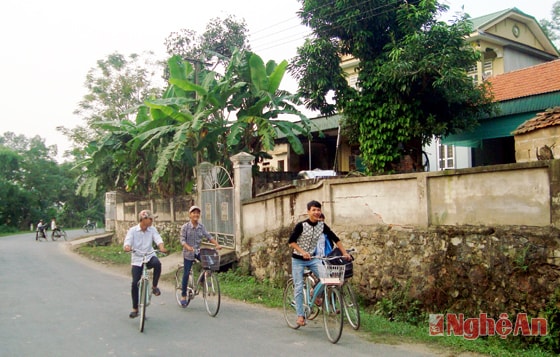 |
| A corner of Lieu Nha village (Thanh Lam commune, Thanh Chuong district). |
The village stretches along the foot of the mountain, with the mountain behind it and the fields in front, and further in the distance the majestic Kim Nghê mountain range. Liễu Nha village is also known as Lưỡng Nghi (formed from the two hamlets of Nghi Văn and Nghi Xuân), Nghè village... Legend has it that in the past, a scholar from the village excelled in his studies, passed the imperial examinations, and became a "Nghè," returning home in glory and bringing honor to the entire village. From then on, the names of the land, the village, the mountains, the streams, the fields... all bore the name Nghè, as a way of acknowledging, honoring, and preserving his name in folklore. In the middle of the village fields, there are still two mounds of earth, remnants of Nghiên Mountain and Bút Mountain, built by the ancestors as a symbol, a reminder to future generations of the village's tradition of studiousness.
The village used to have many temples and pagodas. At the foot of the mountain, near the Chùa field, there used to be the Em Pagoda, with moss-covered stone pedestals at the top, and the Anh Pagoda at the bottom, majestic with many Buddha statues and a resident monk. At the foot of Nghè Mountain is the Cao Sơn Temple, dedicated to the Great King Cao Sơn, with two upper and lower buildings, and imposing statues of the Left and Right Mandarins, hidden beneath three ancient banyan trees. Under the feudal regime, the temple received imperial decrees from various dynasties. Through the vicissitudes of time, the temple is no longer as grand as it once was, having fallen into serious disrepair and is currently undergoing restoration and renovation. Ancient artifacts remaining include the dragon throne and palanquin. On Họ Mountain, nestled amidst the lush green forest, is the Lâm Si Temple, dedicated to the local deity. Standing before the temple's entrance, one can gaze out over the village, mountains, Chọ and Nghè fields, and Nghè stream... a vast expanse. Once only a trace of the past, the Lâm Si Temple has now been restored to its former glory by the local people. These two ancient temples are now centers of cultural and spiritual activity for the local people.
On the outskirts of the village, there is the Liễu Nha communal house, facing the fields and overlooking Nghiên Mountain and Bút Mountain; it was formerly also called Nghè communal house. According to the elders, the communal house was built in the 19th century to worship the village's tutelary deity and served as a community center. The upper communal house has two bays lengthwise, with the back bay housing the altar. The lower communal house has five bays and two gables, with two bays at either end, each containing a platform for civil and military officials. Every year, the communal house is usually used for spring rituals, praying for good health, favorable weather, and a bountiful harvest. When someone in the village passed the imperial examinations, the house would hold a ceremony of triumphant return and a feast for the successful scholars. During the French colonial period, the communal house was the stage for many traditional plays with historical content, fostering patriotism and hatred of the enemy among the people. After a long period of absence, the old communal house was restored in 2011, much to the anticipation of the villagers. The lower and upper communal houses remain in their original locations, with beautiful gates adorned with mythical creatures. The upper communal house now serves not only as a shrine to the village's guardian deity but also as a place to commemorate and honor the heroic martyrs of the village.
Liễu Nha village has two ancient wells. To the right of the communal house, at the foot of Nghè mountain, is Côi well. To the left of the communal house, at the foot of Họ mountain, near Lâm Si temple, is Thống well. These village wells have existed since ancient times, serving as the source of fresh water flowing from the mountains, providing the main water supply for the village. Even during the scorching summer months with the hot Lao wind, when everywhere else is dry, the village wells never run dry… After a period of neglect, the wells have now been renovated by the villagers, with stones added, walls built, and floors paved, making them clean and beautiful. For the people of Nghè village, the village wells are not only a source of clean water for daily life, but also a meeting place, fostering a sense of community and neighborly affection.
In the heart of the village lies the Nguyen family ancestral temple, renowned for its learned ancestors and unwavering revolutionary fighters who made significant contributions to the people and the nation in the cause of national construction and defense: Nguyen Duc Lan, a scholar and military advisor; Nguyen Van Chinh, a laureate and academician; Nguyen Con, Deputy Prime Minister; and Ton Thi Que, a virtuous daughter-in-law of the family and Deputy Director of the Supreme People's Procuracy. The Nguyen family ancestral temple served as a meeting place for scholars to strategize against the enemy during the Can Vuong movement, and as a secret operational base for organizations like Tan Viet and the Revolutionary Youth League. Since the founding of the Party, it has been a secret meeting place for Party members and revolutionary fighters, and a place for printing and storing Party documents and slogans. Currently, the Nguyen family ancestral temple is a provincial-level historical and cultural relic, a place of remembrance and commemoration for descendants of the Nguyen family as well as tourists from near and far.
According to Mr. Nguyen Van Tong (91 years old), the villagers are simple, honest, and hardworking; during the harvest season, they are busy with preparations, but on the third day of the eighth lunar month, they have free time and enjoy traditional opera performances. In the village and at the communal house, the Trung Trac - Trung Nhi opera is often performed, attracting crowds like a festival. During the flood season, when the fields are submerged, the people of Lieu Nha still row boats, men and women singing folk songs and call-and-response songs that echo throughout the village. On cool, moonlit nights, they even go on courtship tours with nearby and distant villages in the district…
The people of Liễu Nha have always been the same, even though life is still full of hardships, they continue to follow in the footsteps of their ancestors, fulfilling the hopes their forefathers entrusted to the Bút Mountain and Nghiên Mountain before the village fields. Gone is the scene of "Like the village chiefs of Nghè/Who are saddened by the plowing season and have to work for hire." The village square and well of yesteryear are once again filled with the warmth of rural life, imbued with the charm and depth of the ancient village!
Huy Thu


