
Dinh Chu Woodworking Village
(Baonghean) - I had heard of the ancient Dinh Chu carpentry village for a long time, but only now have I had the opportunity to visit the village in Thanh Tuong commune, Thanh Chuong district. The village currently has 50 out of 115 households, with nearly 80 workers, and was recognized by the Provincial People's Committee as the "Dinh Chu Carpentry Village" in 2009. Unlike other carpentry villages that specialize in producing fine art and household wooden furniture, Dinh Chu Carpentry Village also undertakes the complete construction of house carpentry, especially for churches in the ancient architectural style...
| RELATED NEWS |
|---|
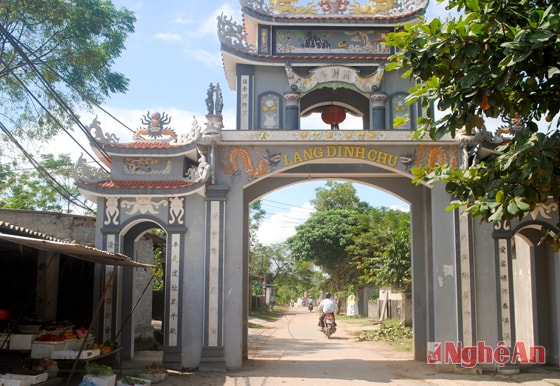 |
| The road leading to Dinh Chu village. |
On a beautiful sunny day, we arrived at Dinh Chu village. As soon as we passed through the rather imposing village gate, with its ancient architecture, we heard the screeching sounds of saws and planers, interspersed with the clattering of hammers, chisels, and carving tools. Mr. Le Dinh Tien, a land administration officer of the commune, led me on a tour around the village, introducing me to the thriving carpentry workshops, before stopping at the workshop of Mr. Nguyen Van Hung's family. Both Mr. Hung and Mr. Tien explained that Dinh Chu village is about 500 years old, and the carpentry trade was introduced there around the same time. The village is proud to still preserve the traditional craft of its ancestors: building churches in the ancient architectural style. The skilled and long-standing carpenters in the village are mainly from the Nguyen Quang, Nguyen The, Nguyen Gia, and Luu families. Calling it an ancient village with an ancient craft is meant to convey these things.
Mr. Hung's carpentry workshop is quite spacious. Upon entering, you'll find piles of large logs of mahogany, jackfruit, and other trees, each thick enough for a person to embrace, already marked and prepared for house construction. The workers, covered in dust, are diligently working, planing, and carving. Inside, all you see is wood and the noisy sounds of saws, chisels, and planers; everyone is focused on their work. When we arrived, Mr. Hung stopped, quickly brushed off the thick layer of dust clinging to his clothes, and greeted us. He is 60 years old, but still looks agile and his eyes are sharp. During our conversation, Mr. Hung proudly said: "Carpentry is a family trade in the village, especially the craft of building ancient churches. There have been ups and downs in the village's history, but generations of people here have continuously strived to preserve the traditional craft, leading to its current prosperity." Mr. Hung is the fourth generation to "stick" to the carpentry trade. Having been in the profession for 45 years, he understands deeply about this arduous and sacred craft. It's sacred because, for generations, his family has specialized in building traditional-style churches for clients near and far. Clients come from Quang Binh, Ha Tinh, Nghe An, and even Vung Tau and Phu Tho... to place orders. They usually order entire church buildings with 2 to 3 bays, and the type of wood is up to the client. Here, he typically builds houses using four types of wood: mahogany, jackfruit, teak, and ironwood. Of these, houses made of ironwood are the most expensive, while mahogany is the cheapest. Currently, a 3-bay house made of ironwood costs 600 million VND, but one made of mahogany only costs 120 million VND. Currently, a family in Anh Son district has ordered a church building made of jackfruit wood, worth 500 million VND, to be completed by the end of this year. Why does he choose these four types of wood for building churches? Mr. Hung explained: "Ironwood and mahogany are excellent, needless to say. Mahogany is soft but tough, lightweight, and rarely gets infested with termites; jackfruit wood is both beautiful, doesn't crack, is easy to work with, and lasts a long time. These types of wood are very suitable for building churches; if the roof doesn't leak, it can last for hundreds of years."
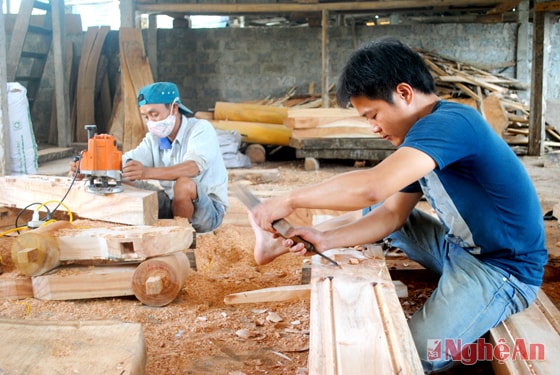 |
| Carvers at Mr. Nguyen Van Hung's carpentry workshop. |
For ordinary houses, carpentry only requires accurate marking, but building churches demands meticulousness and considerable effort. Besides using good quality wood, the carvings must be sharp, intricate, and meticulously crafted according to the client's specifications. The most difficult part is the carving; the beauty of the house depends greatly on the carvings, thus requiring skilled craftsmen. Not only must the work be aesthetically pleasing, but the orders must also be completed on time. Therefore, Mr. Hung's workshop, and the craft village in general, are busy year-round, attracting many highly skilled workers from Ha Nam province. Currently, Mr. Hung employs five skilled workers, including one expert carpenter from the village. He pays salaries based on skill level; woodworkers earn 4.5 million VND per month, while skilled carpenters earn up to 12 million VND per month. However, in the village today, there are only 3 or 4 skilled woodcarvers, so the workshops have to hire workers from Ha Nam province. The tools used are mainly machinery, so the construction time for a house is significantly shortened compared to the previous manual methods. A three-bay, four-truss wooden house takes Mr. Hung's team 45-60 days to complete, including painting and assembling the house for the client. Each year, the workshop receives 4-5 church construction projects, using approximately 80 cubic meters of various types of wood. If there are many clients, Mr. Hung can take on 20 church construction projects annually, as there are many other workshops in the village specializing in church construction like his; he receives projects from clients and collaborates with other workshops. The unique aspect of church construction is that it requires large pieces of wood, making it easier to select and work with. The workers also need to be strong to easily lift and move these large logs. Previously, these types of wood were usually ordered within the province, but in recent years, most of the large-sized acacia and jackfruit wood has to be sourced from Gia Lai and Dak Lak, while teak and ironwood are increasingly scarce and must be ordered from various places. Once the wood is purchased, based on the dimensions of the customer's house, the master craftsman must carefully select the wood, finding the right type of wood to avoid waste. Which trees should be used for pillars, and which should be cut for beams, purlins, and rafters... all are meticulously calculated.
A woodcarver at Mr. Hung's workshop, a young man nearing 30, said: "After more than 10 years in this carving and sculpting profession, the experience I've learned is that you have to strictly adhere to the design. A craftsman needs skillful hands, combined with diligence and meticulousness. To create beautiful, sharp products, the soul and talent of the craftsman are essential. There's always work here year-round, and salaries are paid monthly. With the responsibility of a craftsman, especially when working on churches, the craftsmen always work with heart."
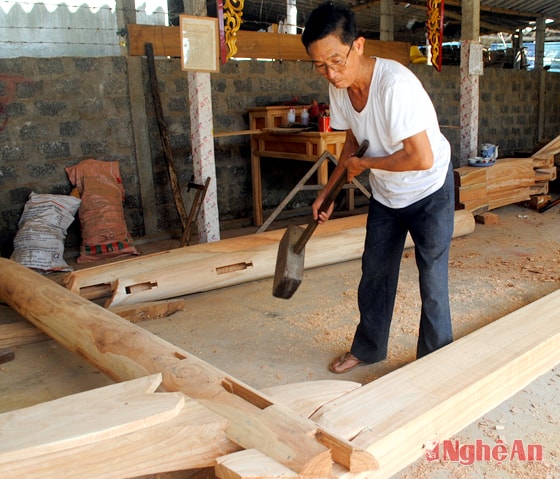 |
| Mr. Nguyen Van Hung completed the church's construction in the traditional architectural style. |
As the largest carpentry workshop in the village, providing year-round work, many young people in the village have learned the trade from Mr. Hung. All five of his children have graduated from university and found employment. When people from the village come to learn the trade, he doesn't keep his skills a secret, because he believes that if he doesn't pass on his knowledge, the craft village will eventually decline or lose its reputation. Therefore, he provides thorough training to all those who come to learn. After mastering the skills, they can either stay and work for him or open their own workshops. To date, he has trained six people from the village, with three staying to work for him and three opening their own workshops in the village. For a seasoned craftsman like Mr. Hung, the joy of building new houses is one thing, but there is also the personal joy of contributing to the development of the village craft.
Famous for its traditional church construction, Dinh Chu carpentry village also boasts a skilled workforce producing a wide variety of household wooden goods. Following the concrete roads deep within the village, we reached the Lam River dike, situated south of Dinh Chu village. There, we found the carpentry workshop of Mr. Le Van Thien, quite famous for his high-end household wooden products. At that moment, Mr. Thien's workshop had two workers, both covered in sweat, but still smiling, their hands moving swiftly to the rhythm of the saws and planers. Mr. Thien invited us into his house, showing us a brand-new set of tables and chairs, still smelling of fresh paint. He proudly mentioned that he had just finished a new set, made entirely of rosewood, priced at 50 million dong. Many customers had already expressed interest in buying it, but he wasn't ready to sell it yet; his main purpose was to introduce the new product. He is currently making a similar set, but from mahogany, at a lower price. Having started as a carpenter at the age of 13, he later went to Hanoi to work for a carpentry workshop, honing his skills and saving up capital. In 1996, he returned to his hometown to start his own business. At that time, he mainly took on projects within and outside the district, specializing in making doors, stairs, and kitchen cabinets. When he had more capital, he opened a carpentry workshop at home. His main products were high-end household furniture such as cabinets, beds, tables, and chairs. Unlike house builders, for those who make household furniture, profit is only possible if they can acquire leftover wood.
Before leaving Dinh Chu Woodworking Village, Mr. Nguyen Van Hung, the owner of a woodworking workshop, couldn't help but feel a little worried and concerned: "What's essential for a craft village is annual product promotion, but that's impossible here. The reason is that, until now, the village hasn't had any organization managing it; it's mostly spontaneous, with households finding their own markets. Ideally, the village should have established a craft association with someone in charge, so that this ancient woodworking craft can develop sustainably. Therefore, the younger generation in the village is no longer very interested in this craft, the number of young people learning the trade is decreasing, and the risk of the craft disappearing is understandable. I hope that the relevant authorities will soon establish an organization to manage the craft village so that the products of Dinh Chu Woodworking Village can be passed down to future generations!" Mr. Hung's words reflect the shared concerns of the villagers!
Xuan Hoang


