
Traditional craft villages - New challenges and opportunities
(Baonghean) - Nghe An province has 133 craft villages and nearly 400 villages with traditional crafts, exporting goods worth approximately 8 million USD annually. With new challenges and opportunities emerging as the ASEAN Economic Community (AEC) comes into operation as a unified bloc, will the craft villages in the province be able to capture the domestic market and maintain their export potential?
The consumer market is difficult.
Over the years, the province has implemented mechanisms and policies to support the development of small-scale industries and traditional craft villages. Specifically, from 2011 to 2014, the total expenditure on policies for the development of small-scale industries and traditional craft villages was 23 billion VND (14 billion VND from centralized capital construction; 4 billion VND from industrial promotion; and 5 billion VND from preferential credit loans). Each recognized craft village received 50 million VND in support from the Provincial People's Committee. Approximately 50% of the craft villages have received investment in transportation infrastructure. Each year, about 20 billion VND is invested in transportation infrastructure, with 14 billion VND invested in 2014.
According to data from the Provincial Cooperative Union, in the first six months of 2015, the value of small-scale handicraft production and traditional craft villages throughout the province reached approximately 2,000 billion VND, with export turnover reaching 8 million USD. The Provincial Cooperative Union received applications from 8 local craft villages for recognition in 2015; and guided 7 craft villages recognized in 2014 to receive their certificates, bringing the total to 133 craft villages in 18 out of 21 districts, cities, and towns in the province. Despite objective and subjective difficulties, these craft villages have made a significant contribution to poverty reduction and social security in the localities.
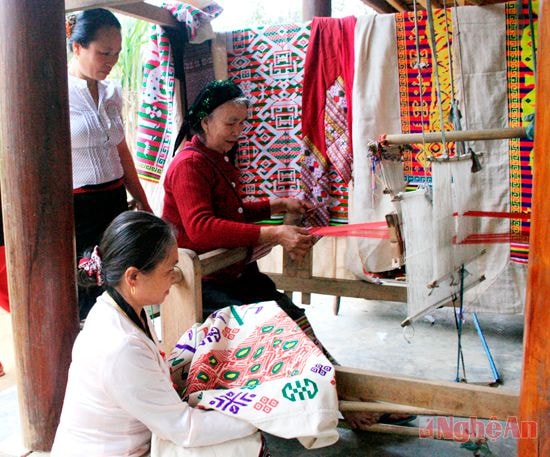 |
| Activities take place in the Dan weaving village (Tien Phong, Que Phong). |
Resolution No. 06-NQ/TU dated November 4, 2011, of the Provincial Party Committee opened up significant opportunities for the development of traditional craft villages and small-scale industries. However, after four years of implementing Resolution 06/2011, the results show that: Innovation in directing the development of small-scale industries and craft villages has been slow. Efforts to overcome difficulties due to a lack of markets for craft village products have yielded low results, and workers' incomes remain low. Some craft villages and rural industries have failed to maintain production, or even ceased to exist (such as rattan and bamboo weaving, hats, and sedge mats). The number of craft villages meeting standards and receiving recognition is decreasing, and the target of 150 villages by 2015 is unlikely to be achieved.
Famous for their peanut brittle, peanut candy, and many other delicious candies, the two confectionery villages of Xuan Bac and Dong Ha (Dien Van commune, Dien Chau district) currently have nearly 240 households with 510 workers involved in the trade. On average, both villages sell approximately 3 tons of candy to the market each day. At the confectionery competition organized by the Provincial Cooperative Union in May, the village's peanut candy won the award for best candy. Currently, the products of the craft villages have reached several northern provinces such as Thanh Hoa, Hai Duong, and Hanoi. The confectionery industry brings Dien Van commune an annual revenue of over 10 billion VND, with an average income of 1.7 - 1.8 million VND per person per month for workers. The quality of the candy is considered quite delicious, but the product packaging is still simple and not very eye-catching. The confectionery products have established a reputation but have not yet been able to expand the market and build a solid brand. Compared to other well-known confectionery brands, the level of competition is still low.
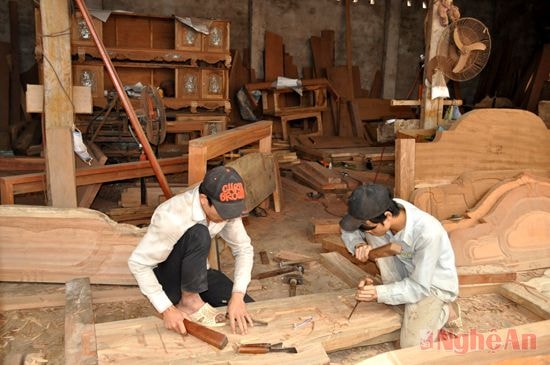 |
| Woodworking production in Phu Nghia craft village (Quynh Nghia, Quynh Luu). |
This is not just a problem for Dien Van confectionery village, but is facing most craft villages in the province. Establishing a brand and finding a foothold in the current market is no easy task, given the influx of goods from many countries into the domestic market. The biggest challenge for craft villages participating in the AEC (ASEAN Economic Community) comes from comprehensive competition, meaning competition not only in foreign markets but also in the domestic market. The removal of tariff barriers means the risk of foreign goods overwhelming domestic goods is something that needs to be anticipated. Meanwhile, the products of most craft villages are still produced on a small scale, family-run, with often monotonous designs, lacking sophistication and appeal.
Regarding export items, to date, only a limited quantity of products from the rattan and bamboo weaving, fish sauce, and fine wood crafts industries have been exported to other countries. Looking back at the rattan and bamboo weaving sector, a large proportion (over 30%) of the existing craft villages are operating inefficiently, with nearly 10 villages almost completely shut down. Previously, the province had more than 10 businesses that purchased products from rattan and bamboo weaving villages, but currently only 6 are still operating. Of these, 5 are small-scale businesses capable of adapting to the market.
Mr. Thai Dai Phong, Director of Duc Phong Company (the unit that connects with more than 30 craft villages in the province regarding the purchase of rattan and bamboo products), said: “To be able to sell rattan and bamboo products, in addition to product quality, the design and technical aspects are extremely important. Especially when exporting to demanding markets like Europe, businesses must comply with a series of strict regulations. Therefore, the skills of workers must be constantly improved, while our workers mainly consider this a secondary craft done during their leisure time, so most still lack the awareness to improve their skills. Compared to other countries, the quality and design of our products are still weak and inferior. High-level vocational training facilities for the small-scale handicraft industry are not yet truly professional.”
The number of workers in traditional craft villages is dwindling, and young people are increasingly reluctant to pursue these trades. Therefore, the shortage of both the quantity and quality of the next generation of skilled labor in traditional craft villages is becoming alarming. This shortage and lack of quality in the workforce is primarily due to the low income of the workers. Vocational training in these villages largely follows the traditional method of passing down skills within families, hands-on instruction, or short-term courses for local children. Furthermore, each artisan teaches their craft in a different way, leading to a lack of uniformity. Consequently, producing handicrafts that meet export standards, especially in terms of quantity, is becoming increasingly difficult.
On the other hand, building brands for traditional craft products still faces many difficulties. Yet, branding is one of the important factors contributing to increasing the value and competitiveness of these products. Van Phan traditional fish sauce (Dien Chau) is a prime example; despite having a brand, it still faces fierce competition from domestic products, not to mention food products from ASEAN countries. Statistics for the first six months of the year show that the company exported over 10,000 liters of fish sauce to Laos and 50 tons of shrimp paste to South Korea and Russia. However, these exports were only through consignment.
Another challenge is the supply of raw materials. The Hoa Tien handicraft cooperative (Quy Chau district) has over 60 members, and its products are currently selling well in many domestic locations such as Hanoi, Hoi An, and Saigon. In the international market, these products have reached many Asian countries such as Laos and Thailand. Although production scale is growing and orders are increasing, according to Ms. Sam Thi Bich, the cooperative's chairperson: "Currently, the facility only secures about 40% of its yarn from local mulberry cultivation and silkworm farming; the rest must be transported from neighboring areas or from Ha Tay and Thai Binh provinces. Dependence on external sources makes brocade production less proactive, and the high costs result in unprofitable sales."
Challenges and opportunities
By the end of 2015, the ASEAN Common Market was established and became operational, allowing for the free movement of services, goods, technology, and labor. Opportunities to access new markets for ASEAN exporters expanded with the removal of trade and service barriers. For example, ASEAN has a "Certificate of Origin," whereby products manufactured within ASEAN are certified as ASEAN products. Therefore, products benefit from ASEAN free trade agreements and regional economic integration. Traditional craft villages are also not immune to these impacts, facing both numerous opportunities and significant challenges.
Assessing the opportunities and challenges that craft villages in the province will face when Vietnam joins the AEC, Mr. Tran Van Huy, Head of the Policy Consulting Department of the Provincial Cooperative Union, said: “It can be seen that with cheaper labor costs compared to other countries in the region, while having many unique products that reflect the national cultural identity, these are some of the advantages for craft villages in the province when entering the AEC market. On the other hand, tariff reductions are an advantage that helps improve the competitiveness of businesses when exporting, which will create conditions for lowering costs and increasing the quality of products as well as increasing the competitiveness of goods... These are many advantages in developing the capacity and advantages of craft villages.”
However, for traditional craft villages to establish their position upon joining the AEC, we need to implement many reforms and innovations. Firstly, we need to restructure the craft villages. While the general view is to preserve and develop traditional craft villages, those producing goods that are currently out of market demand should be boldly eliminated. For industries with development potential and expanding markets, appropriate investment is needed to enhance their position and competitiveness. Secondly, we need to build stable raw material sources. Thirdly, to address the issue of market access for traditional craft village products, the villages must first find ways to improve, innovate, and enhance product quality to meet market demands and requirements. Along with this, promoting and introducing craft village products is crucial to finding and expanding markets for their consumption. Finally, it is necessary to build a workforce for craft villages that is sufficient in quantity and strong in quality, in order to have a long-term direction to attract more young, talented workers to commit to the craft.”
According to Mr. Tran Van Chuong, Vice Chairman of the Provincial Cooperative Union, to promote the development of small-scale industries and traditional craft villages in the coming years, it is necessary to have plans and orientations for each sector and type of product to support the consumption of products from craft villages. Conditions should be created to enable craft villages to gradually expand their scale and scope of operations, strengthen technological innovation and equipment in line with the development of science and technology. At the same time, new technologies should be applied to production to improve product quality and ensure reasonable prices and good competitiveness in the new market era.
Quynh Lan - Thanh Quynh


