
Shrimp farming village in season
(Baonghean) - In the early days of January, traveling along the coast in the communes of Quynh Bang and Quynh Lien, Quynh Luu district, we witnessed the bustling scene of shrimp farming villages in full swing. Smoke billowed from the chimneys of the water boilers, and the sounds of pumps and ventilation fans created a lively atmosphere of the village's traditional craft in the early days of the new year.
(Baonghean) - In the early days of January, traveling along the coast in the communes of Quynh Bang and Quynh Lien, Quynh Luu district, we witnessed the bustling scene of shrimp farming villages in full swing. Smoke billowed from the chimneys of the water boilers, and the sounds of pumps and ventilation fans created a lively atmosphere of the village's traditional craft in the early days of the new year.
One early spring day, we visited Mr. Nguyen Trong Hoang's shrimp hatchery in Quynh Bang. It's a large-scale hatchery comprising: one broodstock shrimp farm, one spawning and nursery farm, and two potting farms. He plans to open another potting farm next year. Engineer Hoang, the owner, after 20 years working in the aquaculture industry in the southern provinces, recently returned to his hometown to rent land and establish his farm. With his experience and scientific approach to business, Hoang's farm quickly became a reputable establishment. In 2013, the farm's net profit reached over 500 million VND from shrimp, crab, and fish breeding (a figure considered quite modest by officials from the Department of Aquaculture).
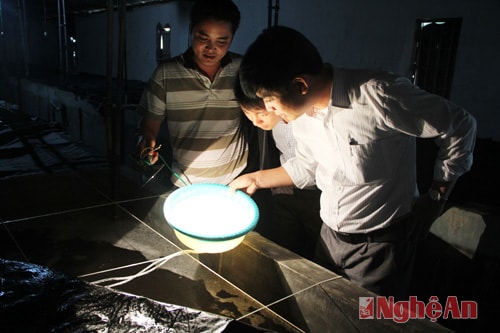 |
| Checking the quality of shrimp larvae. |
Over a cup of tea in early spring, Hoang shared his story about shrimp farming. According to Hoang, the difficulty for shrimp hatcheries in Central Vietnam is the weather; the temperature for production must be between 28-30°C. The production season falls in winter when temperatures are low, so the temperature must be raised. Chimneys emitting smoke day and night are the operation of hot water boilers. Boiling water in pots is pumped into a system of pipes placed in storage tanks to raise the temperature, always maintaining it between 28-30°C. Equally important is selecting the right broodstock. Broodstock must be caught in the wild (shrimp raised in ponds will never reproduce).
Around mid-December, shrimp farmers pack their bags and set off to hunt for shrimp larvae. The broodstock must be caught in fishing grounds in the southern provinces from Da Nang to Ca Mau (shrimp from the North produce lower quality larvae). The best is still shrimp from Ca Mau, and farmers go to shrimp wholesalers to select the larvae. Once they've chosen satisfactory shrimp, they must quickly transport them to the production farm by road or air, ensuring absolute safety, as each pair of broodstock costs tens of millions of dong. The shrimp are then raised on high-protein feed such as fresh squid and snails. After the shrimp stabilize, the aquaculture quality inspection station is notified to take samples for disease testing. Only when the results show no disease are the farmers allowed to breed. From the 20th of December, Hoang went to Da Nang to buy 10 pairs of broodstock shrimp, and by the 25th, he had them breeding. To date, 40 shrimp pots are full. By the end of January, Hoang had shrimp larvae ready for sale, with customers having already placed orders for over 20 million larvae in the first batch. This year, Hoang's hatchery expects to produce 40-50 million shrimp larvae, after which it will switch to producing crab and fish larvae according to orders from localities within and outside the province. According to Hoang, this year's weather has been favorable, with prolonged sunshine before Tet and stable temperatures, reducing the cost of raising the temperature and minimizing shock to the shrimp from changing weather conditions.
Leaving Nguyen Trong Hoang's hatchery, we visited Quynh Lien to see the aquaculture breeding facility of the Aquaculture Breeding Center. After a warm handshake, the farm manager, engineer Pham Hoang Hiep, announced: "This Tet holiday, we'll be celebrating at the farm because we'll also be welcoming the first batch of shrimp on New Year's Eve. Although we won't be able to celebrate with our families, everyone is excited because the shrimp spawning is going well, filling 7 tanks with about 4 million pots. The weather has been favorable, so the shrimp are developing normally." According to Hiep, this year's shrimp spawning is better than last year. After these four parent shrimp finish spawning, the farm will start a new batch, ensuring production of 18-20 million juveniles for the market, before switching to producing crab juveniles. Based on these initial results and the enthusiastic atmosphere among the farm staff, we believe that a prosperous new year awaits Hiep's breeding facility.
In the decades of the last century, industrial shrimp farming in Nghe An began to develop, along with the shrimp seed production industry. Thanks to incentive mechanisms, a skilled technical team, and favorable natural conditions, Nghe An quickly became a reputable center for shrimp seed production, capable of supplying the entire Northern region.
According to Nguyen Canh Hoang, Deputy Head of the Aquatic Seed Quality Inspection Station, there are currently 16 facilities in the province that meet the standards for shrimp seed production, with over 50 farms. Eleven facilities have already brought in nearly 100 broodstock shrimp. The station has been taking samples to test for white spot virus, and so far, no broodstock have been found to be infected. To ensure the quality of the seed, the station not only inspects broodstock and post-larvae before sale but also, before the seed production season, collaborates with the Department of Aquaculture to inspect the conditions of production facilities. Following inspections, two unqualified production facilities in Cua Lo and Dien Chau have been suspended. Initially, this year's shrimp seed production season has been quite favorable due to weather conditions and effective inspection work; no disease outbreaks have occurred so far. Products have already been ordered by dealers from Thanh Hoa to Quang Ninh. Currently, about half of the production facilities have started spawning, and the first batch of shrimp will be exported from mid to late January. With a promising start, the province's plan to produce approximately 300 million tiger shrimp larvae this year is entirely achievable.
Text and photos:Mr. Tuan


