
Cultural villages - An important element in building new rural areas.
(Baonghean)In the national criteria for building new rural areas, there are two criteria in the cultural field: cultural infrastructure and cultural villages that meet standards. As one of the pilot districts nationwide implementing the National Target Program for building new rural areas, the movement to build cultural villages is identified by Nam Dan district as an important task.
Nam Binh Cultural Village (Van Dien) is a purely agricultural hamlet with a total of 184 households, 732 inhabitants, and 341 laborers. However, the people here are dynamic, and in the era of the market economy, they have quickly adopted many trades to develop the economy. Currently, the hamlet has 65 laborers working abroad in Taiwan, South Korea, Malaysia, etc. Three private enterprises and four individuals acting as contractors provide employment for 50 local workers with an average income of 3 million VND/person/month. Thanks to this, the lives of the people are increasingly improving.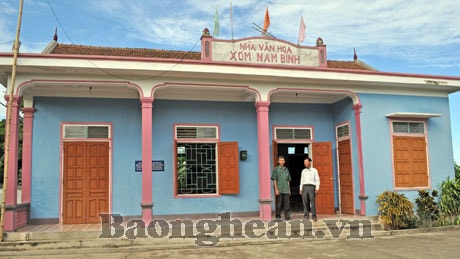
The Nam Binh hamlet cultural center (Van Dien) was built with funds mobilized from the local community.
The average per capita income in 2011 was approximately 14 million VND/person/year. Cultural and sports facilities were built with the support of the people. Village roads and alleys were completely concreted. Ms. Nguyen Thi Loc, a resident of Nam Binh hamlet, said: “To build a cultural village, each of us is aware of our contribution to the locality. As a mother and grandmother, I always teach my children and grandchildren to live harmoniously and respectfully towards their grandparents and parents. A happy family leads to a peaceful village. I think a cultural village must originate from a cultural family.”
From a few initial model villages, Nam Dan now has 160 hamlets and blocks that have achieved the title of Cultural Village. The movement to build cultural villages has truly developed strongly since 2003, when the district launched the project to build and develop cultural life during the period 2002-2010 and the District People's Committee had a policy to support and encourage the construction of cultural villages: the District People's Committee awarded 5 million VND to each cultural village recognized by the province and 1 million VND to each cultural village recognized by the district. For the construction of hamlet and block cultural houses, the district supported 15 million VND for each newly built house; and 5 million VND for each house upgraded or repaired.
From 2008 to the present, the support level for building community cultural centers in hamlets and villages has been increased to 30 million VND per new building. As of the end of June 2012, the entire district had 328 cultural centers. Many communes have basically completed a comprehensive system of cultural and sports facilities. The movement to build cultural villages has truly spread strongly. Many communes have identified specific roadmaps and steps in building cultural hamlets and communities, directing and guiding hamlets and communities to register and organize implementation effectively, thus bringing practical results, such as: Nam Cat, Nam Giang, Kim Lien, Xuan Hoa, Nam Thai…
The most noteworthy aspect of these cultural villages is the increasingly improved spiritual and material living standards, with an increase in the number of wealthy households, a decrease in the number of poor households, and the elimination of hunger; well-built cultural institutions that meet the cultural needs of the people; clean and beautiful village roads and alleys; guaranteed security and social order; social evils that have been eradicated; and increasingly strong community bonds. Many hamlets and neighborhoods have maintained traditional village festivals such as the Spring Wrestling Festival in Van Dien, the Trung Can - Nam Trung communal house festival, etc.
With the goal of having 60% of hamlets achieve the title of "Cultural Village" by 2015 and 70% by 2020, the biggest challenge in building cultural villages in Nam Dan is reducing the poverty rate, the rate of third births, and establishing cultural institutions to serve community life. This not only requires creativity and flexibility in the approach of each locality but, more importantly, requires the exploration of solutions by all levels and sectors, to help each citizen realize that they are both the leading actors in construction and the beneficiaries of the cultural values they themselves create.
Thanh Thuy


