
Vietnamese expatriate village in Phu Quy
(Baonghean) - Fifty-five years ago, responding to President Ho Chi Minh's call to return home, Vietnamese expatriates from Thailand came back to their homeland in Nghe An, choosing the land along the Hieu River to establish their lives. Overcoming initial difficulties, these expatriates have risen to develop the economy, preserve and promote the traditional cultural values of both Vietnam and Thailand, and build a unique Vietnamese expatriate village.
In 1960, responding to President Ho Chi Minh's call, Ms. Mai Thi Bich Noi, then President of the Association of Vietnamese Overseas in Thailand in Thai Hoa town, was just over 14 years old when she joined her family and nearly 1,000 other Vietnamese people on a ship returning to Vietnam from Thailand. She still vividly remembers that day when she arrived in Vietnam, President Ho Chi Minh personally came to greet her and chat with everyone. If she hadn't introduced herself, we would have thought she was a native Thai, because her face bore strong Thai features. Even her name, "Noi," was chosen by her grandparents and reflects Thai culture. Recalling her memories of her time living in Thailand, she opened a wooden cabinet, searching for photographs and artifacts she had preserved after so many years in Vietnam. She recounted that in 1945, during the French occupation, in addition to fighting foreign invaders, the people of the country also had to fight against "the enemy of hunger" and "the enemy of illiteracy." The historic famine of 1945 claimed the lives of countless people, young and old. Death and starvation forced the people of Tuyen Hoa district (Quang Binh province) to "save themselves" by migrating to Laos and Thailand. She recounted: "In Thailand, my family, along with other Vietnamese people living on both sides of the Mekong River, survived the famine and managed to stay by fishing, weaving, and embroidery. Although life was more stable than before, and many families had some savings, they still longed for their homeland and country, but had not yet had the opportunity to return. In 1959, President Ho Chi Minh called on Vietnamese people living in Thailand to return home, and everyone was extremely excited. On January 10, 1960, a ship carrying patriotic Vietnamese people returned home after decades of exile."
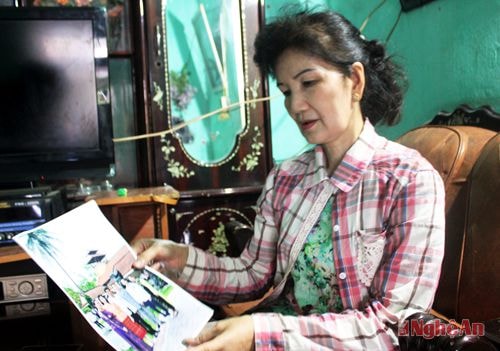 |
| Ms. Mai Thi Bich Noi recounts her memories of returning home. |
Mrs. Noi recalled: “When we arrived at Hai Phong Port, the people were given the choice of living in Vinh City or the Phu Quy area (Nghia Dan). They heard about the fertile red basalt soil on the banks of the Hieu River, so they chose this place to settle down and build a new life.” The first bus carried 100 families to Thai Hoa Town (formerly Nghia Dan District, now Thai Hoa City) according to their choice.
Initially, they were all apprehensive about this "sacred forest and poisonous water" land, but with their longing to return to their homeland fulfilled, they focused on building new lives. The initial difficulties passed, and the people began to stabilize their lives. Traditional craft villages were established, such as fine art woodworking and weaving. To this day, Lien Thang block in Hoa Hieu ward remains famous for its timber processing village, producing items like cabinets, beds, tables, and chairs. Some who were accustomed to fishing on the Mekong River still live along the Hieu River, earning a living through fishing. From 100 Vietnamese expatriate households, the number has now grown to over 196 households across generations in Hoa Hieu ward. Typical examples include Mr. Le Duy Lai (61 years old), who studied mechanics in Thailand and returned to work as an auto repairman at the 250 Mechanical Repair Workshop in Thai Hoa town; and Mr. Nguyen Ai Huu (79 years old), who was hired by the 19/5 Farm after returning to Vietnam. After many years of doing business, he is now the owner of a chain of restaurants and hotels in the area… “Now, those who returned to Thai Hoa from Thailand to live are all in their twilight years. Although life is still difficult, their economic situation is somewhat stable. For us, we always remind our children and grandchildren of their origins as Vietnamese people who once lived in Thailand, so they must remember to consider Thailand as their second home, while Vietnam is their true homeland, where they can live, study, work, and become useful members of society…,” Mrs. Noi said.
Mr. Nguyen Kim Hai, Vice Chairman of the Hoa Hieu Ward People's Committee, said: "Vietnamese expatriates from Thailand who came to live here are very united and affectionate, supporting and loving each other to build their homeland. In addition, they brought with them the Lam Vong dance, the traditional rice wine drinking, and the gong playing... becoming a unique cultural feature in Phu Quy in particular and Nghe An province in general..."
In 2004, the Association of Vietnamese Overseas in Thailand, located in Thai Hoa Town, was established. Every spring or on major holidays, they gather together, enjoying the traditional Lam Vong dance and fragrant rice wine to toast each other and reminisce about old times.
| Besides the Vietnamese expatriate village in Hoa Hieu ward (Thai Hoa town), in the same period, 49 households with nearly 300 people from Thailand, answering the call of their homeland, returned to live in Viet Huong village, Chau Hoi commune (Quy Chau district, Nghe An province). |
Ha An(Vinh City)


